
Our Blog
This isn’t just a blog—it’s your go-to resource for mastering Facebook ads with clarity and results.
Every post is designed to turn complex ad concepts into actionable strategies that save time, prevent wasted spend, and improve ROI.
Think of it as your free playbook for structured campaigns, tested frameworks, and real-world ad insights.
News
Article & Resources
We cover the core strategies that drive results:
Campaign Structure – Learn how to organize ads for clarity, tracking, and scalability.
Optimization & Metrics – Focus on what truly impacts ROI and stop chasing vanity metrics.
Creative & Messaging – Test and refine content that resonates and converts.
Scaling Systems – Grow campaigns predictably without chaos or wasted spend.
Problem-Solving Frameworks – Quickly identify and fix inefficiencies in any campaign.
Every strategy is designed to be actionable, repeatable, and results-driven—so you can stop guessing and start scaling.

The Framework I use for Creative Testing - Meta Ads
Creative Testing Framework Meta Ads
Just the Most Important Bits
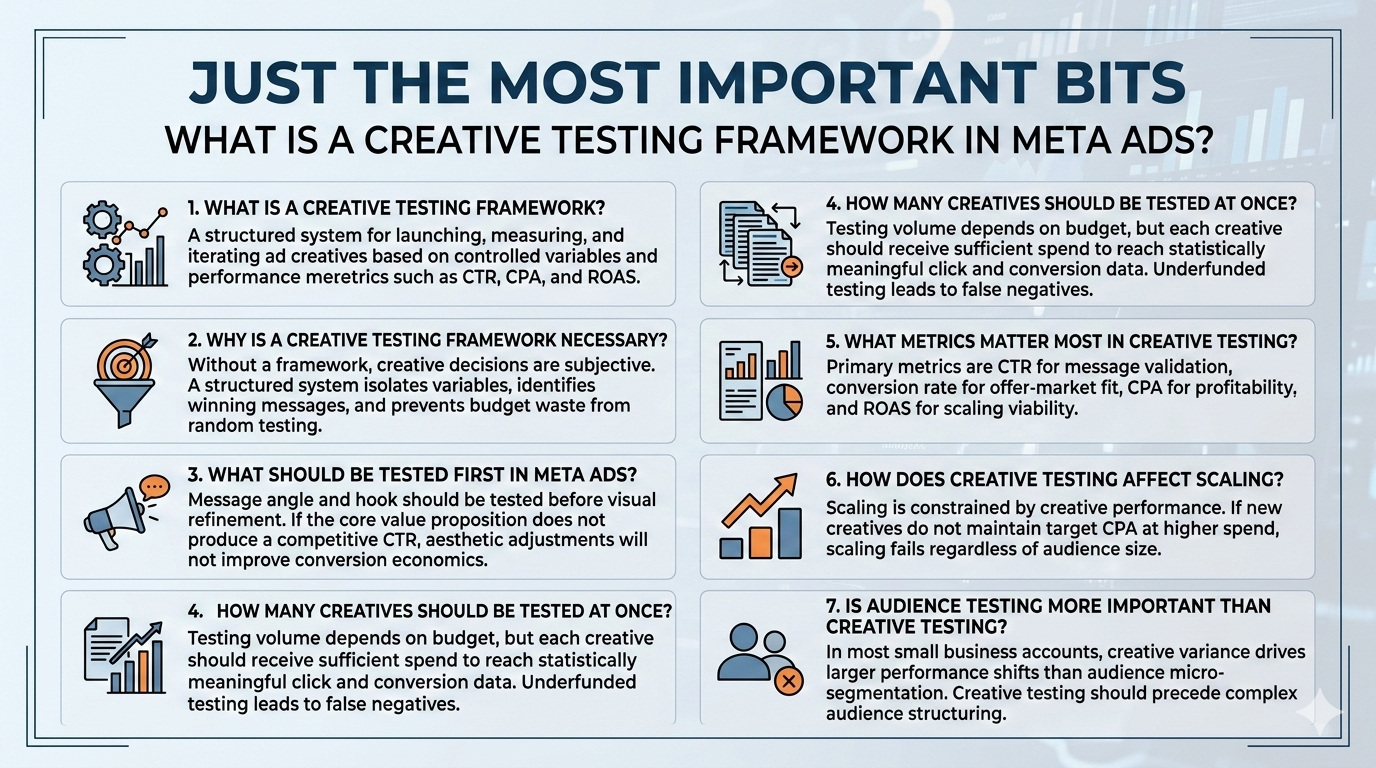
What is a Creative Testing Framework in Meta Ads?
A Creative Testing Framework in Meta Ads is a structured system for launching, measuring, and iterating ad creatives based on controlled variables and performance metrics such as CTR, CPA, and ROAS.
Why is a Creative Testing Framework necessary?
Without a framework, creative decisions are subjective. A structured system isolates variables, identifies winning messages, and prevents budget waste from random testing.
What should be tested first in Meta Ads?
Message angle and hook should be tested before visual refinement. If the core value proposition does not produce a competitive CTR, aesthetic adjustments will not improve conversion economics.
How many creatives should be tested at once?
Testing volume depends on budget, but each creative should receive sufficient spend to reach statistically meaningful click and conversion data. Underfunded testing leads to false negatives.
What metrics matter most in creative testing?
Primary metrics are CTR for message validation, conversion rate for offer-market fit, CPA for profitability, and ROAS for scaling viability.
How does creative testing affect scaling?
Scaling is constrained by creative performance. If new creatives do not maintain target CPA at higher spend, scaling fails regardless of audience size.
Is audience testing more important than creative testing?
In most small business accounts, creative variance drives larger performance shifts than audience micro-segmentation. Creative testing should precede complex audience structuring.
What Is a Creative Testing Framework in Meta Ads?
A Creative Testing Framework in Meta Ads is a structured methodology used to systematically validate messaging, angles, formats, and hooks within the Meta advertising ecosystem. It replaces subjective creative decisions with measurable experimentation tied directly to acquisition metrics.
For small business owners running campaigns through Meta Platforms advertising infrastructure, creative is the primary performance lever. Auction dynamics on Facebook and Instagram reward ads that generate engagement and conversions efficiently. A disciplined testing framework ensures that performance improvements are repeatable rather than accidental.
Creative testing is not about producing more ads. It is about isolating variables. Each test should control for audience, placement, and budget allocation so that performance differences can be attributed directly to the creative itself.
Without this structure, data becomes contaminated. Decisions then rely on intuition instead of conversion metrics. Over time, that leads to rising CPA and unstable ROAS.
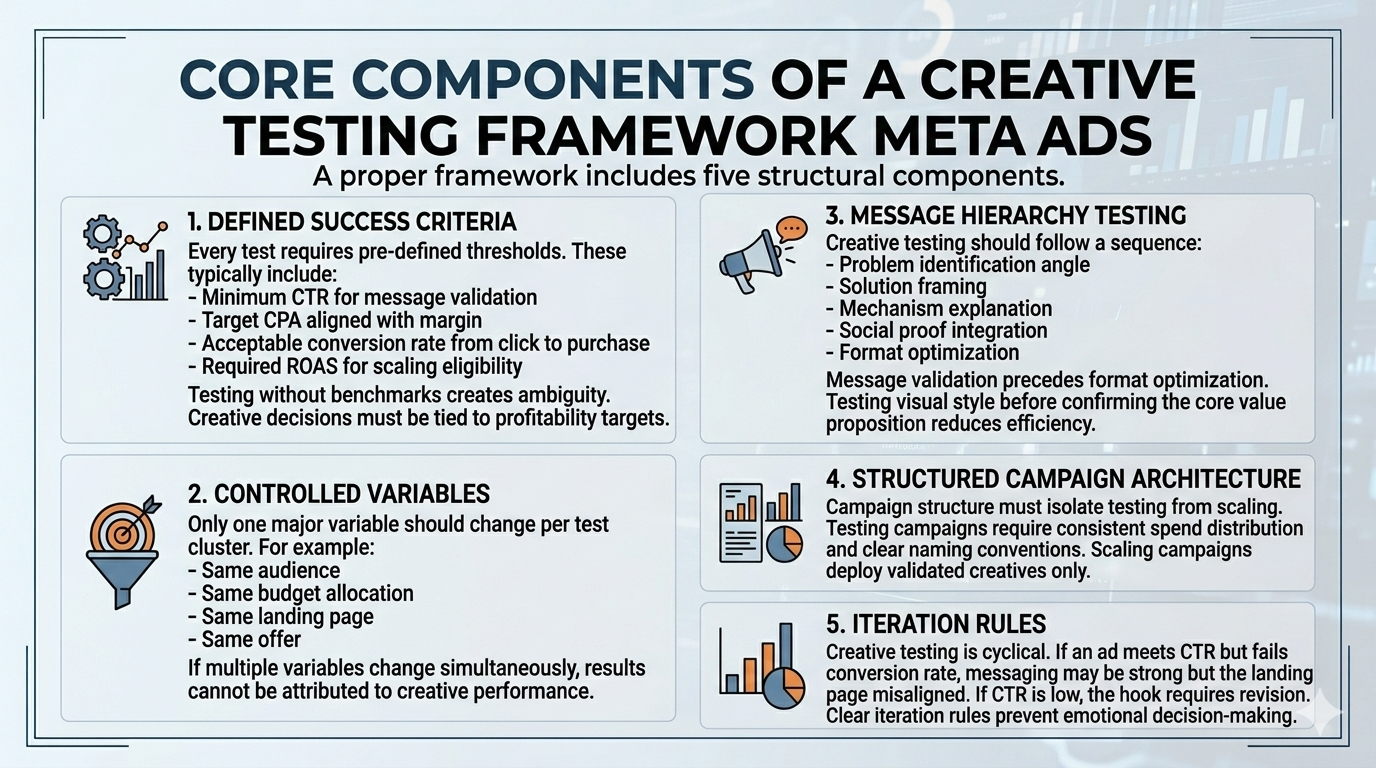
Core Components of a Creative Testing Framework Meta Ads
A proper framework includes five structural components.
1. Defined Success Criteria
Every test requires pre-defined thresholds. These typically include:
Minimum CTR for message validation
Target CPA aligned with margin
Acceptable conversion rate from click to purchase
Required ROAS for scaling eligibility
Testing without benchmarks creates ambiguity. Creative decisions must be tied to profitability targets.
2. Controlled Variables
Only one major variable should change per test cluster. For example:
Same audience
Same budget allocation
Same landing page
Same offer
If multiple variables change simultaneously, results cannot be attributed to creative performance.
3. Message Hierarchy Testing
Creative testing should follow a sequence:
Problem identification angle
Solution framing
Mechanism explanation
Social proof integration
Format optimization
Message validation precedes format optimization. Testing visual style before confirming the core value proposition reduces efficiency.
4. Structured Campaign Architecture
Campaign structure must isolate testing from scaling. Testing campaigns require consistent spend distribution and clear naming conventions. Scaling campaigns deploy validated creatives only.
5. Iteration Rules
Creative testing is cyclical. If an ad meets CTR but fails conversion rate, messaging may be strong but the landing page misaligned. If CTR is low, the hook requires revision. Clear iteration rules prevent emotional decision-making.
How a Creative Testing Framework Works Inside Meta Ads
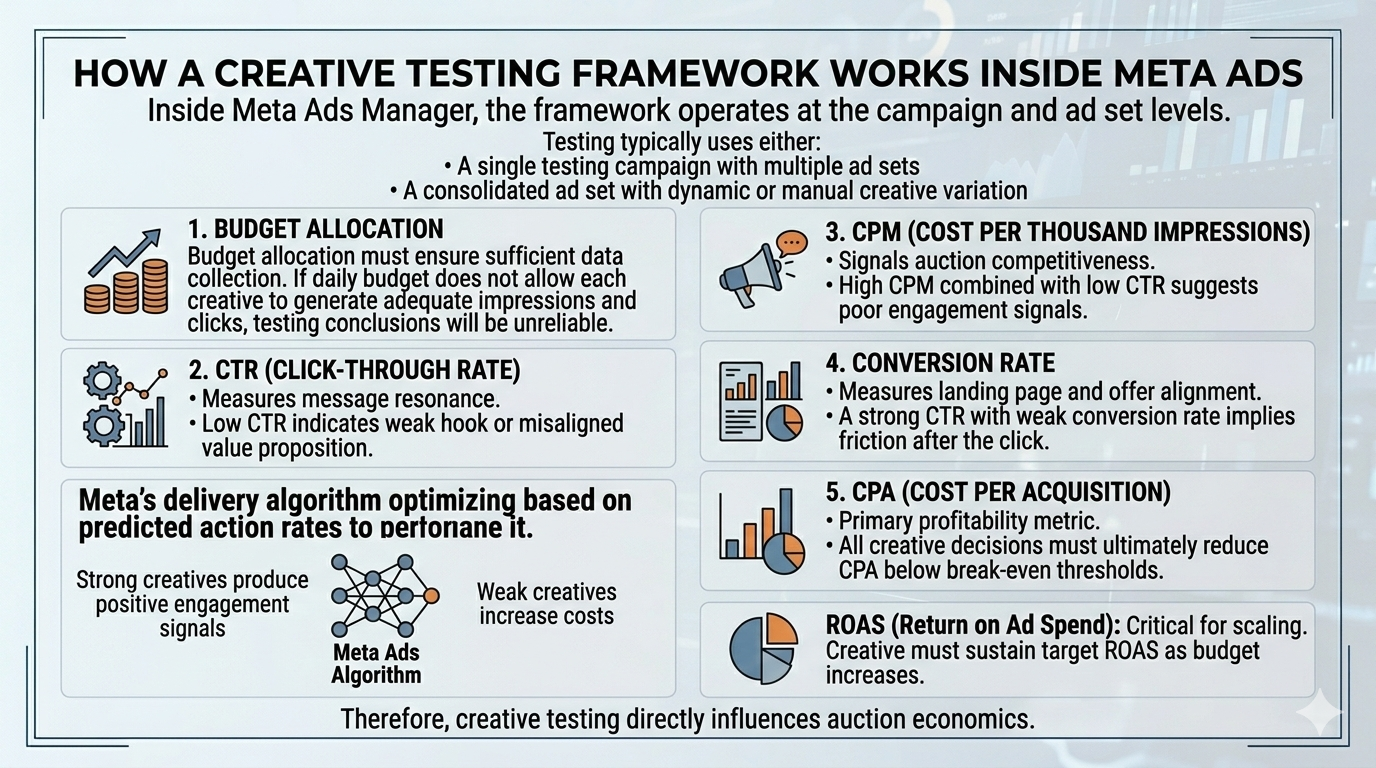
Within Meta Ads Manager, the framework operates at the campaign and ad set levels.
Testing typically uses either:
A single testing campaign with multiple ad sets
A consolidated ad set with dynamic or manual creative variation
Budget allocation must ensure sufficient data collection. If daily budget does not allow each creative to generate adequate impressions and clicks, testing conclusions will be unreliable.
Key Metrics in Meta Creative Testing
CTR (Click-Through Rate):
Measures message resonance. Low CTR indicates weak hook or misaligned value proposition.
CPM (Cost Per Thousand Impressions):
Signals auction competitiveness. High CPM combined with low CTR suggests poor engagement signals.
Conversion Rate:
Measures landing page and offer alignment. A strong CTR with weak conversion rate implies friction after the click.
CPA (Cost Per Acquisition):
Primary profitability metric. All creative decisions must ultimately reduce CPA below break-even thresholds.
ROAS (Return on Ad Spend):
Critical for scaling. Creative must sustain target ROAS as budget increases.
Meta’s delivery algorithm optimizes based on predicted action rates. Strong creatives produce positive engagement signals, improving delivery efficiency. Weak creatives increase costs through poor engagement metrics.
Therefore, creative testing directly influences auction economics.
Practical Implementation: Step-by-Step Framework
Step 1: Define Break-Even CPA
Calculate break-even CPA using:
Margin per sale × allowable acquisition percentage
If LTV is relevant, incorporate projected repeat purchase behavior. Without a financial baseline, creative testing lacks direction.
Step 2: Develop Message Angles
Create 5–10 distinct angles tied to:
Specific pain points
Desired outcomes
Mechanism differentiation
Competitive positioning
Each angle must be meaningfully different. Minor wording changes do not constitute angle variation.
Step 3: Launch Controlled Test Campaign
Structure the campaign so each creative receives proportional budget. Avoid scaling budgets mid-test. Let performance stabilize before evaluating.
Step 4: Evaluate by Thresholds
Use minimum data benchmarks before pausing creatives. Early fluctuations in CTR or CPA should not trigger immediate decisions.
Creatives fall into three categories:
Winners: Meet CTR and CPA targets
Iteration candidates: Strong CTR but weak conversion rate
Rejects: Fail CTR threshold
Step 5: Iterate Intelligently
If CTR is below benchmark, revise the hook or opening statement.
If CTR is strong but CPA is high, examine offer or landing page alignment.
If both CTR and conversion rate are strong, increase budget gradually.
Scaling should occur in separate campaigns to protect test integrity.
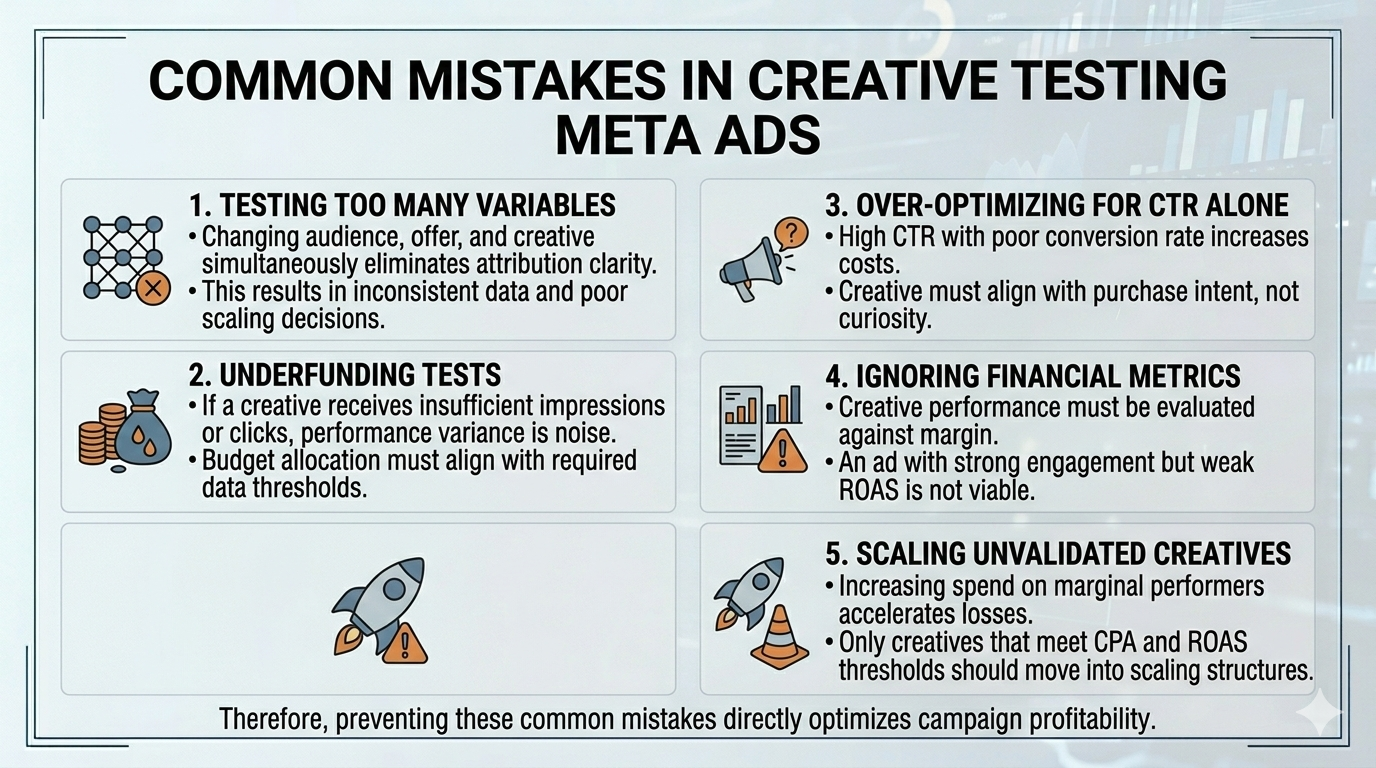
Common Mistakes in Creative Testing Meta Ads
Testing Too Many Variables
Changing audience, offer, and creative simultaneously eliminates attribution clarity. This results in inconsistent data and poor scaling decisions.
Underfunding Tests
If a creative receives insufficient impressions or clicks, performance variance is noise. Budget allocation must align with required data thresholds.
Over-Optimizing for CTR Alone
High CTR with poor conversion rate increases costs. Creative must align with purchase intent, not curiosity.
Ignoring Financial Metrics
Creative performance must be evaluated against margin. An ad with strong engagement but weak ROAS is not viable.
Scaling Unvalidated Creatives
Increasing spend on marginal performers accelerates losses. Only creatives that meet CPA and ROAS thresholds should move into scaling structures.
Financial and Performance Implications
Creative testing directly impacts acquisition economics.
Lower CPA increases margin per transaction. Higher CTR reduces CPM through improved engagement signals. Strong conversion rates compound these gains.
When creative testing is disciplined, scaling becomes predictable. Budget allocation can increase without immediate CPA inflation. Without structured testing, scaling exposes weaknesses rapidly, causing rising costs and declining ROAS.
For businesses with defined LTV models, creative performance affects long-term profitability. If CPA exceeds allowable acquisition cost relative to LTV, growth becomes unsustainable.
Creative testing is therefore not a branding exercise. It is a financial optimization system tied to unit economics.
Conclusion
A Creative Testing Framework in Meta Ads is a structured, data-driven system for validating messaging before scaling spend. It isolates variables, defines financial thresholds, and uses measurable performance metrics to guide iteration.
Small businesses operating inside Meta’s auction environment must prioritize creative discipline over intuition. Controlled experimentation reduces wasted spend and produces scalable acquisition channels.
When implemented correctly, creative testing improves CPA stability, protects ROAS during scaling, and aligns advertising decisions with margin realities.
Need more hands-on help?
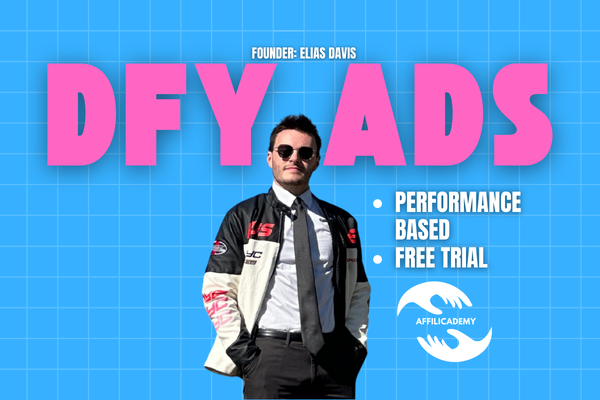
If this article got you thinking, but you want done-for-you Facebook ad management on a performance basis, check out Affilicademy.com.
They only get paid when your ads perform, and yes — there’s a free trial so you can see it in action before committing.
And yes, we’re partnered with them, so reading this article helps us pay the bills and keep these guides free for you.
FAQ: Creative Testing Framework Meta Ads
What is the best way to test creatives in Meta Ads?
The best approach is to isolate creative variables within a controlled campaign structure, define CPA and CTR benchmarks, and evaluate performance only after sufficient data volume is achieved.
How long should a creative test run in Meta Ads?
A test should run until each creative reaches statistically meaningful impressions and conversion data relative to your budget and average CPA.
What CTR is considered good for Meta Ads?
Acceptable CTR varies by industry, but it must align with your CPA and ROAS targets. CTR should be evaluated relative to conversion rate, not in isolation.
Should I use Advantage+ for creative testing?
Advantage+ may automate optimization, but structured testing requires control. Use automation only after validating core messaging.
How many creatives should be active in a test campaign?
The number depends on budget capacity. Each creative must receive enough spend to generate reliable performance data before evaluation.

Who This Is For
Entrepreneurs, small business owners, digital marketers, and agencies who want to stop guessing and start scaling. If you’re ready to turn messy campaigns into structured, profitable systems, this is for you.

Free Resources
No upsells. Just info.

Integrity
Actually valuable info.
Learn
Diagnose
General Resources
Copyright 2026. FBadsmaster.com. All Rights Reserved.