
Our Blog
This isn’t just a blog—it’s your go-to resource for mastering Facebook ads with clarity and results.
Every post is designed to turn complex ad concepts into actionable strategies that save time, prevent wasted spend, and improve ROI.
Think of it as your free playbook for structured campaigns, tested frameworks, and real-world ad insights.
News
Article & Resources
We cover the core strategies that drive results:
Campaign Structure – Learn how to organize ads for clarity, tracking, and scalability.
Optimization & Metrics – Focus on what truly impacts ROI and stop chasing vanity metrics.
Creative & Messaging – Test and refine content that resonates and converts.
Scaling Systems – Grow campaigns predictably without chaos or wasted spend.
Problem-Solving Frameworks – Quickly identify and fix inefficiencies in any campaign.
Every strategy is designed to be actionable, repeatable, and results-driven—so you can stop guessing and start scaling.

Break-Even ROAS Guide
Break-Even ROAS Guide: How Small Business Owners Can Measure and Optimize Profitability
Just the Most Important Bits
Break-even ROAS is the minimum return on ad spend required to cover all costs, including product cost, ad spend, and operational expenses.
Calculating break-even ROAS ensures your campaigns are profitable before scaling or investing additional budget.
Key metrics for calculation include gross margin, ad spend, conversion rate, and average order value.
Use the formula: Break-Even ROAS = 1 / Gross Margin for simple product-level calculations. For more precise campaigns, include fixed costs and overhead.
Campaign structure affects ROAS measurement: separate campaigns by product line, offer, or funnel stage to isolate performance.
Accurate tracking through Facebook Pixel or Conversion API is essential to measure true ROAS against break-even targets.
Scaling campaigns should occur only after the ROAS exceeds the break-even point consistently across ad sets.
Underperforming creatives, misaligned audiences, and incorrect bidding are common causes of falling below break-even ROAS.
Break-even ROAS guides budget allocation, helping business owners invest in profitable ad sets while pausing inefficient ones.
Monitoring over time allows identification of trends, seasonality, and creative fatigue, keeping campaigns profitable.
Introduction
Break-even ROAS is a critical metric for small business owners using Facebook ads. It determines the minimum revenue needed per dollar spent on ads to cover costs and maintain profitability. Understanding and applying break-even ROAS allows businesses to manage acquisition efficiently, identify profitable campaigns, and make data-driven decisions on scaling. Unlike surface-level ROAS, break-even ROAS accounts for margins, operational costs, and ad spend, ensuring campaigns contribute positively to the bottom line. Mastering this metric is essential for disciplined ad management and predictable business growth.
Core Explanation
Break-even ROAS is derived from a precise relationship between revenue, cost, and margin:
1. Definition
Break-even ROAS represents the point where revenue from ads equals the sum of product cost, ad spend, and operational overhead. Spending beyond this point contributes to profit, while underperforming campaigns generate losses.
2. Components
Gross Margin: Net revenue minus cost of goods sold (COGS).
Ad Spend: Total amount invested in Facebook campaigns.
Operational Costs: Fixed costs, transaction fees, and fulfillment costs.
Conversion Rate: Percentage of ad viewers who make a purchase.
3. Calculation
Simple formula: Break-Even ROAS = 1 / Gross Margin
Advanced formula: Break-Even ROAS = (COGS + Fixed Costs + Ad Spend) / Revenue Generated
This allows precise measurement at product, campaign, or ad set level.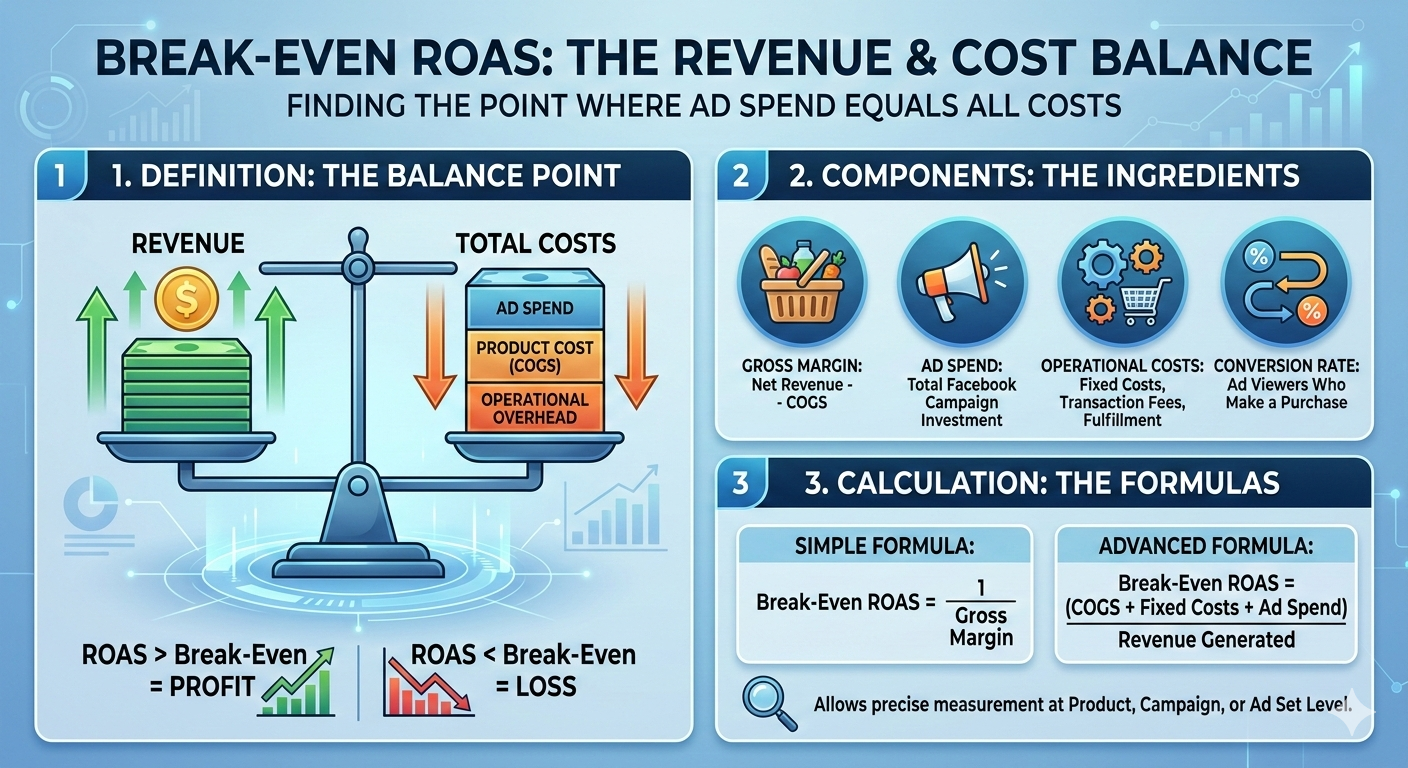
Mechanism Within Facebook Ads
In practice, break-even ROAS integrates into Facebook ad operations as follows:
1. Campaign Structure
Campaigns should be segmented by product, funnel stage, or audience to ensure accurate ROAS tracking. Aggregating data across unrelated products can mask underperforming ads.
2. Metrics Tracking
Track CPA, CTR, CPC, ROAS, and conversion rate. ROAS is compared against the break-even threshold to determine profitability. Pixel or Conversion API integration ensures accurate data collection.
3. Testing Framework
Controlled creative testing helps identify ad variations that exceed break-even ROAS. One variable should be changed per test to isolate effects on ROAS.
4. Scaling Logic
Incrementally increase ad set budgets once ROAS consistently exceeds the break-even point. Pause or adjust campaigns below the threshold to prevent losses.
Practical Application
Step-by-step operational guidance:
Calculate gross margin for each product or offer.
Determine break-even ROAS using simple or advanced formula based on business complexity.
Configure campaign objectives in Facebook Ads Manager. Use conversions or catalog sales for ROAS tracking.
Set up ad sets targeting precise audiences with appropriate budget allocation.
Develop multiple creatives per ad set, ensuring message alignment with the audience.
Track ROAS and CPA daily for the first week to ensure accurate performance measurement.
Identify winning ad sets where ROAS exceeds break-even consistently.
Scale winning campaigns incrementally by 20–30% to maintain performance stability.
Refresh creatives and rotate audiences to prevent ad fatigue and maintain ROAS above break-even.
Document results and maintain structured testing for iterative improvement.
Common Mistakes or Misapplications
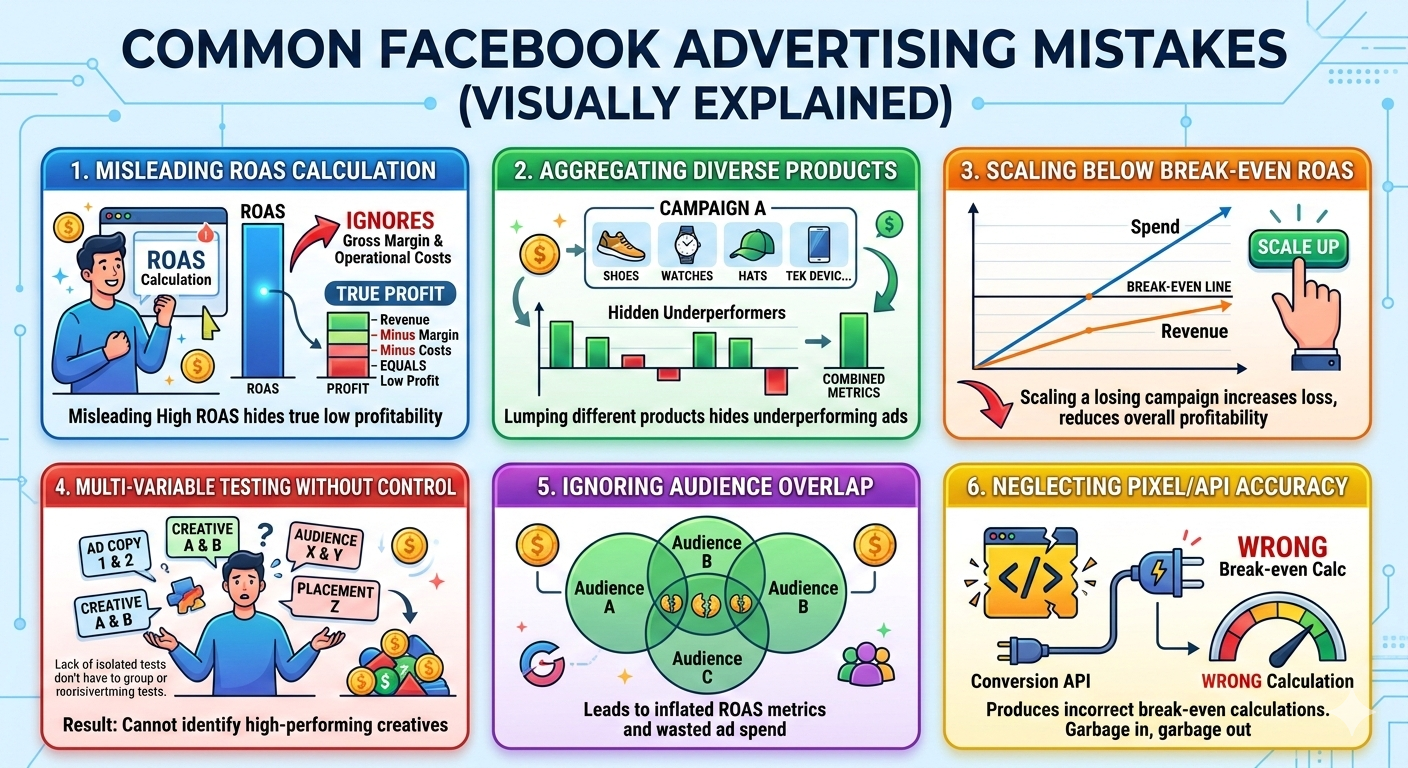
Calculating ROAS without including gross margin or operational costs results in misleading profitability.
Aggregating campaigns with diverse products can hide underperforming ads.
Scaling campaigns below break-even ROAS increases loss and reduces overall profitability.
Testing multiple variables simultaneously without control prevents accurate identification of high-performing creatives.
Ignoring audience overlap leads to inflated ROAS metrics and wasted spend.
Neglecting pixel or Conversion API accuracy produces incorrect break-even calculations.
Financial and Performance Implications
Applying break-even ROAS has direct implications on business outcomes:
CPA Management: Knowing the minimum ROAS allows businesses to target ad spend efficiently.
Budget Allocation: Focus funds on campaigns exceeding break-even ROAS, reducing wasted spend.
Scaling Decisions: ROAS guides incremental scaling, ensuring sustainable growth.
Profit Margin Protection: Maintaining campaigns above break-even prevents losses and preserves margin.
Creative Testing Impact: Identifies creatives that maximize revenue per ad dollar, improving long-term ROAS.
Conclusion
Break-even ROAS is a foundational metric for disciplined Facebook ad management. It ensures campaigns are profitable, guides scaling decisions, and informs budget allocation. Small business owners who calculate and track break-even ROAS accurately can control acquisition costs, optimize creatives, and maintain consistent profitability. Structured execution and rigorous testing are necessary to sustain performance and maximize return on ad spend.
Need more hands-on help?
If this article got you thinking, but you want done-for-you Facebook ad management on a performance basis, check out https://affilicademy.com/10freeugc.
They only get paid when your ads perform, and yes — there’s a free trial so you can see it in action before committing.
And yes, we’re partnered with them, so reading this article helps us pay the bills and keep these guides free for you.
FAQ
What is break-even ROAS?
Break-even ROAS is the minimum return on ad spend required to cover all costs and maintain profitability in Facebook ad campaigns.
How do I calculate break-even ROAS?
Use the formula: Break-Even ROAS = 1 / Gross Margin for simple calculations. Include fixed costs and overhead for precise measurement.
Why is break-even ROAS important for Facebook ads?
It ensures campaigns are profitable, informs scaling decisions, and prevents overspending on underperforming ad sets.
How do I scale campaigns using break-even ROAS?
Incrementally increase budgets on campaigns where ROAS consistently exceeds the break-even threshold. Pause or adjust underperforming campaigns.
What common mistakes reduce ROAS accuracy?
Ignoring gross margin, combining diverse products in one campaign, testing multiple variables simultaneously, and misconfigured pixel or Conversion API can all distort break-even ROAS measurement.

Who This Is For
Entrepreneurs, small business owners, digital marketers, and agencies who want to stop guessing and start scaling. If you’re ready to turn messy campaigns into structured, profitable systems, this is for you.

Free Resources
No upsells. Just info.

Integrity
Actually valuable info.
Learn
Diagnose
General Resources
Copyright 2026. FBadsmaster.com. All Rights Reserved.