
Our Blog
This isn’t just a blog—it’s your go-to resource for mastering Facebook ads with clarity and results.
Every post is designed to turn complex ad concepts into actionable strategies that save time, prevent wasted spend, and improve ROI.
Think of it as your free playbook for structured campaigns, tested frameworks, and real-world ad insights.
News
Article & Resources
We cover the core strategies that drive results:
Campaign Structure – Learn how to organize ads for clarity, tracking, and scalability.
Optimization & Metrics – Focus on what truly impacts ROI and stop chasing vanity metrics.
Creative & Messaging – Test and refine content that resonates and converts.
Scaling Systems – Grow campaigns predictably without chaos or wasted spend.
Problem-Solving Frameworks – Quickly identify and fix inefficiencies in any campaign.
Every strategy is designed to be actionable, repeatable, and results-driven—so you can stop guessing and start scaling.

Campaign Structure Guide
Just the Most Important Bits
What is campaign structure in Facebook ads?
Campaign structure is the organized hierarchy of campaigns, ad sets, and ads. It determines how budgets, audiences, and creatives are managed to maximize performance and control.Why is proper structure critical?
A disciplined campaign structure allows precise measurement of CPA, CTR, and ROAS, prevents budget misallocation, and enables controlled scaling.How many campaigns should a small business run?
Start with one or two campaigns targeting distinct objectives, such as prospecting and retargeting. Scaling should follow clear performance thresholds.What metrics matter most at each level?
Campaign: ROAS and overall CPA.
Ad Set: Audience performance, frequency, and CTR.
Ad: Creative-level engagement, relevance, and conversion efficiency.How do ad sets differ from campaigns?
Ad sets define targeting, budget allocation, and placements. Campaigns consolidate objectives and high-level budgets.How do you test creatives effectively?
Run multiple ads within each ad set, control variables, and rotate creatives before fatigue reduces signal.When should you scale a campaign?
Scale once the ad set meets efficiency thresholds and has generated statistically significant conversion data.Common mistakes to avoid:
Mixing objectives in one campaign, insufficient creative testing, and ignoring audience overlap.What budget allocation strategy works best?
Allocate budgets based on CPA targets per ad set. Separate testing from scaling budgets to avoid early misfires.
Introduction
Facebook ad performance is not random. Success relies on structured campaigns that align budgets, audiences, and creatives with measurable goals.
This campaign structure guide breaks down how small business owners can organize their Facebook advertising for predictable results.
We will cover hierarchy, mechanisms, operational logic, common errors, and financial implications so you can apply disciplined systems that improve CPA, ROAS, and scaling efficiency.
Core Explanation of Campaign Structure
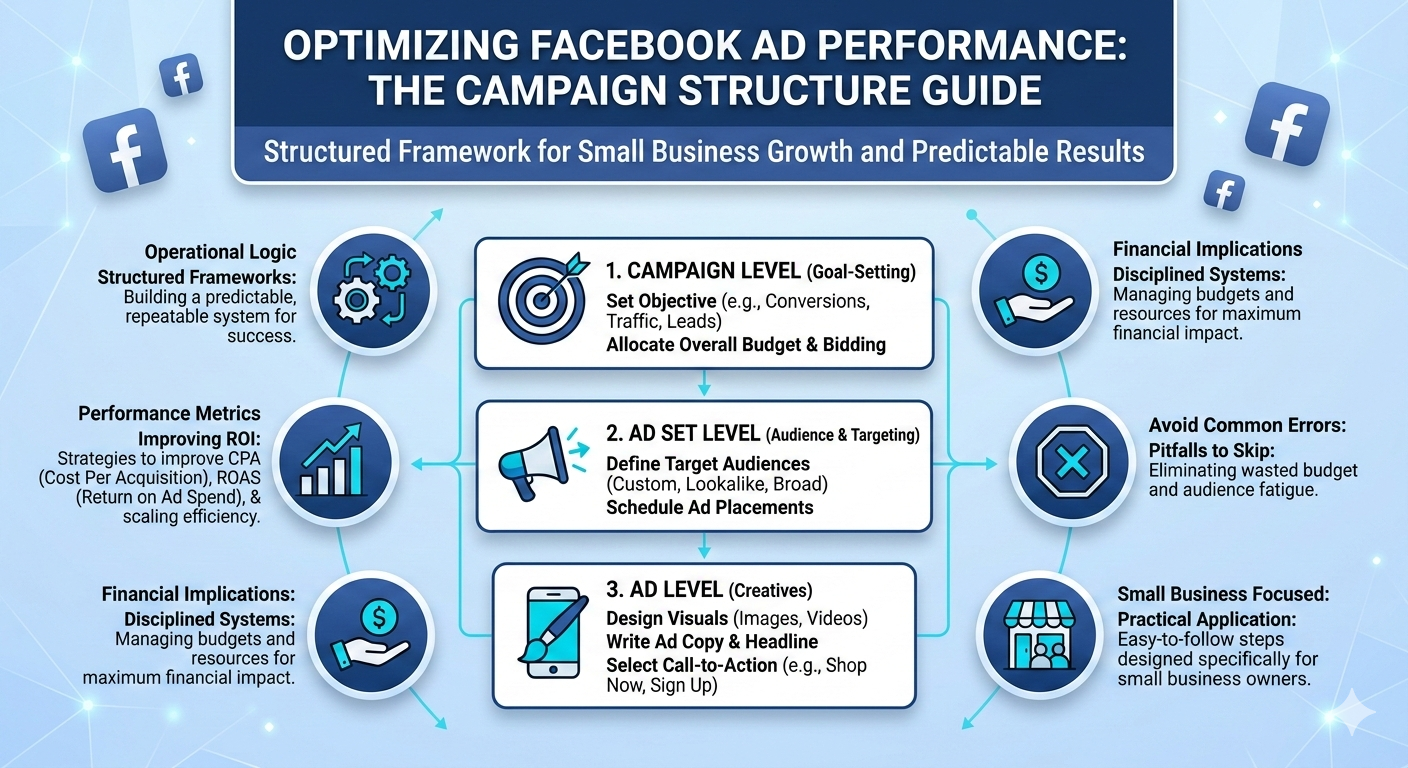
Campaign structure is the organized hierarchy of three layers:
Campaign Level – Defines the objective, overall budget, and core business goal. Objectives can include conversions, lead generation, or traffic.
Ad Set Level – Determines audience, placement, budget distribution, and bidding strategies. Each ad set should target a single audience segment.
Ad Level – Houses creatives, copy, and call-to-actions. Testing variations occurs here to measure engagement and conversion efficiency.
This hierarchy allows control over budget distribution, performance measurement, and systematic iteration.
Components to Monitor
CPA (Cost per Acquisition): Measure efficiency at ad set and campaign levels.
CTR (Click-Through Rate): Determines engagement efficiency and signals creative effectiveness.
ROAS (Return on Ad Spend): Key metric to assess whether scaling is financially justified.
Frequency: Indicates potential ad fatigue at the audience level.
LTV (Lifetime Value): Provides context for budget decisions relative to expected returns.
Mechanism: How Campaign Structure Works in Facebook Ads
Facebook’s ad delivery algorithm interacts with your campaign structure to optimize for conversions and efficiency.
Campaign Objective Selection: The algorithm prioritizes conversions or engagement based on your defined goal.
Ad Set Budgeting: Budget allocation determines delivery speed. Higher budgets with proper targeting accelerate learning without overspending.
Creative Testing and Rotation: Multiple ads per ad set enable statistically reliable performance comparisons.
Audience Segmentation: Clear segmentation reduces overlap and ensures each ad set targets unique, high-propensity prospects.
Data Aggregation: Campaign-level metrics consolidate results for actionable decisions, while ad set metrics reveal audience-specific performance.
Properly structured campaigns allow these mechanisms to operate efficiently, producing actionable insights without guesswork.
Practical Application: Step-by-Step Implementation
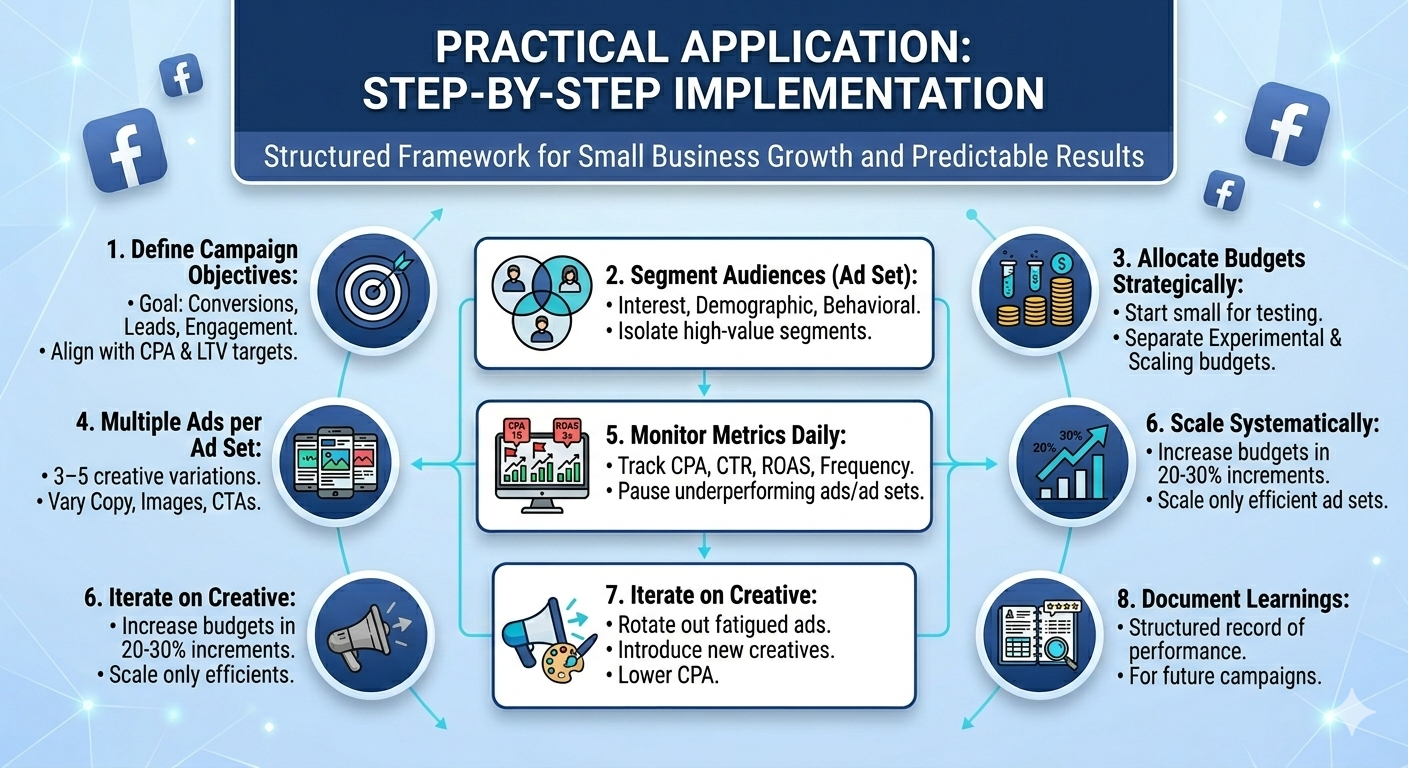
Define Campaign Objectives: Determine whether the goal is conversions, leads, or engagement. Align this with CPA and LTV targets.
Segment Audiences at Ad Set Level: Use interest, demographic, and behavioral segmentation to isolate high-value segments.
Allocate Budgets Strategically: Start small for testing. Separate experimental budgets from scaling budgets to maintain data integrity.
Create Multiple Ads per Ad Set: Implement 3–5 creative variations to control for copy, image, and CTA differences.
Monitor Performance Metrics Daily: Track CPA, CTR, ROAS, and frequency. Pause underperforming ads or ad sets.
Scale Systematically: Increase budgets in 20–30% increments for ad sets meeting efficiency thresholds. Keep testing alongside scaling.
Iterate on Creative: Rotate out fatigued ads and introduce new creatives to maintain engagement and lower CPA.
Document Learnings: Maintain a structured record of ad performance for future campaigns.
Common Mistakes or Misapplications
Mixing prospecting and retargeting objectives in one campaign.
Using broad budgets without separating test and scale phases.
Rotating creatives too frequently, which prevents statistical significance.
Ignoring audience overlap, which inflates frequency and reduces efficiency.
Failing to track campaign-level KPIs, leading to incorrect scaling decisions.
Financial and Performance Implications
Campaign structure directly impacts CPA, ROAS, and scaling efficiency.
CPA Control: Structured ad sets allow pinpointed budget adjustments to reduce cost per acquisition.
ROAS Optimization: Segmented audiences with precise creatives maximize return on ad spend.
Scaling Logic: Controlled, data-driven scaling avoids exponential waste and preserves margin.
LTV Alignment: Matching audience segments to expected lifetime value prevents over-investment.
Disciplined execution of structure reduces wasted ad spend and accelerates profitable growth.
Conclusion
Campaign structure is foundational for predictable Facebook ad performance.
Following this campaign structure guide ensures efficient budget allocation, reliable creative testing, and measurable financial outcomes.
Small businesses can control CPA, optimize ROAS, and scale safely using a structured, data-driven system.
Need more hands-on help?
If this article got you thinking, but you want done-for-you Facebook ad management on a performance basis, check out Affilicademy.
They only get paid when your ads perform, and yes — there’s a free trial so you can see it in action before committing.
And yes, we’re partnered with them, so reading this article helps us pay the bills and keep these guides free for you.
FAQ
How do I structure Facebook campaigns for maximum ROAS?
Start with clear objectives, separate audiences at the ad set level, and test multiple creatives per ad set. Use performance data to scale efficiently.
How many ad sets should I run in one campaign?
Run distinct ad sets for each target audience segment. Avoid more than 3–5 initially to maintain statistical significance.
What is the ideal budget allocation per ad set?
Allocate based on expected CPA and campaign objective. Separate test budgets from scaling budgets for precise control.
How do I avoid audience overlap?
Use Facebook’s audience exclusion tools to prevent the same users from being targeted across multiple ad sets.
When should I scale a campaign?
Scale ad sets that meet efficiency thresholds with statistically significant conversions. Increase budgets incrementally while continuing to test creatives.
Can small businesses run profitable campaigns with minimal budget?
Yes. A structured campaign with disciplined testing and audience segmentation can produce predictable results even with limited spend.

Who This Is For
Entrepreneurs, small business owners, digital marketers, and agencies who want to stop guessing and start scaling. If you’re ready to turn messy campaigns into structured, profitable systems, this is for you.

Free Resources
No upsells. Just info.

Integrity
Actually valuable info.
Learn
Diagnose
General Resources
Copyright 2026. FBadsmaster.com. All Rights Reserved.