
Our Blog
This isn’t just a blog—it’s your go-to resource for mastering Facebook ads with clarity and results.
Every post is designed to turn complex ad concepts into actionable strategies that save time, prevent wasted spend, and improve ROI.
Think of it as your free playbook for structured campaigns, tested frameworks, and real-world ad insights.
News
Article & Resources
We cover the core strategies that drive results:
Campaign Structure – Learn how to organize ads for clarity, tracking, and scalability.
Optimization & Metrics – Focus on what truly impacts ROI and stop chasing vanity metrics.
Creative & Messaging – Test and refine content that resonates and converts.
Scaling Systems – Grow campaigns predictably without chaos or wasted spend.
Problem-Solving Frameworks – Quickly identify and fix inefficiencies in any campaign.
Every strategy is designed to be actionable, repeatable, and results-driven—so you can stop guessing and start scaling.
Facebook Ads Fundamentals
Facebook Ads Fundamentals: A Complete Guide for Small Business Owners
Just the Most Important Bits
Facebook Ads Fundamentals are the foundational principles of paid social advertising on the platform, including campaign structure, audience targeting, bidding, and measurement.
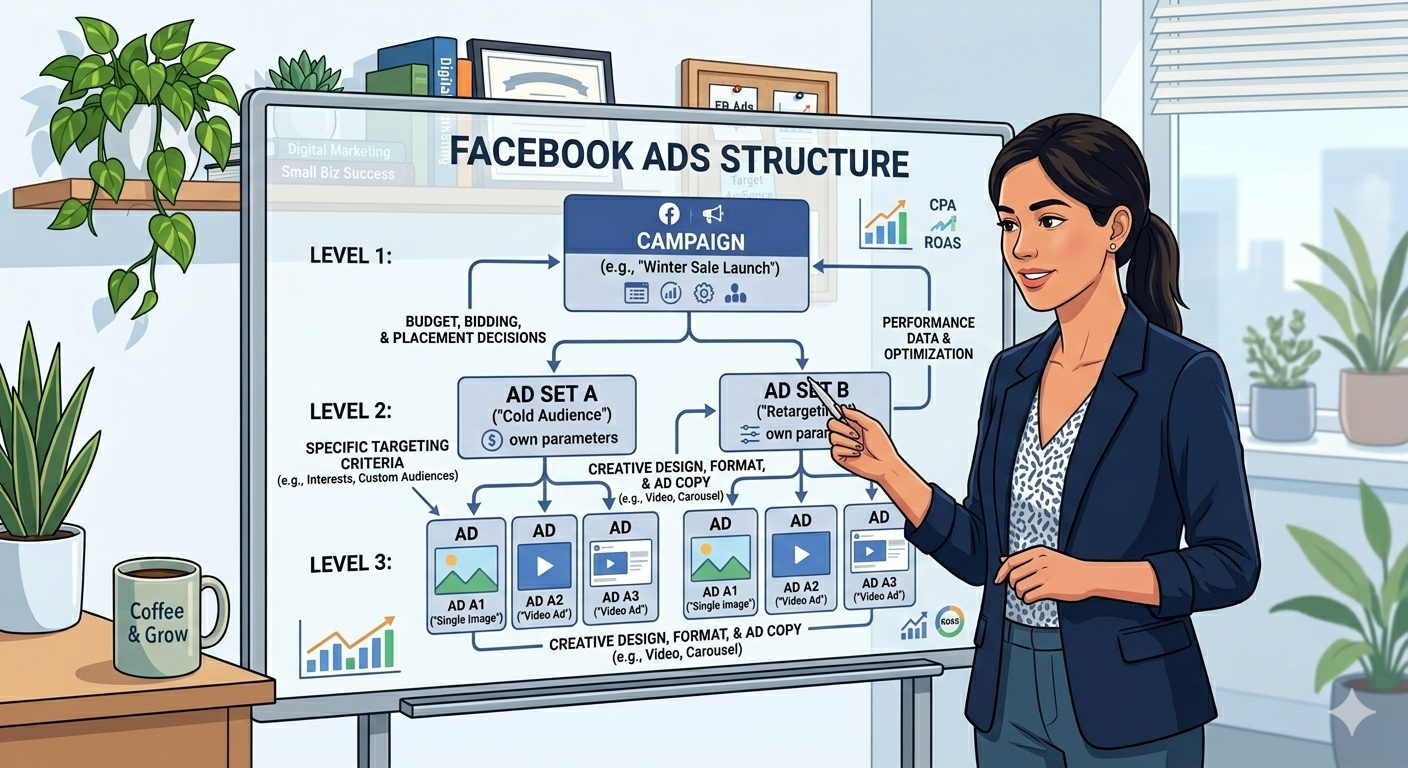
Campaigns are organized into three levels: Campaign, Ad Set, and Ad. The campaign defines the objective, ad sets define targeting and budget, and ads contain creative assets.
Key metrics include CTR (Click-Through Rate), CPC (Cost Per Click), CPM (Cost Per Mille), ROAS (Return on Ad Spend), CPA (Cost per Acquisition), and LTV (Customer Lifetime Value).
Audience segmentation and precision targeting are critical for cost-efficient acquisition. Broad or untargeted audiences increase spend without improving performance.
Structured creative testing determines which ad variations drive results. A controlled system prevents wasted spend and identifies high-performing ads quickly.
Budget allocation should follow a testing-first approach. Start small, optimize winners, then scale gradually using performance signals.
Conversion tracking through the Facebook Pixel or Conversion API is required for accurate CPA and ROAS measurement.
ROAS is determined by revenue divided by ad spend; CPA is determined by cost per conversion. Both are driven by audience quality, creative effectiveness, and bid strategy.
Scaling is performed by incrementally increasing budgets on top-performing ad sets while monitoring CPA and ROAS.
Continuous iteration and disciplined testing are mandatory. Performance will degrade if ad fatigue, audience saturation, or structural errors are ignored.
Introduction
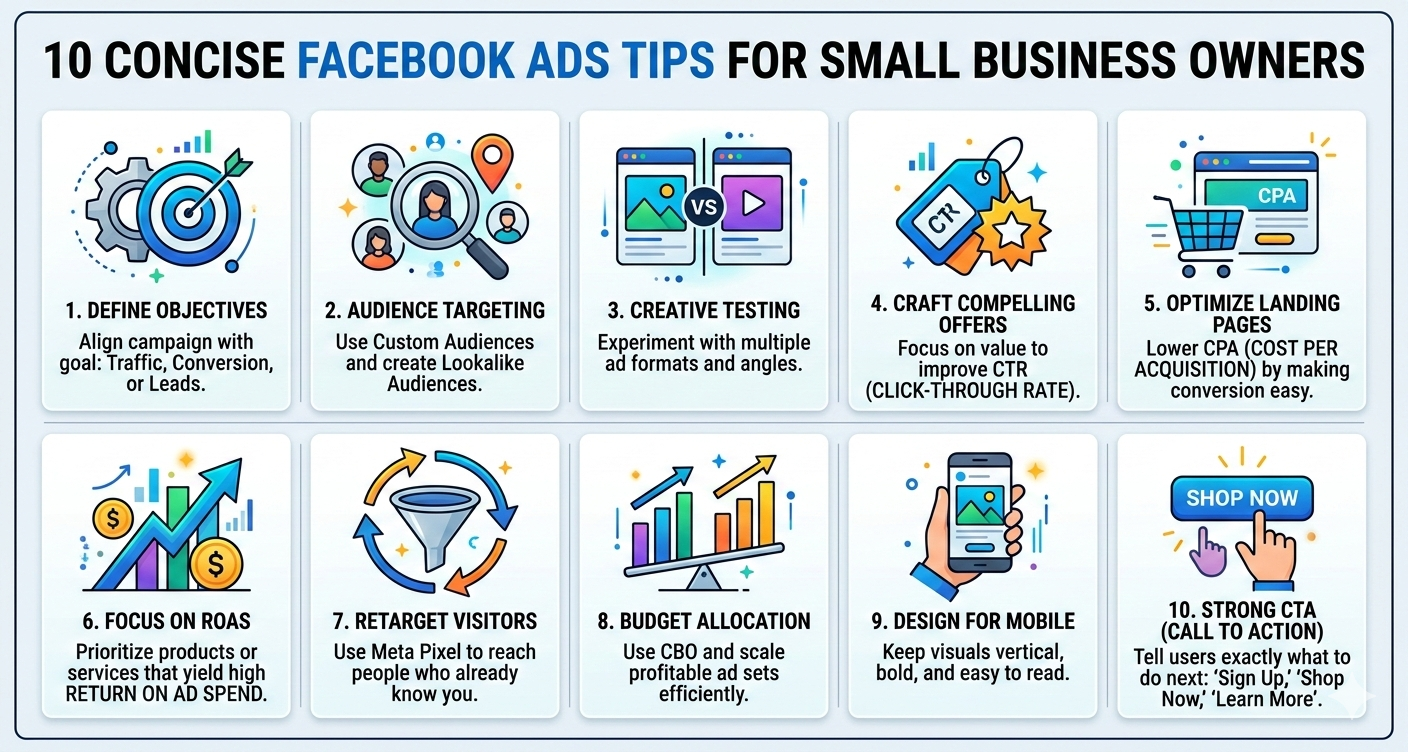
Facebook Ads Fundamentals encompass the core strategies, metrics, and operational practices necessary for small business owners to generate predictable results from paid social campaigns. Mastering these fundamentals allows business owners to manage acquisition costs, improve return on ad spend, and implement disciplined scaling systems. These principles are essential for anyone looking to leverage Facebook’s algorithm efficiently, reduce wasted budget, and make data-driven decisions. Understanding campaign structure, targeting logic, and performance measurement is crucial to turning Facebook advertising into a repeatable and measurable growth engine.

Core Explanation
Facebook Ads Fundamentals can be broken down into precise operational components:
1. Campaign Structure
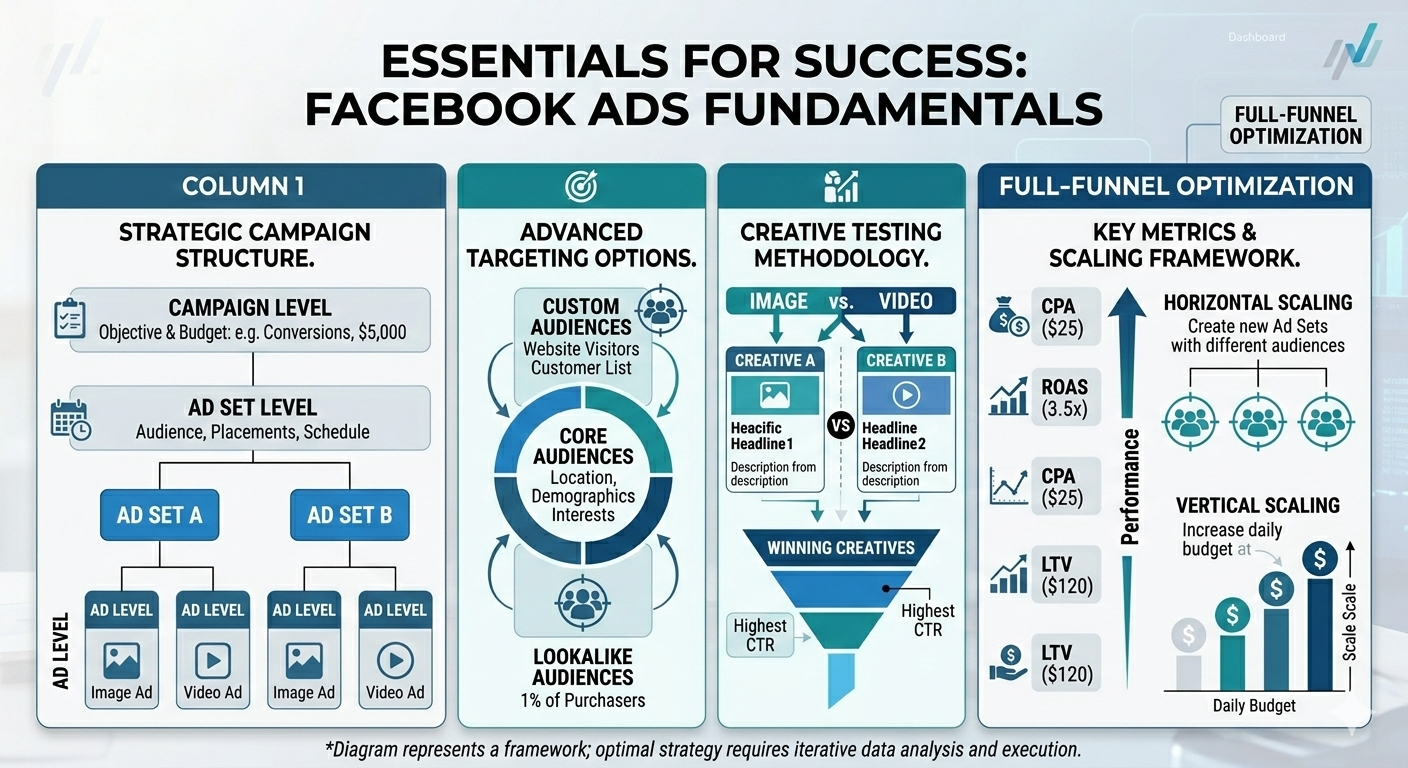
Campaigns are hierarchical. The campaign level defines the objective, such as conversions, traffic, or catalog sales. Ad sets define targeting, budget, and schedule. Ads contain creative elements such as images, video, headlines, and copy.
2. Audience Targeting
Targeting includes Custom Audiences, Lookalike Audiences, interest-based targeting, and demographic parameters. Acquisition performance relies on audience quality and relevance.
3. Budgeting and Bidding
Budget allocation and bid strategy directly influence CPA and ROAS. Automatic bidding allows Facebook to optimize for conversions within defined constraints. Manual bidding is effective when the cost per action is known and predictable.
4. Metrics
Performance is measured through CTR, CPC, CPM, CPA, ROAS, and LTV. CTR indicates creative engagement. CPA measures acquisition efficiency. ROAS evaluates overall revenue relative to spend.
5. Creative Testing
Structured testing involves running multiple variations of ad copy, creatives, and calls to action. Testing under controlled conditions ensures valid performance insights and informs budget scaling decisions.
Mechanism of Facebook Ads
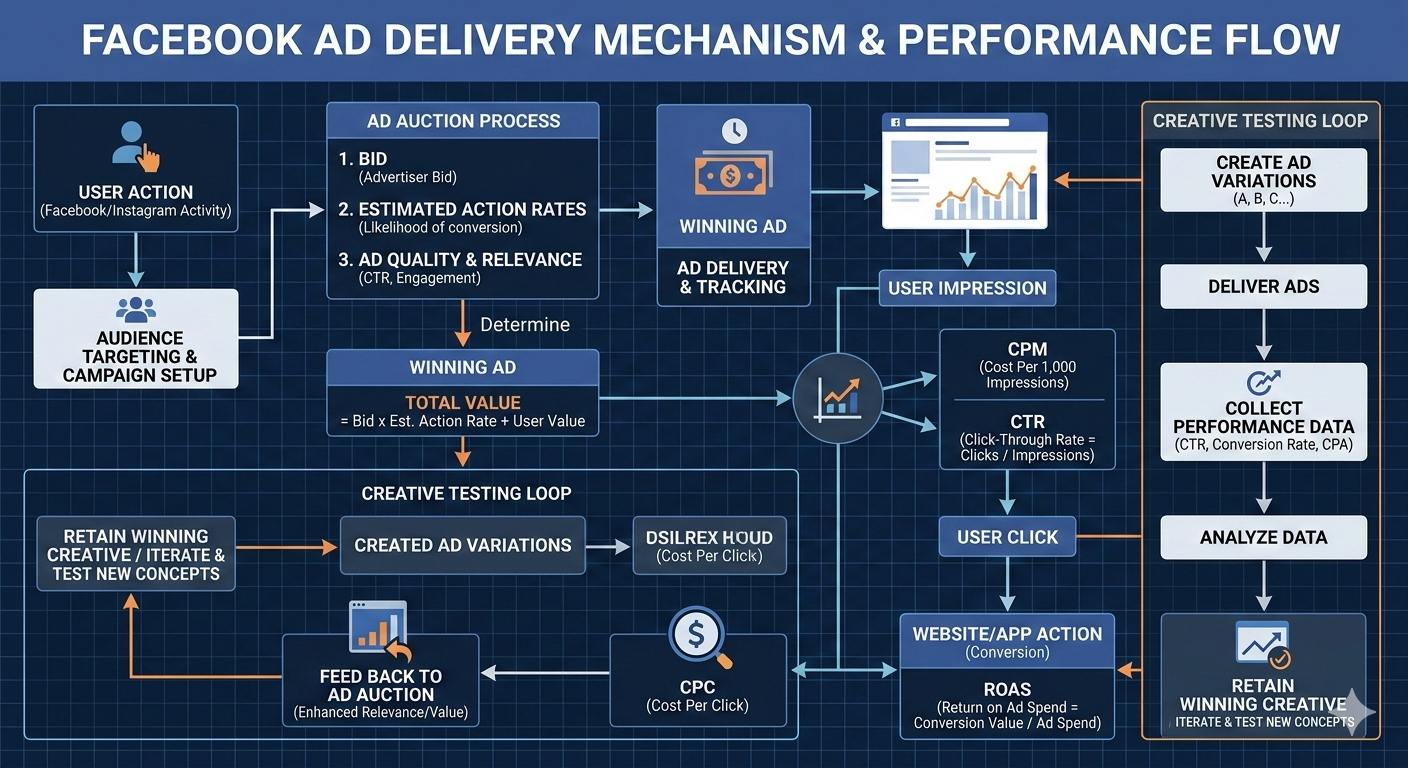
Facebook Ads operate as an auction system, but the underlying mechanism is performance-driven. Here’s how fundamentals are applied:
Campaign Structure Implementation
Each campaign has a single objective. Ad sets control audience segmentation, budget allocation, and delivery optimization. Ads contain the creative, which is the lever for CTR and engagement.
Metrics in Action
Facebook’s algorithm prioritizes ads with higher engagement and lower CPA. CTR impacts ad relevance, CPM reflects auction competition, and ROAS connects revenue to spend.
Testing Framework
Split testing multiple ads within an ad set isolates variables. For example, testing different video lengths or messaging approaches identifies the most cost-efficient acquisition path.
Scaling and Optimization
Scale ad sets that meet ROAS and CPA targets. Incrementally increase budgets by 20–30% to avoid algorithm disruption. Pause underperforming creatives and refresh testing regularly.
Practical Application
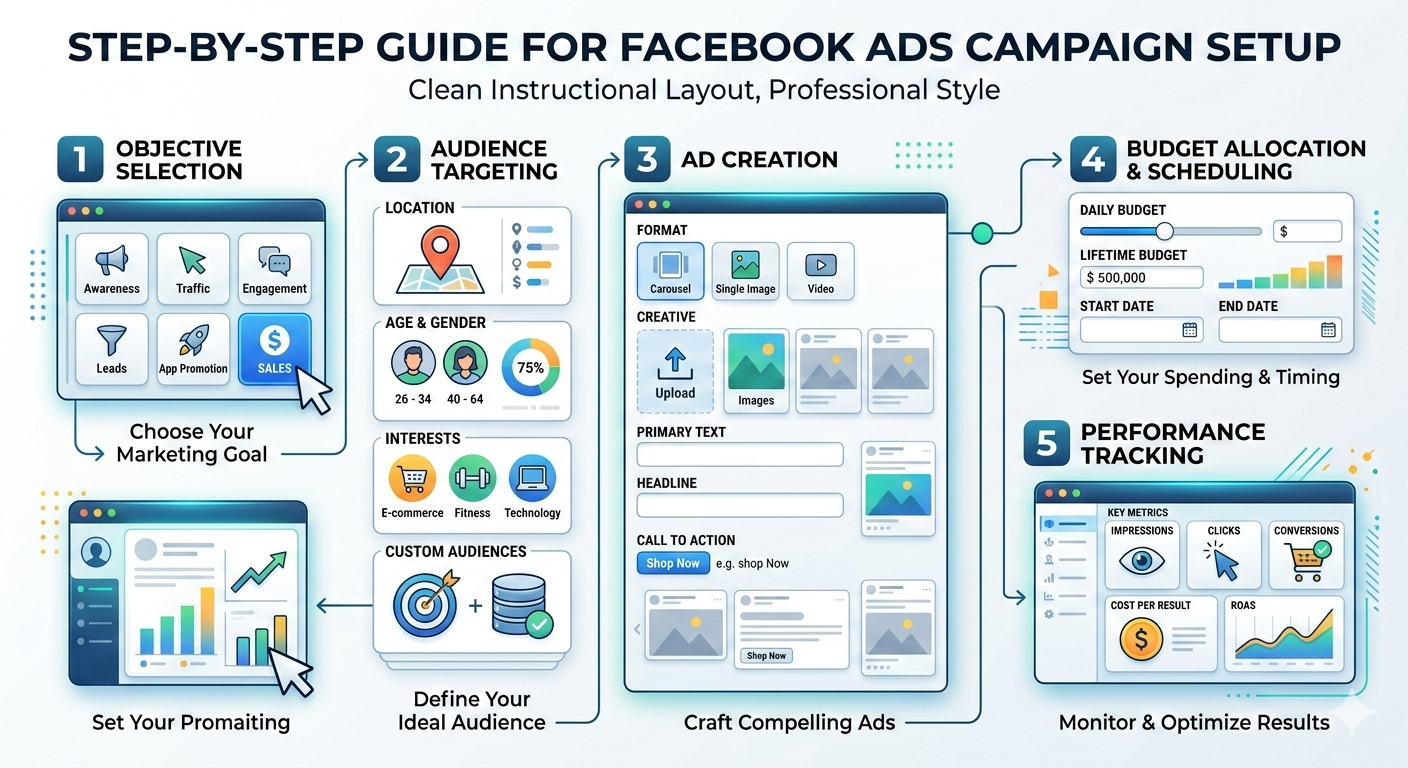
Implement Facebook Ads Fundamentals using this step-by-step approach:
Define the campaign objective aligned with business goals.
Set up ad sets with clear audience segmentation. Avoid overlapping audiences.
Develop multiple creatives per ad set. Include variations in copy, visuals, and CTA placement.
Allocate small test budgets to each ad set to measure initial performance.
Track CPA and ROAS using Facebook Pixel or Conversion API. Ensure accurate conversion data.
Analyze results after 3–7 days to determine winners.
Scale winning ad sets incrementally while monitoring CPA and ROAS.
Rotate or refresh creatives to mitigate fatigue and maintain CTR.
Adjust targeting, budget, and bidding based on performance trends.
Document results and maintain structured testing for iterative improvement.
Common Mistakes or Misapplications
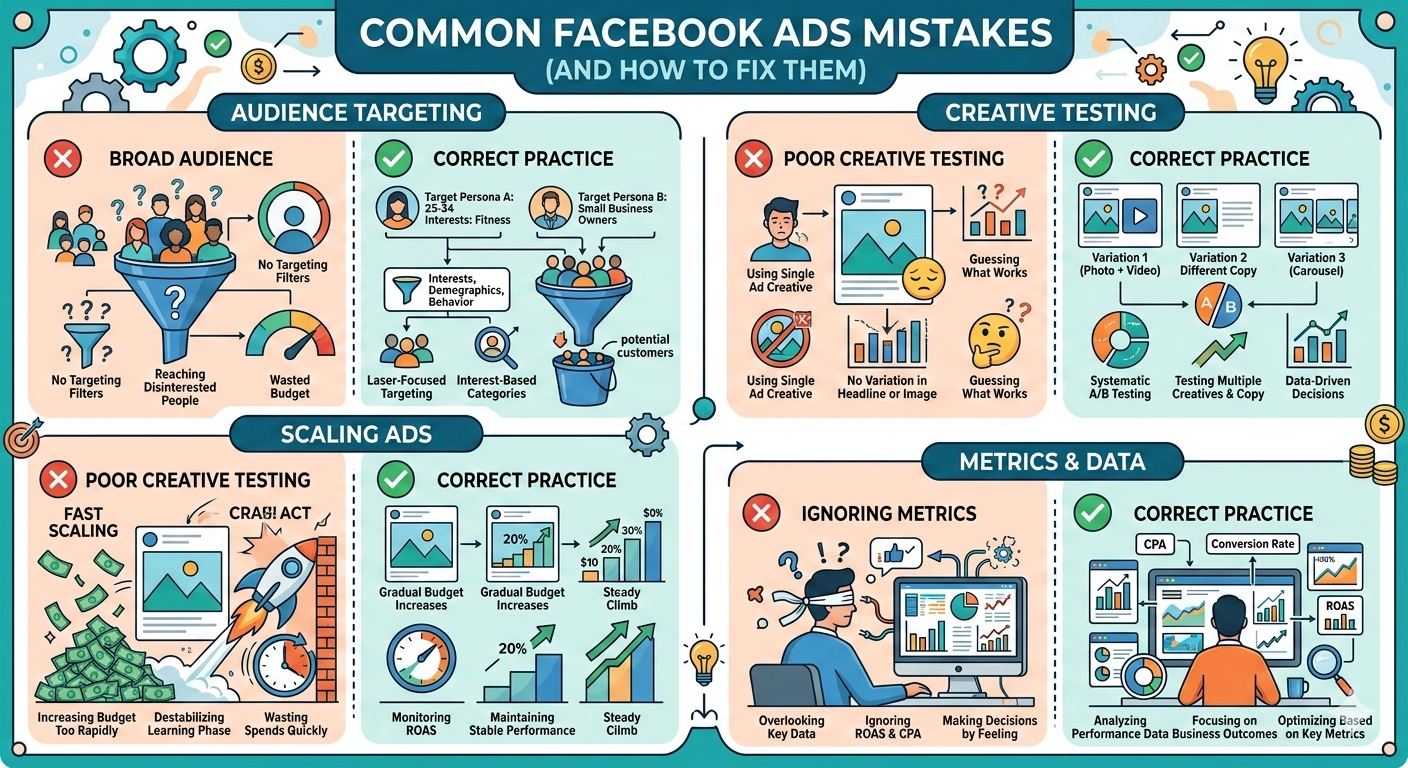
1. Ignoring Campaign Structure
Not segmenting campaigns and ad sets leads to ineffective budget allocation and unclear performance signals.
2. Poor Audience Definition
Overly broad audiences drive up costs and reduce conversion efficiency. Use precise Custom and Lookalike Audiences.
3. Inconsistent Creative Testing
Testing multiple variables simultaneously without control invalidates insights. One change per test is optimal.
4. Improper Budget Scaling
Scaling ad sets too quickly can increase CPA. Gradual budget increases maintain algorithm stability.
5. Neglecting Metrics
Focusing only on impressions or clicks without CPA and ROAS analysis misaligns campaigns with business outcomes.
Financial and Performance Implications
Applying Facebook Ads Fundamentals impacts cost structure and revenue outcomes:
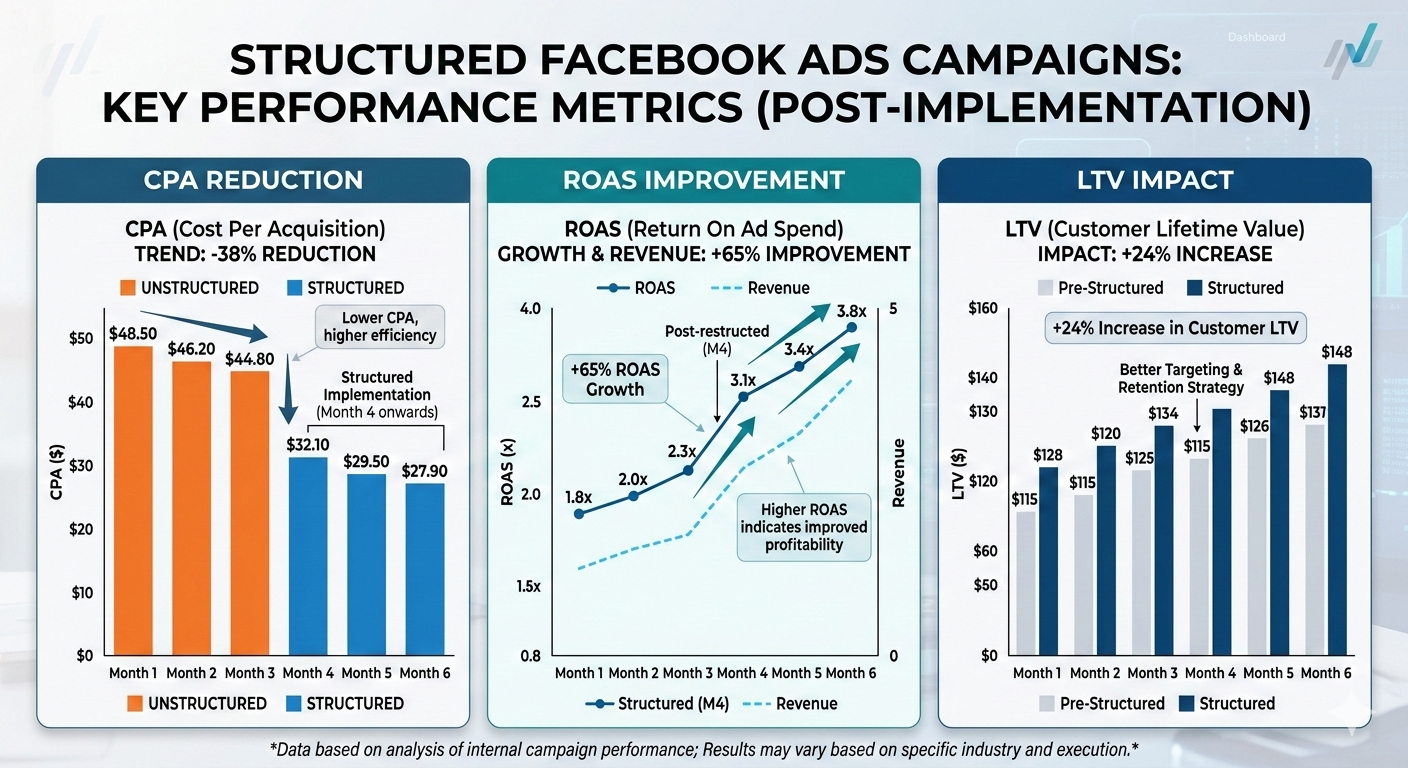
CPA Optimization reduces acquisition cost and increases profit margin.
ROAS Tracking ensures advertising spend translates into measurable revenue.
LTV Integration allows strategic budget allocation toward high-value customers.
Scaling Efficiency maximizes revenue without overspending.
Creative Testing prevents wasted ad spend and improves campaign ROI over time.
Conclusion
Facebook Ads Fundamentals are a structured system of campaign design, audience targeting, budgeting, creative testing, and performance measurement. Small business owners who apply these principles with discipline achieve predictable acquisition costs, measurable revenue growth, and scalable advertising systems. Consistent execution and controlled iteration are the foundation for sustainable Facebook ad performance.
FAQ
What are Facebook Ads Fundamentals?
Facebook Ads Fundamentals are the principles of campaign structure, audience targeting, creative testing, and performance measurement that enable systematic ad management.
How do I measure Facebook ad performance?
Performance is measured using CTR, CPC, CPM, CPA, ROAS, and LTV. Each metric reflects a different component of engagement, efficiency, and profitability.
How should I structure Facebook campaigns?
Use a three-level structure: Campaign defines objectives, Ad Sets control targeting and budget, and Ads contain creative. Segmentation ensures performance clarity.
How do I reduce CPA on Facebook ads?
Focus on high-quality audience targeting, test multiple creatives, optimize bidding, and scale winners gradually to maintain cost efficiency.
What is the role of creative testing in Facebook ads?
Creative testing identifies the most cost-efficient ads. Controlled testing isolates variables to determine which combinations of visuals, copy, and CTA maximize results.
How do I scale Facebook ad campaigns?
Incrementally increase ad set budgets by 20–30% once CPA and ROAS targets are met. Refresh creatives regularly to prevent fatigue and maintain performance.
What common mistakes reduce ad efficiency?
Ignoring campaign structure, targeting broad audiences, testing multiple variables simultaneously, scaling too fast, and neglecting key metrics are common errors.
If you want Fully Managed Facebook Ads, for Free.
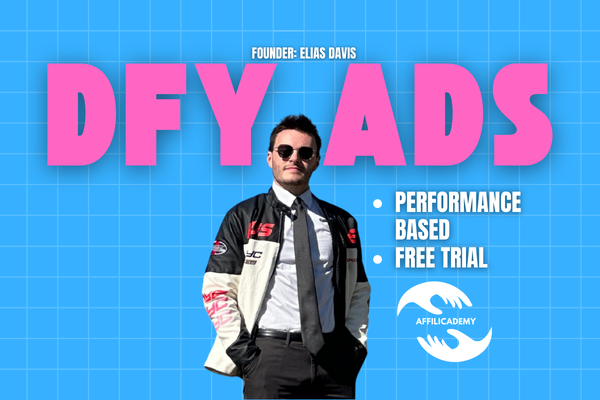
If this article got you thinking, but you want done-for-you Facebook ad management on a performance basis, check out Affilicademy.com/10freeugc.
They only get paid when your ads perform, and yes — there’s a free trial so you can see it in action before committing.
And yes, we’re partnered with them, so reading this article helps us pay the bills and keep these guides free for you.

Who This Is For
Entrepreneurs, small business owners, digital marketers, and agencies who want to stop guessing and start scaling. If you’re ready to turn messy campaigns into structured, profitable systems, this is for you.

Free Resources
No upsells. Just info.

Integrity
Actually valuable info.
Learn
Diagnose
General Resources
Copyright 2026. FBadsmaster.com. All Rights Reserved.