
Our Blog
This isn’t just a blog—it’s your go-to resource for mastering Facebook ads with clarity and results.
Every post is designed to turn complex ad concepts into actionable strategies that save time, prevent wasted spend, and improve ROI.
Think of it as your free playbook for structured campaigns, tested frameworks, and real-world ad insights.
News
Article & Resources
We cover the core strategies that drive results:
Campaign Structure – Learn how to organize ads for clarity, tracking, and scalability.
Optimization & Metrics – Focus on what truly impacts ROI and stop chasing vanity metrics.
Creative & Messaging – Test and refine content that resonates and converts.
Scaling Systems – Grow campaigns predictably without chaos or wasted spend.
Problem-Solving Frameworks – Quickly identify and fix inefficiencies in any campaign.
Every strategy is designed to be actionable, repeatable, and results-driven—so you can stop guessing and start scaling.
How to Scale Advertising For Free
How to Scale Facebook Advertising, for Free.
"Once you know what works, you can run infinite ad tests for free on Facebook. All you do is spend some of the profits you already made." - Elias Michael Davis, founder of Affilicademy.
Facebook ads are often difficult due to the fact you have to constantly invest more money to scale the business. This is not the right way to do things.
My core ideological difference is that I see ad spend as the single greatest investment I have, more than the S and P 500, more than gold.
Every dollar I invest normally gets 10% yearly. Facebook ads generate me a 12.5x ROAS monthly. Every time I get a chance to increase my budget, I do.
How to Scale Advertising For Free - Table of Contents:
How to Scale Facebook Advertising, for Free.
Part 1 - How do you Become Profitable on Facebook Ads?
Part 2 - Which Creatives Work Best?
Part 3 - How do Levels of Awareness Affect Facebook Ads Strategy?
What do you Mean by "for Free," Ads Cost Money?
Yes, they do. You have ad spend when you run ads, but once you are profitable, every dollar more is free.
This is because it comes out of the sales generated by the previous cycle of ad spend. Not out of your pocket. The trouble is scaling, and becoming profitable initially.
So, this article will cover that in this order:
How to become profitable initially using the SCALER framework to know how many creatives to test.
What creatives work best for which brands, why, including examples.
Levels of awareness, and how it related to ad profitability.
Iteration strategy development.
This covers all of the basics you need to run a profitable ad strategy that will get you to the point where you are generating thousands of dollars in revenue daily, without constantly needing more money to invest.
Part 1 - How do you Become Profitable on Facebook Ads?
You cannot do anything else if you are not profitable. If you burn cash to grow a business, and you arent funded by billionaires, you need to be able to extract money out of the business.
The most efficient way to do this is by understanding what your audience responds to. The most efficient way to know what you audience responds to is to test.
SCALER lets you test efficiently, test the right volume, at the right time.
You need a lot of volume to understand what your audience wants. Like a lot. More than you probably think.
Let me explain why with a photo.
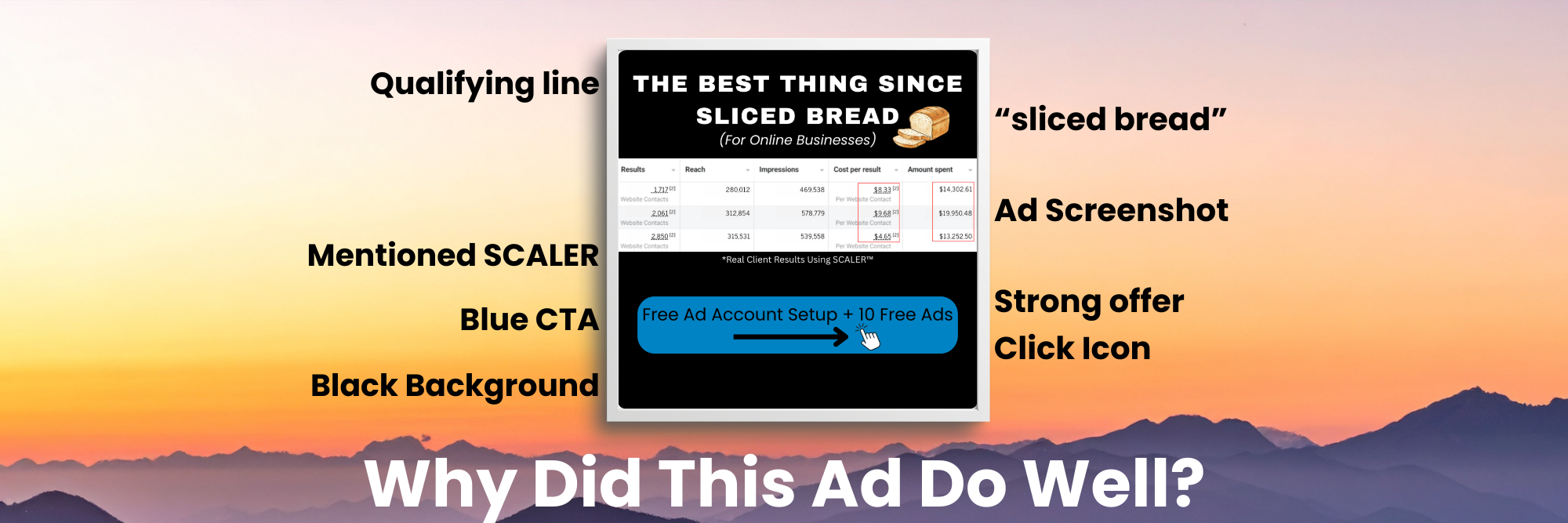
Did this ad do well because its on a black background and it stands out? What about the emojis that were used? It could be the reference to the popular saying…But theres also the ad screenshot and the qualification line.
or could it be some combination of those elements?
Thats a minimum of 8 individual things you may want to test, just to understand why this ad performed.
The better you understand what works, the more you can increase your profitability.
The problem most business owners and ad agencies make is they simply do not test enough content. They launch batches of 3-5 ads, see a winner if they get lucky, and assume thats enough to know their audience.
That is how you waste massive amounts of spend, fail to scale advertising, and do not learn anything valuable. SCALER solves this by defining, using a math equation, how many ads you actually need to test per batch to get meaningful data.
Keep in mind - the goal is not just to test ads in general, but every element that makes an ad unique. The hooks, visuals, offers, CTAs, actors, music, and everything else you need, all in a single batch.
What is the Point of All this Testing?
This makes it so you can test, iterate, and increase profitability counting in days and weeks, not months. Each variable you test gives you information to craft the perfect ads. SCALER forces you to run enough volume to know what works, not just think.
Profitability comes after the first 2-3 rounds of testing. Every creative that passes the minimum success standard stays on, the ones that don't get edited or changed. By definition, things only get better. You reinvest and increase budget until you hit ad capacities, then hold ad budgets and increase creative volume.
Every dollar you spend either helps you learn to be profitable, measurably, or is profitable. That is why ad scaling is "free." Once you know what works, you never have to invest another dollar, and the profits fund the next batch.
So I Just Need to Make a ton of Content?
Not Exactly. Another piece of the puzzle is ad velocity. Even a "hit ad" will have decreasing ROAS over time, as audiences lower interest, increase repeat views, or it becomes less relevant. SCALER lets you measure when your ads are reducing results, and prevents volatility by having consistent testing cycles, rather than reactively changing things once they already don't work.
This prevents total campaign ROAS decay, and keeps profits coming in regardless of individual ad performance.
In essence, becoming profitable does not have to be luck, it can be structured testing, measurement, and iteration. SCALER gives you the framework to hit profitability quickly, so your ad spend works like a machine instead of a sink, draining money away.
If you want to see the full SCALER formula, fill out the form here, and Ill even cover the cost to roll it out for your business.
Part 2 - Which Creatives Work Best?
Good.
Now that profitability is structurally solved through SCALER, the next question is obvious:
What creatives will actually work for my brand?
Volume alone does not save you. You still need high-quality ads that convert. Most brands make one of two mistakes. They either copy competitors and assume replication equals results, or they overproduce one format, usually UGC, believing format alone determines performance.
Neither approach works consistently because creative performance is contextual. What works depends on your margins, your product type, your customer psychology, and where your audience sits in the buying journey.
Note from the author: Here I'll be using image static ads, however, these principles carry across other media types. They just are difficult to put on an article. If you want video examples, text me on the form at the end.
What Type of Ads Should A Problem-Solving Product Use?
If you are a high-margin, problem-solving brand such as skincare, supplements, or SaaS, belief is the bottleneck. Your creative must clearly articulate the problem, demonstrate the solution, provide proof, and close with a strong call to action.
Founder-led videos, testimonial cuts, before-and-after visuals, and screen recordings work well here because they reduce skepticism. The audience is buying certainty that you can help them. Your ads must build trust before they extract money.
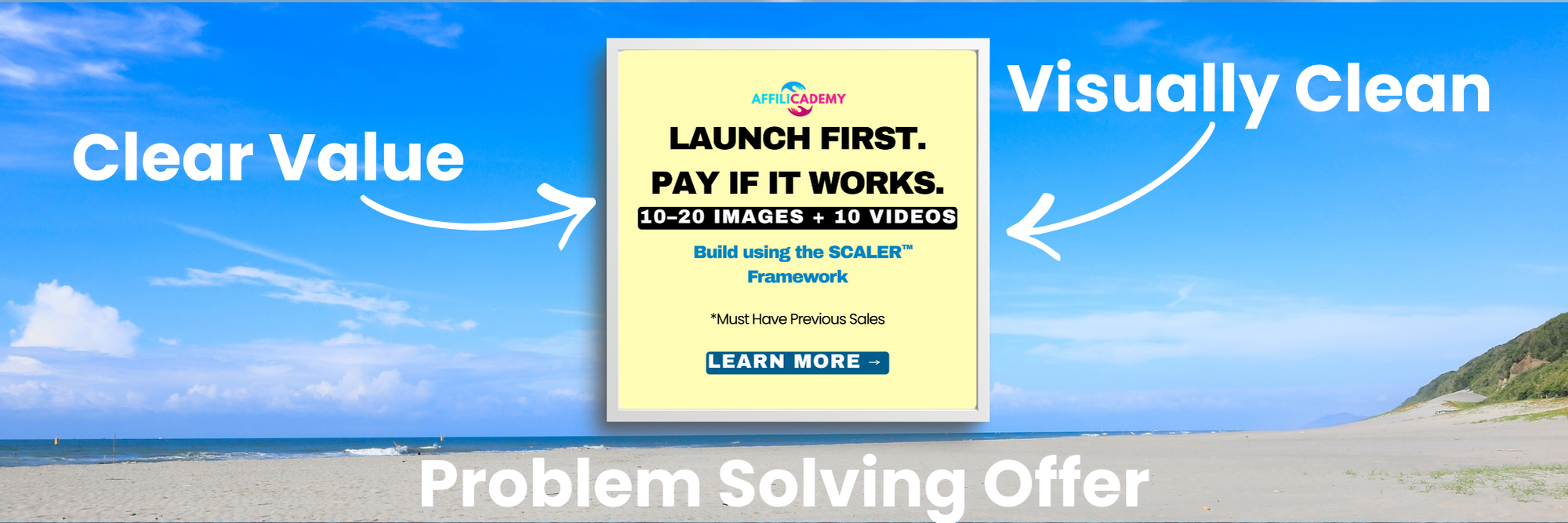
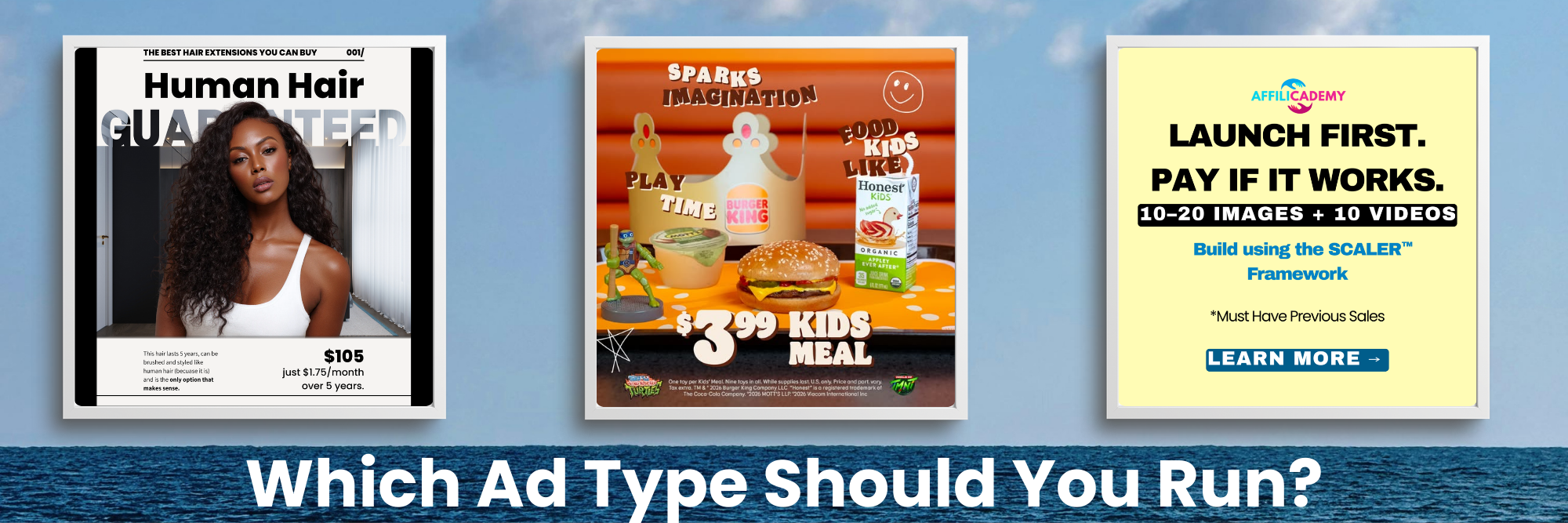
An example of an advertisement run by Affilicademy.com
What Type of Ads Should A Low Margin, Impulse Buy Product Use?
If you are selling a low-margin impulse product such as gadgets or novelty fashion items, attention is the bottleneck. Here, speed matters more than depth.
Fast hooks, visual pattern interruption, quick demonstrations, and social proof overlays perform best because the goal is to capture attention instantly and convert within seconds. If you run image ads, they have to be visually interesting to keep people watching. You are competing inside a short-form feed environment.
Your ad must grab the viewer aggressively and hold them long enough to trigger impulse behavior. You are leveraging the fact that people naturally have curiosity, and leading that to buying behavior.
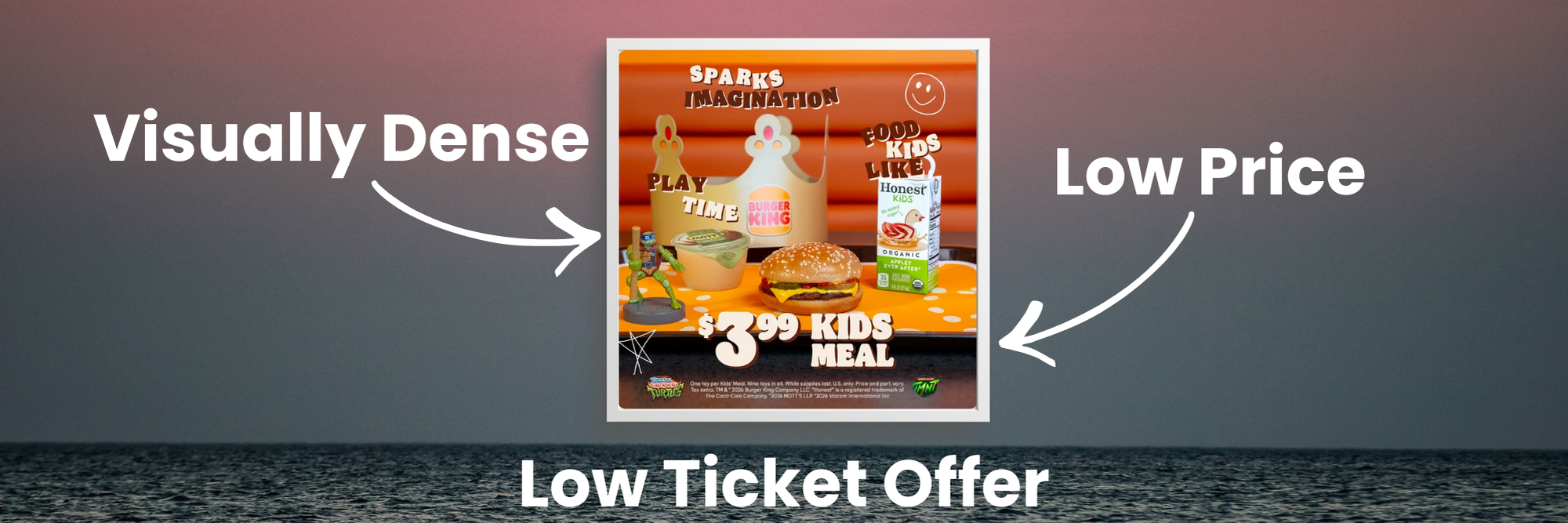
an example of an advertisement run by bk.com
What Type of Ads Should A Premium Brand Use?
If you operate a premium brand, overproduction can hurt you. Highly polished studio ads often create psychological distance and reduce relatability.
In many cases, lightly edited, authentic-feeling content outperforms cinematic creative because it lowers resistance. This is why SCALER forces structured comparisons between polished and raw, founder and actor, demo and testimonial, long-form and short-form.
You should never assume your audience cares if your product is highly polished. In all likelihood you are not Cartier or Rolex. People need to know your product is good, and trust the social reviews. People who buy premium products care about the social benefits. Show people talking about your product.

an example of an ad run by rawvhairs.com
What Type of Variables Should I Test?
All of them. Every ad is a stack of variables. The hook, visual setting, offer framing, CTA structure, actor identity, music choice, and on-screen text density all contribute to performance. When you isolate and rotate these variables methodically, patterns emerge.
You may discover your audience responds disproportionately to negative hooks, simple backgrounds, founder delivery, and urgency-based calls to action. That is why you test. So that you know what works.
What is Success?
Most brands never reach this level of clarity because they change too many elements at once or kill ads before performance stabilizes. They scale a single winner instead of identifying clusters of winners that share structural similarities.
The goal is multiple ads winning for the same underlying reasons. When three or four creatives succeed using the same hook structure or emotional angle, you have found leverage. You can then turn this into an advertising system, and not be reliant on a single ad creative.
Next, we need to examine why creatives that convert cold traffic often fail with warm audiences, and how awareness level directly determines profitability.
Part 3 - How do Levels of Awareness Affect Facebook Ads Strategy?
So now you should have an idea of what SCALER is, why you should be testing, and the general type of content you need for your brand, based on the type of product/offer you sell. The next step is understanding the levels of awareness, and how to phrase different offers to attract the widest possible audience. We will also talk about funnel development, and the differences between each level.
To help make this as easy to understand as possible, I'll use a single offer for this entire section. "I want to run your ads, on a performance basis." I'll point out the differences for the funnel, ad, landing page, and nurturing required for each step.
Totally Unaware - They Don't Even Know They Have a Problem
This is the coldest possible traffic. They do not know Affilicademy. They do not know affiliate-based acquisition exists. They probably do not even know their current ad system is not working. At this level its not possible to sell anything directly, regardless of what you sell.
You ad language needs to focus on telling them they have a problem, rather than the offer itself. For example here, I said "Are Your Ads Good Enough?" because it creates curiosity, and allows the viewer to decide. The goal here is to open up the idea there is something they don't know.
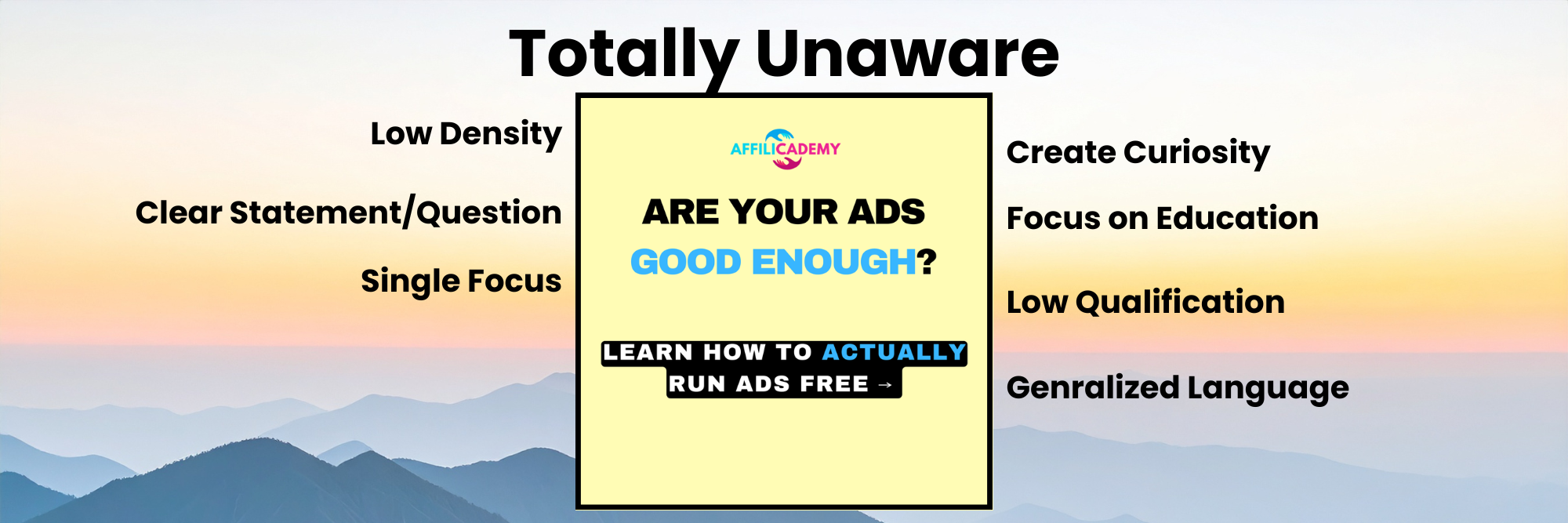
This is an actual ad Affilicademy.com ran to a VSL landing page profitably.
What are the differences between different brand offers?
For service businesses like mine, you want to lead to a VSL or long form educational page, like this one, where you help them understand an issue in its entirety. The goal is to reframe their current understanding of a problem to a new one, where you show them they are not doing things as well as they could. Always remember you are selling a system, an idea, not a specific offer.
For low ticket product offers you want to use a lead magnet or entry product/offer that is cheap or free. This is something that helps see the desire for your product, without selling it instantly. For example, if you were selling children's toys, you might send people to an article about how different toys assist in brain development, and have a download available with different products, and list yours as the best.
For premium products, you absolutely want to use a VSL showcasing the social desire for your product, along with case studies, reviews, or UGC content showing your product live. Lead nurturing is likely required here, where you put them on an email list, text list, and run retargeting ads to higher levels of awareness over time. Instant conversion is unlikely, so you should focus on education, hoping for long term sales.
Problem Aware - They Don't Know the Solution to Their Problem.
This audience understands they have a problem. For skincare it might be they have acne. For my audience, they know their ads are not consistent. This audience does not understand the root causation of their issue, or that there is a solution that can help them. You are still focusing on education here.
At this level of awareness, you can speak to an actual pain point, not just curiosity. They do not need to be convinced they have a problem anymore, but you need to be able to articulate the pain they are experiencing better than they can. If you can describe the symptoms perfectly, they will trust you when you offer a solution.
Your ad language should diagnose the issue and encourage them to think about the potential solutions. For example, "Are you tired of Wasting Money on Meta" is a clear pain point that can be addressed. The difference here is to articulate the problem well enough to change them from understanding they have a problem to making them want a solution.
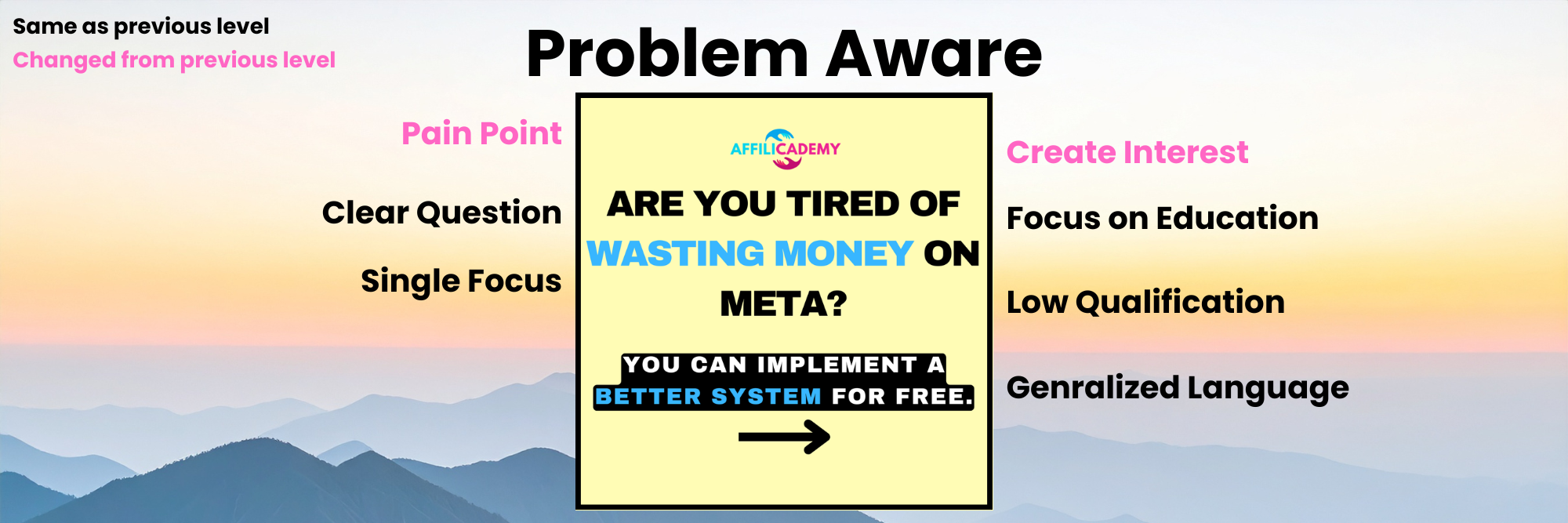
These ads perform the best when they introduce a new solution to an existing problem. This creative explains that there is a better way to address a problem, it doesn't ask them to make a commitment. You also want to make sure the problem is addressable, and doesn't make them lose hope. If I said "Everyone is Wasting Their Money on Meta." It makes the problem seem impossible to solve.
What are the differences between different brand offers?
For service offers it still should be going to a VSL, but it can be a lot more direct. Address the problem in the hero section, and spend less time convincing them they have an issue, get right into solutions after clarifying the problem you are solving. Introduce how your service fixes their problem. The idea is to convert them to solution aware.
For low ticket offers, this is where you can start to introduce instant purchase options. Generally, you want to convince them the product will solve the problem using the headline, description, and images, but skip the rest of the levels of awareness in favor of offering a discount, or reason to purchase now such as urgency. Proof mechanisms will help a lot to build trust, such as reviews, demonstrations, and outcome messaging focused on how they will feel once they buy your product. Connect the product directly to your offer.
Premium products have it more difficult, you have to demonstrate proof. case studies, testimonials, and clear positioning of your solution being the best way to solve their pain. You still will have to lead nurture, but you want to reinforce your solution as the best, not just sell. You can start to do Us vs. Them once you educate them past solution aware. Risk management is the most important due to the price.
Solution Aware - They Don't Know There are Products that Solve Their Problem.
The difference between this step and product aware is here they know that there is a solution, but have not yet started considering specific products or brands to solve their problem. For example, at problem aware about Affilicademy they are thinking "My ads just cannot scale past $100 per day." At solution aware they are thinking "I probably need to improve the testing system I use for ads." They have not yet started thinking "Should I hire Affilicademy, or find employees?"
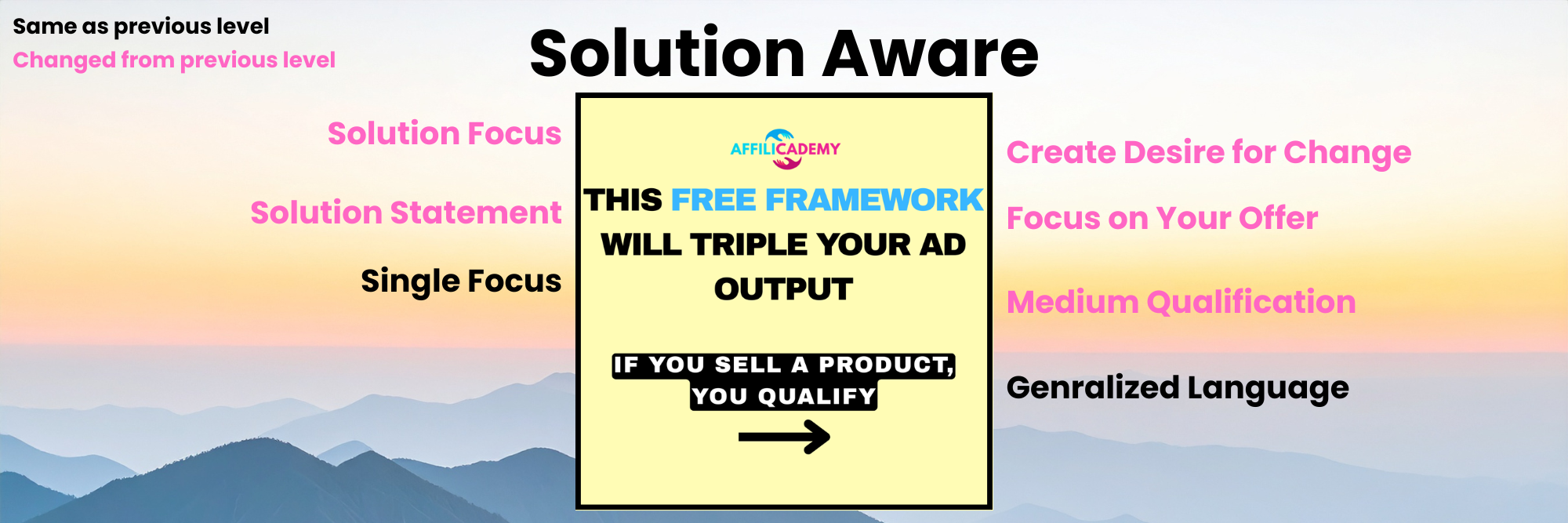
At this level, you need to introduce the specific solution they are aware of, and the landing page introduces your product. This is also the level where you can start funneling actual sales, although conversion will increase at higher levels of awareness.
What are the differences between different brand offers?
For service businesses this is the step where you clearly explain the specific offer and benefits your product has, assuming they understand the solution in general. You sell the concept of the system, then sell yourself as the best option at the end. Authority is important here, but explaining the specifics of your product and its benefits are more important, to shift them from solution to product aware.
For low ticket offers, you introduce the product type directly. For example, they know they have acne on a skincare offer, so you introduce your product as an acne clearing serum, and how it works. You don't need to run Us vs Them ads here, just make them aware of your product and how it works. You can run direct to sales page.
For premium products, this is where you want to really lean into the brand story. Founder lead ads work incredibly well here, explaining how you experience the problem, created the solution, and developed the product. You still want to lean heavily into lead nurturing, but you can actually start to see sales velocity. The emails and texts you send can have offers, not just education.
Product Aware - They Know About Your Product, but Need an Extra Push.
They audience you are advertising to here have already seen some of your content. They may have gone as far as watching a VSL, or may have just need your ads in the past. They have likely engaged with your content in some way which has created memorability for your brand. They are now evaluating you vs your competition. "Is this right for me?" is the question to answer.
Case studies, proof, value statements, clear benefits. These are the things to focus on for this level of awareness.
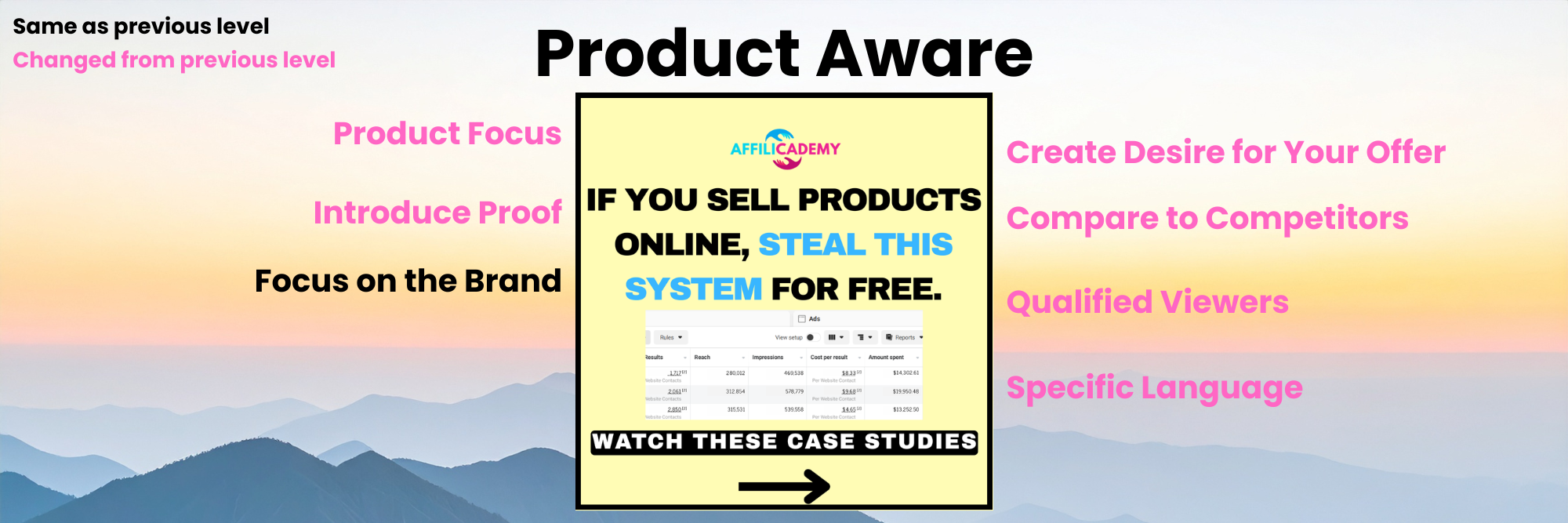
What are the differences between different brand offers?
For service offers, you want to drive towards action. "Steal this system" requires the viewer to accept they will do something and take an action after clicking the ad. Content should focus on proof, wins, and value reasoning. Objection handling should be brought up on the landing page, where you explain away concerns with proof and reasoning. Reduce risk with guarantees if possible.
For low ticket product offers, this is where direct traffic conversion starts being really successful. Focus on reviews, GUC, guarantees, and clear benefit and offer stacking. You want to dominate their mind with all the benefits, and can use these ads as heavy retargeting for previous levels. Urgency, bundles, and limited time offers work really well here. Education has completed.
For premium offers you want to focus on lowering risk, increasing benefits, and social proof. The best thing you can offer here is showing just how desired your product is, street interviews of people raving about it, saying its so hard to find, how great it is. Expert endorsements are helpful, and a guarantee is critical. Retargeting should justify the increased price. Commitment is the goal, making them loyal to your brand.
Fully Aware - They Just Need a Reason To Take Action Now.
This is where they know everything about your brand, and just need some urgency or reason to take action. "Do I need this right now?" is the question to answer. Your ad language should be direct and action oriented, and have a clear, time limited offer.
You don't need to focus heavily on education, this is just a reason to take action today. Running direct purchase or lead capture is ideal.
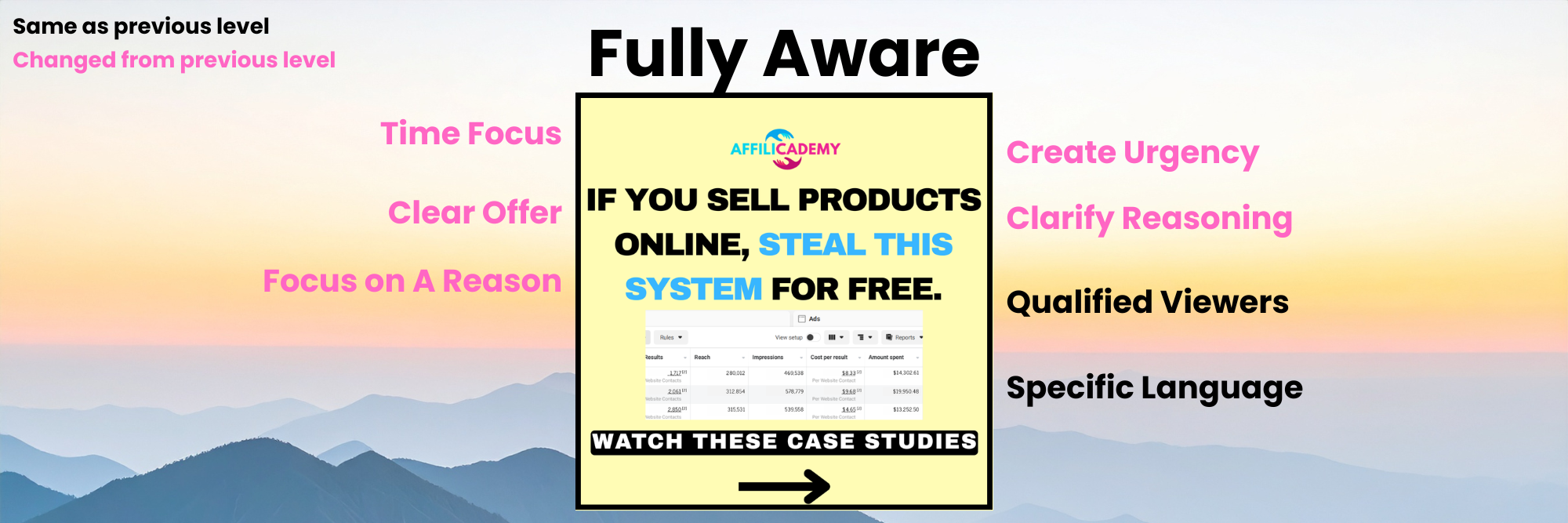
What are the differences between different brand offers?
For service offers, send directly to a booking page or purchase link. You should emphasize deadlines, limited capacity, pricing changes. You want to still layer in objection handling and proof, but it should be focused on action. Long VSLs reduce output by reiterating things people already understand, causing boredom.
For low ticket offers, this is direct response advertising. Send them to a landing page with a clear offer, with a discount if they buy a bundle. The goal is the minimum number of clicks to get a purchase.
For premium products, you want to layer in urgency heavily. Stock limits, enrollment windows, bonuses, and guarantees limited by time, all work well. Depending on the price, phone sales may be a viable option, but you want to assume they are already very interested. Focus on commitment and action.
Profitability is based on reducing friction for every level here. The more seamless the ability to purchase is, the more money you will make.
Levels of Awareness Summary - How Do Levels of Awareness Affect Advertising Choices?
If you look through all levels together, each is attempting to address a shift in the buyers internal conversation metrics. The goal is to match your messaging with each level of awareness and take advantage of the widest possible audience, increase ad spend, and funnel people to purchases over time. The closer you line up with their current state, the higher these ads perform.
Each stage requires new landing pages, creatives, VSLs, and offers. To take full advantage, you also want to layer in iteration, which I'll cover next.
Part 4 - How to Leverage Iteration
Now that you understand how to match messaging to each level of awareness, the next critical piece of long-term profitability and scaling is consistent iteration. In the last section of this article, Ill go through the strategy I use for iteration, and how to keep it on a consistent weekly schedule to prevent ad ROAS drops.
For this section, I am defining iteration as the process of making controlled adjustments to single variables from winning ads, increasing the total number of advertisements systematically. This is not guessing at what works, it is finding the variables, defining them, and testing them, and then creating more creatives over time. It is repeatable, measurable, and it increases your ad output while decreasing risk and preserving the elements that already have been proven to work.
Iteration is what turns awareness into performance that is stable over many months or years. SCALER tells you how many ads to test. Awareness tells you what message categories to test. Iteration tells you how to keep an ad campaign performing as the platforms evolve and your offer updates over time.
If you fail to iterate properly, you have increased variability month over month, and less predictable results. This means your risk increases.
Why is Iteration so Important Compared to Finding Winning ads?
Even great, winning ads, do not last forever. In the short form environment, attention drops quickly, and platforms reward fresh, new creatives. Additionally, iteration assists with the awareness section, allowing a fuller understanding of your product over time, acting as brand solidification. Iteration is the tool that allows preservation of your strongest ads, even as specific variables need updated.
With the SCALER framework, iteration accounts for 75% of your creative focus. Specifically, 50% of new ads are single variable tests of ads that are already working, and 25% are changing things about ads that didnt quite hit the mark, to improve them. the last 25% is brand new ads that you have never tested, making sure to take advantage of the potential for new opportunities and winning formulas.
This split ensures you never run out of ads, that your profitability increases over time, and that you are able to test brand new strategies which have the potential to increase your overall profit, while reducing the risk profile.
So what is the Actual Process for Testing Ads?
well, lets go back to this image.
Lets say this ad did really well. What you would do is adjust one element, and run it as an iteration. Continue to do this until you reach ad capacity. Here is an example of what that might look like.
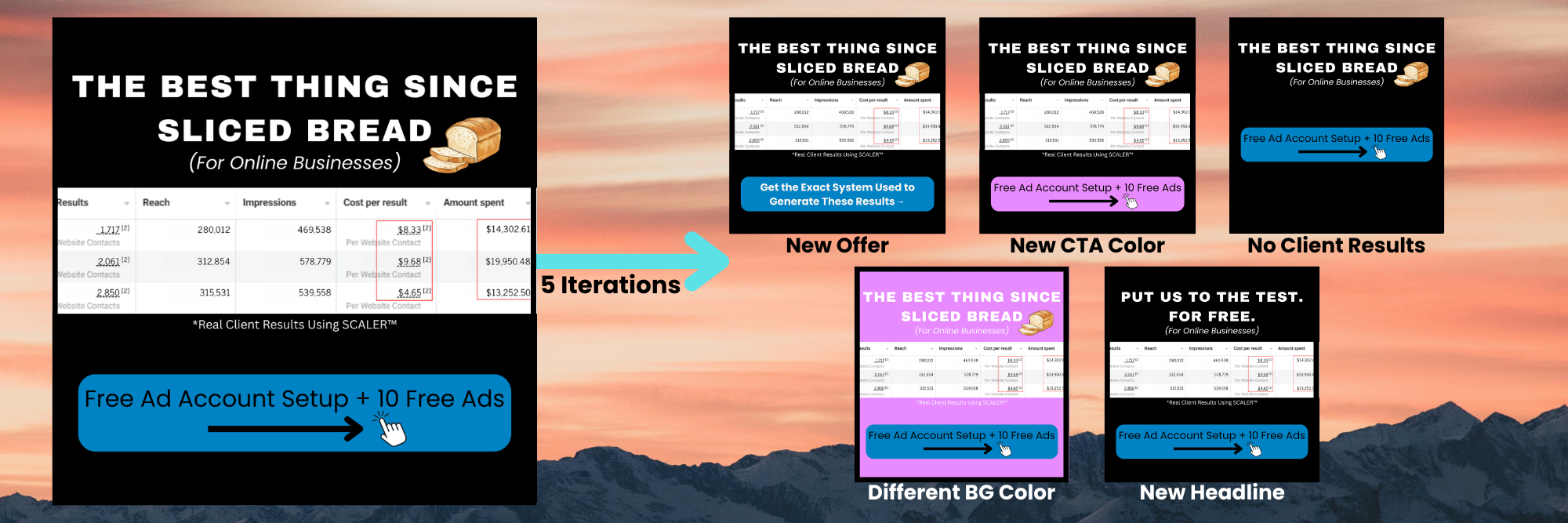
Here, you just change one element. This ensures you are actually testing for one change, not multiple. It also means when results adjust, you can measure it specifically. When you do this over many different ads, and many different variables, you begin to see patterns.
Lets say for example, that every time you test an iteration with a pink background, results are 10% better on average. This means when you create new creatives, you can make the majority of them have a pink background.
It improves your results over time. This is iteration.
This is to Complicated - How Can I Make it Simpler?
Yes, this ad strategy is complicated. That is why I can implement all of it, for free, for your business, and once it works I will take a percentage of the profits on the backend. I'll cover the cost of creating everything, managing the account, and ensure you get great results, using the SCALER framework.
If you are interested, fill out the form on our website:
Note from the author: Thank you for reading this far. The information in this article already puts you ahead of 99% of businesses advertising on Facebook right now. I know you will do great things, and good luck on the journey.

Who This Is For
Entrepreneurs, small business owners, digital marketers, and agencies who want to stop guessing and start scaling. If you’re ready to turn messy campaigns into structured, profitable systems, this is for you.

Free Resources
No upsells. Just info.

Integrity
Actually valuable info.
Learn
Diagnose
General Resources
Copyright 2026. FBadsmaster.com. All Rights Reserved.