
Our Blog
This isn’t just a blog—it’s your go-to resource for mastering Facebook ads with clarity and results.
Every post is designed to turn complex ad concepts into actionable strategies that save time, prevent wasted spend, and improve ROI.
Think of it as your free playbook for structured campaigns, tested frameworks, and real-world ad insights.
News
Article & Resources
We cover the core strategies that drive results:
Campaign Structure – Learn how to organize ads for clarity, tracking, and scalability.
Optimization & Metrics – Focus on what truly impacts ROI and stop chasing vanity metrics.
Creative & Messaging – Test and refine content that resonates and converts.
Scaling Systems – Grow campaigns predictably without chaos or wasted spend.
Problem-Solving Frameworks – Quickly identify and fix inefficiencies in any campaign.
Every strategy is designed to be actionable, repeatable, and results-driven—so you can stop guessing and start scaling.
What Are the Most Common Mistakes in Paid Social Campaigns?
What Are the Most Common Mistakes in Paid Social Campaigns?
A Strategic Breakdown From Performance Marketing’s Trenches
The reason your paid advertising on Facebook and Instagram is not working is not because of your bid strategy, your audience, your targeting, or any of the other fluffy keywords that seem impossible to optimize for. The reason your ads aren't working is because you aren't making good enough creatives at high enough volume to scale.
When marketers ask what are the most common mistakes in paid social campaigns, they’re really asking why so many initiatives plateau, collapse at scale, or deliver volatile performance. The answer is that most paid social efforts fail because they lack a strategic test architecture, disciplined evaluation mechanism, and a process that turns randomness into repeatable wins.
This article reframes the question, explains the core mechanism driving paid social performance, deconstructs recurring mistakes, and presents a structured framework that turns mistakes into predictability. I’ll be referencing the SCALER framework, outlined here, to handle creative volume, as well as the creative iteration strategy recommended by Affilicademy.
At the end you will have the information needed to create high quality creatives, setup your ad account properly, iterate and increase your total ad results, and most importantly, know why these strategies actually work.
The Core Mechanism Behind What Makes Paid Social Work
At the heart of any paid social campaign that consistently works lies a simple but non‑obvious mechanism: disciplined variation and evaluation against clear performance thresholds.
Paid social platforms, especially Facebook/Instagram, are fundamentally statistical engines. Specifically they look for signal from your statistics such as CTR and conversion rate. This is what allows you to take advantage of that system:
Sufficient Testing Volume - you must generate enough impressions, link clicks, and data points for the platform’s algorithm to learn what resonates.
Controlled Creative & Message Variation - you must change only one variable at a time (or in statistically controlled batches) to understand what’s actually moving performance.
Clear Evaluation Thresholds - you must define what success looks like before testing, so you can accelerate winners and kill losers without bias.
Iteration With Store of Knowledge - each test’s learnings must feed the next cycle, building strategic memory rather than random guessing.
If any of these elements are missing, paid social advertising does not teach you what works for your brand. The confusion creates inconsistent results, wasted spend, and the illusion that Facebook ads are too expensive, unpredictable, or “not right for me.”
Contrast this with what doesn’t work in practice:
Random creative swaps with no hypothesis.
Scaling based on impressions rather than outcome signal.
Optimizing campaigns on early volatile data.
Running too few variations to overcome platform learning thresholds. (anything less than 10 ads per week.)
Success in Facebook advertising is process‑driven, not intuition‑driven.
Common Mistakes / Misconceptions in Paid Social Campaigns
Below is a breakdown of the recurring structural mistakes I see in campaigns, why they occur, what actually happens, and what the correct strategic response is.
Mistake 1: Not Testing Enough - Even When it Seems Like a Lot.
Why people make this mistake
Marketers believe that one or two ads is “enough to learn.” They think budgets should be concentrated on a small number of creatives to “avoid fragmentation.” They prioritize efficiency before establishing effectiveness.
What actually happens in practice
With too few ads, you can not test enough variables in a short enough time period for it to be effective. You need creative diversity to know what actually is impacting performance. Without variation, the learning phase never completes, performance plateaus early, and optimization is impossible.
What the correct structural approach looks like
Paid social campaigns must be designed as structured testing machines. This means:
Running 8–16 initial variations at minimum.
Each variation changes a controlled element (headline, hook, CTA, value angle).
Each variation is tested to a statistically meaningful learning threshold (not just a handful of impressions).
You do not test until you win; you win by testing.
Mistake 2: Creative Templates Are Under Utilized or Forgotten Entirely
Why people make this mistake
Marketers outsource creative to designers or agencies and expect random aesthetics to drive performance. They believe “good design” equals “good ad.” Pretty ads almost never are the reason for performance. Problem targeting, messaging, and imagery aligning with the ICP is what counts.
What actually happens in practice
Beautiful creatives often flop. Conversely, structurally optimized templates with predictable message hooks perform better because they are engineered for performance, not aesthetics.
Without templates, every ad is a new test, with no variables. This means you can not reliably learn. There is no repeatable mechanism for generating winners.
What the correct structural approach looks like
Top performers use creative templates that have repeatedly shown to drive clicks and conversions. Templates are high‑leverage structural scaffolding that reduces variance and accelerates learning.
Here are some example templates I have used successfully, and an ad they turned into.
Mistake 3: Failing to Iterate on Advertising Causes Inconsistency
Why people make this mistake
Once a campaign runs, marketers prematurely scale all winning ads, tinker randomly with losing ones, or restart from scratch every month. This is easier in theory than evaluation and testing, since it requires less understanding of the causation.
What actually happens in practice
These behaviors generate random churn, not strategic evolution. Without systematic iteration, campaigns stagnate. Facebook’s algorithm adapts to whatever is present, not necessarily what is optimal for your business goals.
What the correct structural approach looks like
Iteration must be:
Based on the variables that have previously worked
Use the same template when testing
Increase the overall creative volume in a campaign
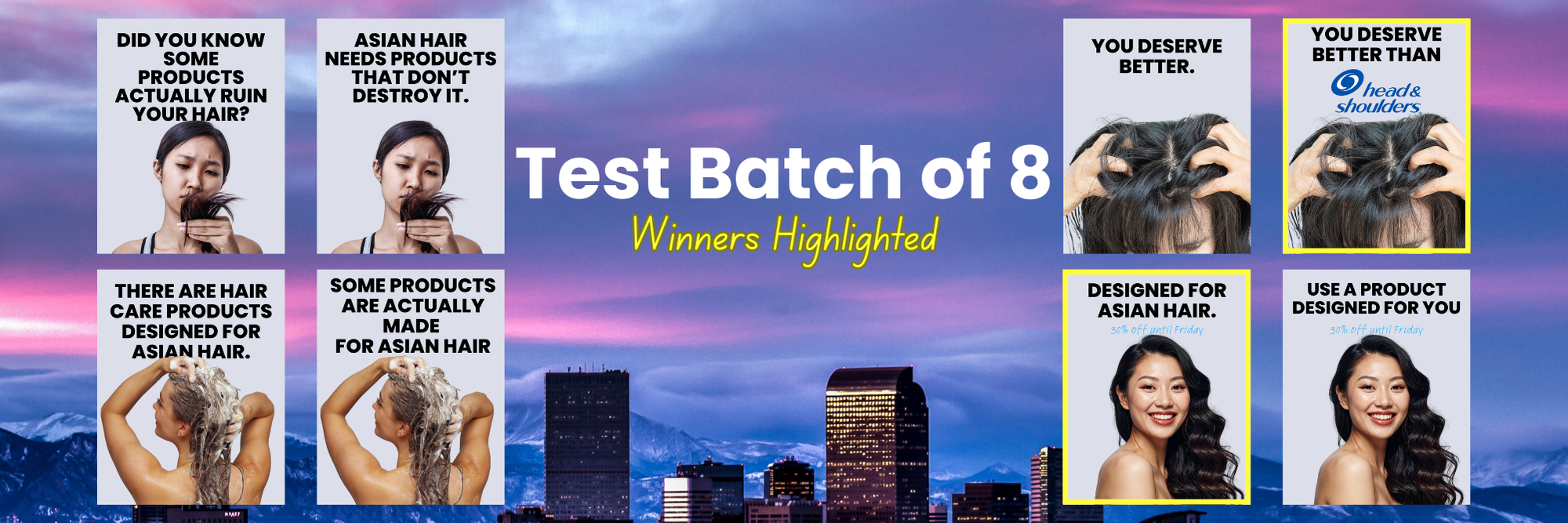
Here is a specific example. Lets say these two ads performed out of this batch of 8. What can I extrapolate from the results of this advertising sample? The first is that using the word “Asian” works better for this brand than using generalized wording. The second is that mentioning a competitor also worked well.
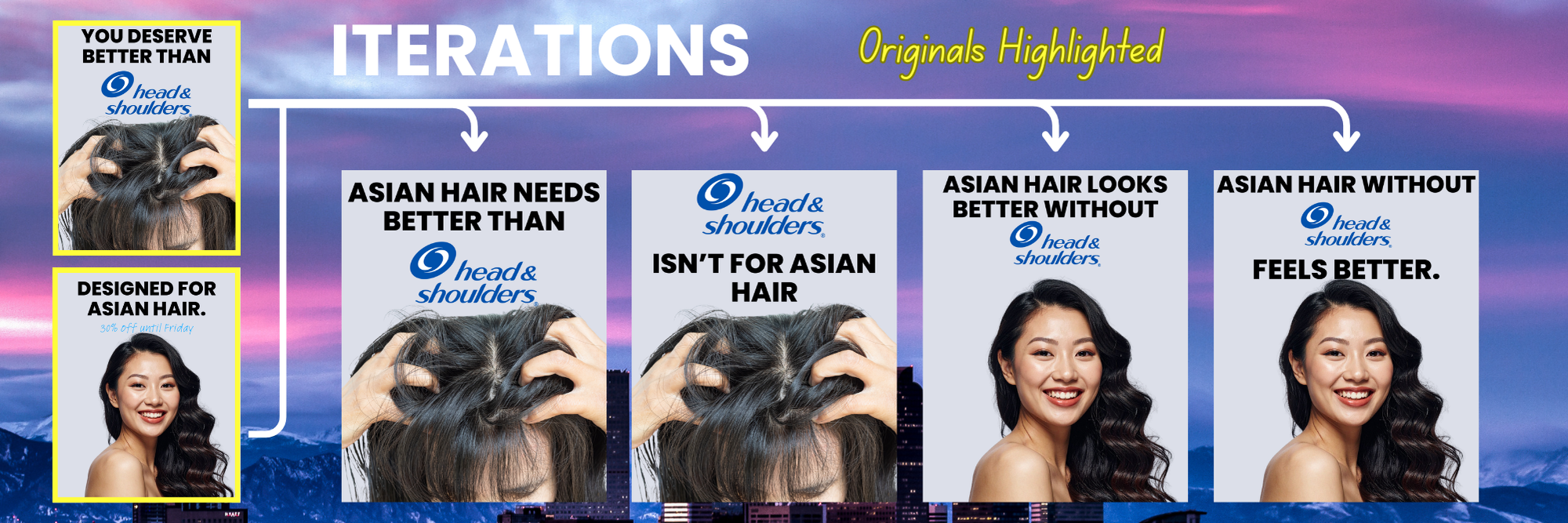
So what would proper iteration look like here? With the rule of making sure all headlines use the word “Asian” and compare to a competitor, I could create a batch of Us vs Them ads like this:
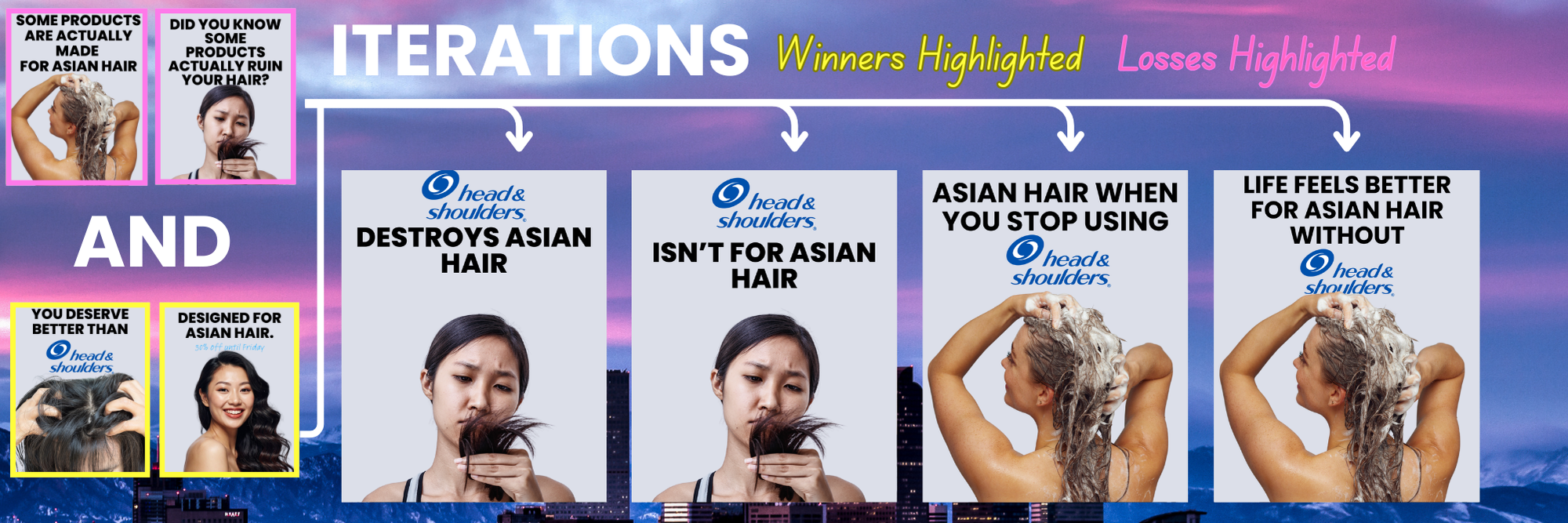
You can also iterate on ads that missed the mark, but might not with alterations and information provided by previous testing. You take the core elements of the ads that didn’t work, and adjust them to apply the new rules you are iterating. This gives you even more content to test, and the ability to confirm if those variables are important enough to change the performance of a loser ad, and convert it to a winner. That would mean it is very valuable to your audience. Here is what that might look like.
Mistake 4: Failing to Leverage and Identify one ICP per Advertisement.
Why people make this mistake
Marketers generally use target market when it comes to advertising. ICP is the better method. It defines your target as someone specific. Marketers like to use target market because it sounds good, not because it works.
What actually happens in practice
Target market is too broad. It doesn't let you focus on the specific emotional state of the viewer, and the problems they are experiencing in relation to their level of awareness. This lowers your ability to improve ad messaging.
What the correct structural approach looks like
Well‑defined ICPs (Ideal Customer Profiles) look like this.

This gives you much more to work with when creating ad messaging.
How to Set up a Profitable Facebook Ad Campaign
How Many Campaigns Should I use?
You only need to set up one campaign, and one ad set. This is because your creative does all of your targeting. If you have a clear offer, using the text on the image, Facebook will show it to the right people. Manual targeting works worse than general targeting since Andromeda is now the most advanced targeting algorithm in the world.
How so I set up the Creatives?
Place each creative as an independent ad within the ad set. Use headlines that match with the text on screen, and body descriptions that supplement the benefits of your product. Its that simple.
When do I Iterate?
The time it takes to know when to iterate is actually based on your budget. You want to spend 200% of your target CPA before deciding to turn an ad off or change it. Once you have spent the 200%, evaluate if you are getting the results you want, and either turn the add off, or don't. Its simplistic. I use a rule of if Andromeda has not generated at least one conversion at 200% of target CPA, I turn the ad off. You could be more or less strict.
Make Sure to Track Results Over Time
You want to make sure you are learning, not just changing things one at a time. Store the highest performing ads, their different variables, and how testing goes in a central document, preferably a good sheet with links to each ad. This makes organization incredibly easy and makes sure you are learning and improving.
Remember, I Do All of This for you, for Free.
If you want all your creatives created for you, by a human, to have me teach you the ads process so you can understand it for your business specifically, and manage all the ads DFY, I am happy to. The best part is I'll only take a percent of the profits generated.
Fill out the form to see if you qualify: affilicademy.com/10freeugc

Who This Is For
Entrepreneurs, small business owners, digital marketers, and agencies who want to stop guessing and start scaling. If you’re ready to turn messy campaigns into structured, profitable systems, this is for you.

Free Resources
No upsells. Just info.

Integrity
Actually valuable info.
Learn
Diagnose
General Resources
Copyright 2026. FBadsmaster.com. All Rights Reserved.