
Our Blog
This isn’t just a blog—it’s your go-to resource for mastering Facebook ads with clarity and results.
Every post is designed to turn complex ad concepts into actionable strategies that save time, prevent wasted spend, and improve ROI.
Think of it as your free playbook for structured campaigns, tested frameworks, and real-world ad insights.
News
Article & Resources
We cover the core strategies that drive results:
Campaign Structure – Learn how to organize ads for clarity, tracking, and scalability.
Optimization & Metrics – Focus on what truly impacts ROI and stop chasing vanity metrics.
Creative & Messaging – Test and refine content that resonates and converts.
Scaling Systems – Grow campaigns predictably without chaos or wasted spend.
Problem-Solving Frameworks – Quickly identify and fix inefficiencies in any campaign.
Every strategy is designed to be actionable, repeatable, and results-driven—so you can stop guessing and start scaling.

How Do I Measure the ROI of Instagram Ads?
How Do I Measure the ROI of Instagram Ads?
Key Takeaways
1. ROI is a financial output metric.
Instagram ads do not generate ROI by themselves; the underlying economics of acquisition, conversion efficiency, and margin determine whether paid traffic compounds or collapses.
2. The correct ROI calculation depends entirely on the objective.
Lead generation, direct-response eCommerce, and subscription models require different attribution windows, contribution margins, and payback expectations. ROI cannot be standardized without defining the economic goal.
3. Structured testing increases measurable ROI by increasing knowledge on targeting.
Without controlled variable isolation, defined thresholds, and sufficient creative capacity, performance data becomes statistically noisy, making ROI impossible to prove with confidence.
4. Scaling changes the math.
What appears profitable at low spend often deteriorates when frequency rises and hit rate declines. Sustainable ROI requires creative iteration systems.
5. ROI improves through compounding feedback loops.
Lower acquisition cost increases contribution margin, which funds more creative volume, which improves hit rate which creates a scalable profit engine.
1. Introduction: Measuring ROI Is a Structural Problem, Not a Reporting Problem
The question “How do I measure the ROI of Instagram ads?” is usually approached as a reporting exercise. Operators open Ads Manager, export a spreadsheet, divide revenue by spend, and assume the result reflects performance. It rarely does.
ROI on Instagram, and social media in general, is determined primarily by two numbers. Acquisition cost (CPA/Conversion rate) and LTV (the total amount of revenue generated over the life of a customer) once you take into account profit margin. Numbers like CTR, CPC, CPM help you understand how to improve your acquisition cost, but do not define it. The idea here is to use all possible information to improve your cost to LTV ratio.
ROI in digital marketing follows a simple financial formula:
ROI = (Net Profit from Ads – Ad Spend) ÷ Ad Spend
I want to clarify, since this is different than what I just said. That is your surface level ROI. It is simply what you made from the ads directly after a customer hits your website. It does not take into account what the 90 day value of a customer is, and is really only the first metric to look at.
It is also inconsistent. Your ad ROI will vary week to week, ad to ad, and has a natural level of fluctuation. Its also incredibly difficult to create ads that are profitable for small businesses who sell products in the $35-$50 range, since if your profit is only $15, you do not have a lot to work with.
This changes if you take into account the fact that once someone buys something, you can actually improve their overall value by continuing to retarget them, talk to them, and they now have some brand loyalty.
This article has already told you, technically, how to measure ROI. If you want to learn how to measure it in the best way, and how to improve it over time, the next steps are what matters.
2. The Core Mechanism Behind Measuring the ROI of Instagram Ads
If surface-level ROI is simply revenue minus spend, then the real question becomes: what structural inputs determine whether that number improves over time?
The core mechanism behind measuring the ROI of Instagram ads is the relationship between acquisition cost and lifetime value, filtered through contribution margin.
At its most practical level:
Acquisition Cost (CAC) = Total Ad Spend ÷ Number of Customers Acquired
Customer Value = Average Order Value × Purchase Frequency × Retention Window
Contribution Margin = Revenue – Cost of Goods – Fulfillment – Processing
True ROI depends on the spread between CAC and the profit-adjusted lifetime value of a customer.
If your CAC is $40 and your 90-day contribution margin per customer is $120, your system has room to scale. If your CAC is $40 and your contribution margin is $45, your system is fragile. One fluctuation in CPM or conversion rate erases profitability.
This is why CTR, CPC, and CPM do not define ROI. They influence CAC. CAC influences margin spread. Margin spread determines ROI.
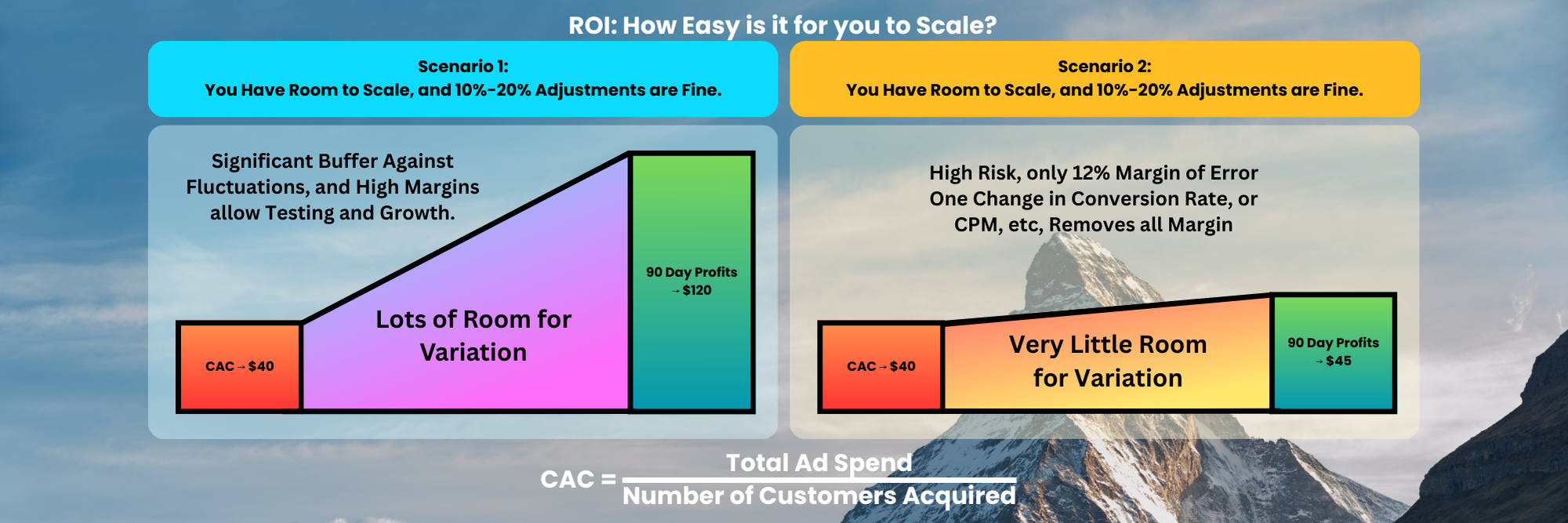
When measuring ROI correctly, you are not asking, “Did this ad make money this week?” You are asking, “What is my net CAC:LTV ratio, and is it improving?”
Structured Testing and Knowledge on Targeting
Structured testing refines targeting intelligence. Each controlled test teaches you:
Which ICP segment converts at lower CAC
Which awareness stage produces higher initial AOV
Which messaging angle increases retention likelihood
When you isolate variables properly, you are building a knowledge asset. That knowledge compresses acquisition cost over time because your targeting becomes increasingly precise.
Random experimentation does the opposite. Spending without learning increases volatility. Volatility makes ROI measurement unreliable.
The more controlled creative variations you test against a clearly defined ICP, the more accurately you can predict CAC before scaling. This keeps your margins normal, and most importantly allows you to feel confident reinvesting profit into additional advertising. If it feels like gambling I would never advertise.
Threshold Enforcement Protects Measurable ROI
To measure ROI properly, you must define acceptable ranges before launch. For example:
Minimum CTR required to continue testing
Maximum CAC allowed relative to 90-day LTV
Required conversion rate for scaling
If your CAC exceeds the allowable percentage of contribution margin, the campaign stops. No debate. No “waiting for learning.”
Note from the author: I know there is a learning phase with Facebook, but with Andromeda in 2026 that learning phase is a few hours/few thousand impressions NOT a few weeks. It should cost you less than 200% of target CAC to know if an ad is working. If you are spending money and not making it back, turn the damn ad off.
This creates a controlled performance environment where ROI becomes measurable because inputs are constrained. To tie this back to the core question “How do you measure ROI,” This allows you to actually know what your ROI is consistently, so that you can create projections, and feel confident in the calculation.
Profit-Based Scaling Logic
Scaling is increasing budget only when incremental spend produces incremental profit.
As spend increases, CAC typically rises due to audience expansion and frequency. If your LTV spread is thin, scaling compresses ROI. If you think about the graphic, if your margin is 5$ and your CAC increases by 10% (very normal when expanding campaigns) you now make 1$ per purchase. Not really worth it. If you go from $80 down to $75 its not a big deal.
Therefore, the system must continuously widen the spread between CAC and contribution margin through:
Improved targeting intelligence
Creative iteration
Backend monetization improvements
This is important for getting measurable ROI from Instagram ads because when acquisition cost and lifetime value are structurally aligned and continuously optimized, ROI becomes a controllable financial variable rather than a fluctuating dashboard metric.
3. Common Structural Mistakes and Misconceptions
When businesses ask, “How can I prove the ROI of social media?”, the failure is almost always a lack of understanding on why ROI is valuable.
Mistake 1: Measuring ROI on Revenue Instead of Profit
Revenue-based ROAS inflates perceived success. If you generate $20,000 in revenue on $10,000 in ad spend, it appears you have a 2.0x return. But if cost of goods and fulfillment total $9,000, your actual profit before ad spend is $11,000. Subtract ad spend and you are left with $1,000 in net profit.
That is a 10% ROI, not 100%.
The performance consequence is premature scaling on fragile economics.
The correct structural approach is contribution-margin-based ROI. Always subtract product cost, shipping, and transaction fees before evaluating ad profitability.
ROAS is good to understand if your offer is interesting to an audience, since they do not know your profit margin. For actual math and scaling, its effectively useless.
Mistake 2: Ignoring the 90-Day Value of a Customer
Surface ROI only measures immediate transaction value. It does not account for repeat purchases, upsells, cross-sells, or subscription continuity.
If you sell a $45 product with $15 profit, direct ROI may be negative at first purchase. But if the average customer purchases three times in 90 days, your true contribution margin increases dramatically.
Operators who ignore post-purchase monetization underestimate ROI and restrict scaling unnecessarily.
The correct structural approach is to measure ROI at multiple windows: day 1, day 30, day 90. That allows you to determine whether front-end break-even acquisition is viable given backend monetization.
This also helps you attract lines of credit if needed. Many product-based businesses are capital intensive, and restricted by your ability to buy products ahead of time. If you can prove to a bank your 90 day ROI is 3.5x, it’ll be a lot easier to get a loan to buy inventory and increase net income vs if you go to them with a “plan” on how to improve it.
Mistake 3: Scaling Without Creative Replacement Capacity
When a campaign is profitable, operators increase budget without increasing creative volume. Frequency rises. Conversion rate drops. CAC increases. This is because many people do not take into account the face Meta is showing your ads to the most profitable audience first. When you increase budget, the audience is less aware and less profitable.
They interpret this as “Instagram ads stopped working.”
What actually happened is just levels of awareness. You need wider ad targeting, a better offer, and better lead nurture.
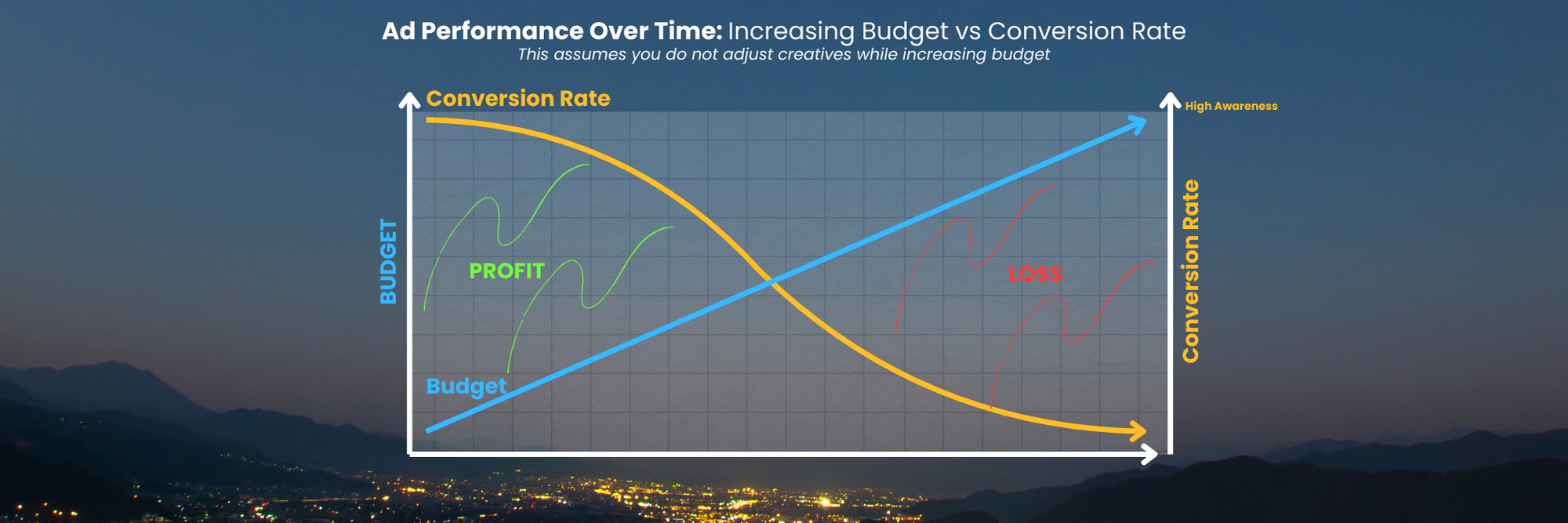
The correct structural approach is to scale creative production in proportion to spend. Creative capacity must increase as budget increases.
Mistake 4: Conflating Targeting Expansion with Optimization
Expanding targeting does not equal improving performance. Broad targeting at higher spend introduces lower-intent users, raising CAC.
Operators assume scale requires broader audiences. In reality, scale requires deeper message-to-market alignment and creative volume within defined ICP segments.
The balance is increasing the targeting by targeting people who are qualified for your product, but not as aware. Let’s say you sell parachutes. “I wonder if Parachutes 360 is best for me?” is product aware. “I wish I had a better parachute. This one always makes me nervous.” is problem aware. There are a lot more people who could be targeted who don’t know about YOU vs just more people in general.
Mistake 5: Reactive Optimization
Turning campaigns on and off daily, editing multiple variables simultaneously, and reacting emotionally to short-term fluctuations destroys data integrity.
ROI fluctuates naturally. Without statistical patience and predefined thresholds, performance interpretation becomes chaotic.
The correct structural approach is disciplined iteration cycles with defined evaluation windows.
This is important for getting measurable ROI from Instagram ads because eliminating structural errors stabilizes CAC and clarifies LTV spread, making financial return provable and repeatable.
4. Why Most Efforts Collapse at Scale (Advanced Pitfalls)
Instagram ads often appear profitable at low daily spend and then deteriorate as budgets increase. This is a structural capacity issue.
Creative Fatigue and Frequency Compression
At low spend, ads are shown to the highest-propensity segment of your audience. As spend increases, impressions repeat. Frequency rises. Novelty declines. This is only an issue if your frequency increases massively, but is still a factor.
Conversion efficiency drops. CAC rises. Margin compresses.
Without ongoing creative iteration, ROI deteriorates mechanically.
Note from the author: I felt like I had to address creative fatigue since I head a lot of people talk about it. It takes 11+ views from one person to generate sales a lot of the time. If your frequency is less than ~10-15 you are totally fine. If your ads are good they can support a very high frequency.
Audience Expansion Mechanics
As you scale, the algorithm expands into lower-intent segments to fulfill budget allocation. Lower intent equals lower conversion rate.
Lower conversion rate equals higher acquisition cost.
If your margin buffer is thin, the system collapses under scale pressure.
This is the number one reason that your ROI will decrease vs creative fatigue.
Declining Hit Rate
Hit rate is the percentage of creatives that meet defined thresholds. At low spend, a small number of strong creatives may sustain performance. At high spend, you need a larger inventory of validated ads.
If creative throughput does not increase, fatigue outpaces replacement.
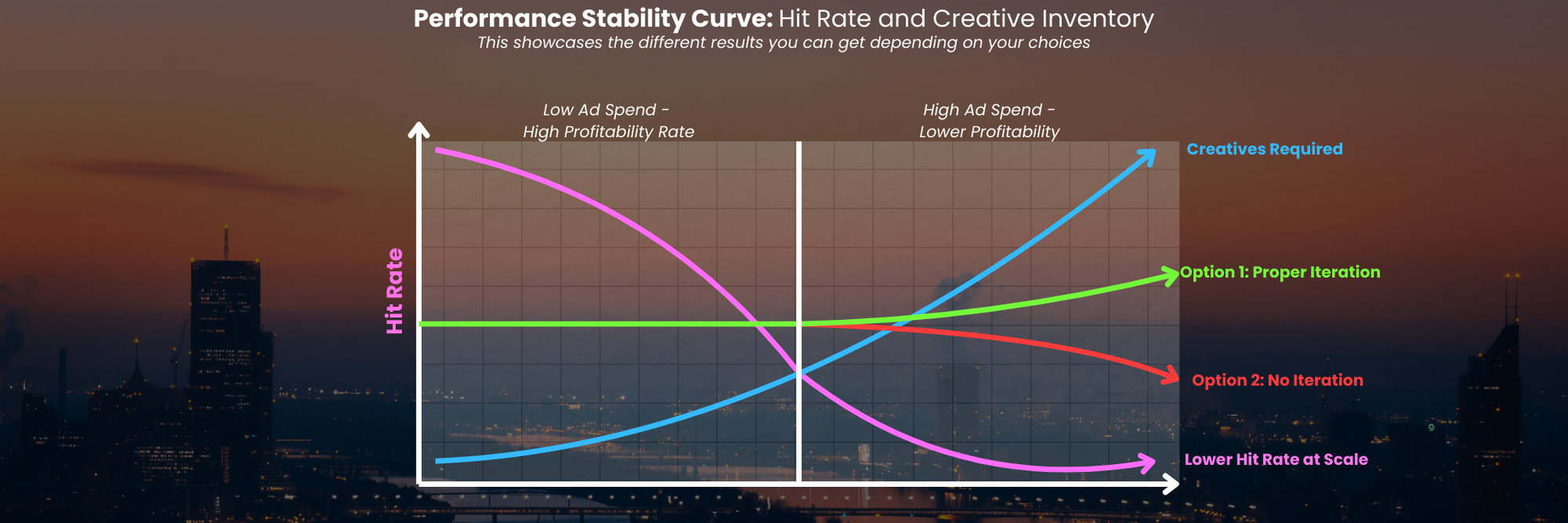
Scaling is therefore a creative and targeting intelligence problem, not a budget problem. More targeting requires more creatives and iteration.
This is important for getting measurable ROI from Instagram ads because scale amplifies structural weaknesses, and without creative capacity and targeting precision, CAC rises beyond profitable thresholds.
5. The Correct Strategic Framework for Measuring and Improving ROI
To measure and improve ROI systematically, the acquisition system must be engineered around controllable financial inputs.
1. Define the Precise ICP
Narrow ICP definition reduces variance in conversion behavior. Reduced variance improves predictability in CAC. Specifically when you define the ICP focus on qualifying problems they are experiencing that you can put into words. “Tired” is not great, “Consistent exhaustion during the day which impact your ability to work efficiently” is good. The formula for this is “[Symptom] at [time] which impacts [activity]” which gives you a lot to talk about.
2. Align Messaging to Awareness Stage
Cold audiences require problem articulation. Warm audiences require proof. Hot audiences require friction reduction or a reason to buy now, I.E. a time based sale.
Alignment increases conversion efficiency, lowering acquisition cost.
3. Implement a Controlled Creative Testing Matrix
Test one variable at a time within a defined structure. Maintain consistent targeting when testing messaging. Maintain consistent messaging when testing audience segments.
Each test should increase knowledge about targeting precision.
This is elaborated on with this article: affilicademy.com/post/mistakes
4. Define Performance Thresholds Before Launch
Set maximum allowable CAC relative to 90-day contribution margin. Define minimum acceptable CTR and conversion rate.
Campaigns that fail are replaced.
5. Measure Multi-Window ROI
Track:
Immediate ROI
30-day ROI
90-day ROI
This provides clarity on whether front-end break-even is justified by backend monetization. Throughout this article I have focused on the 90 day ROI, but if you can be consistently profitable in 30 days, you can use the magical tool of a credit card to put ads on, then pay it off before 30 days, leveraging external capital without needing bank approval. This is risky if you are not consistent, but one of the highest leverage tools I have ever used.
6. Scale Creative Capacity with Budget
If the budget increases 50%, creative testing volume must increase proportionally. Otherwise, fatigue erodes margin. Think of it as with more budget you have more views/conversions, which means you can test more, and you should.
7. Reinvest Profit to Expand the Gap
As CAC decreases and LTV increases, reinvest surplus margin into further testing and customer retention initiatives.
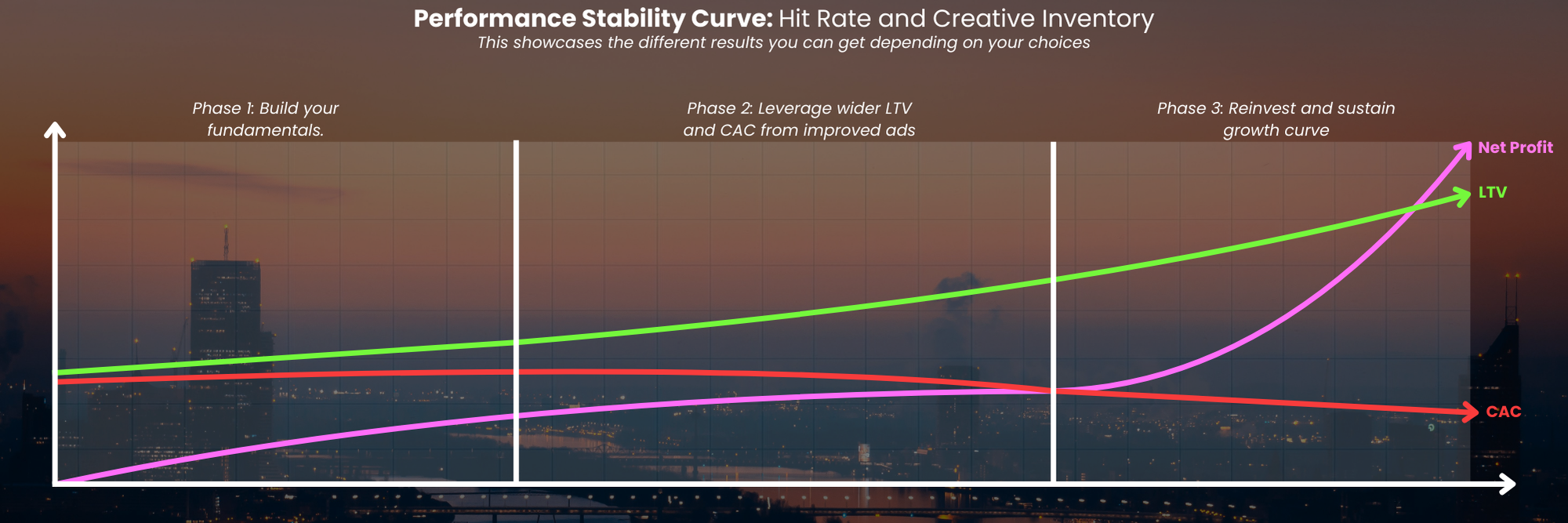
The goal is to widen the gap between acquisition cost and lifetime value, which will increase your total profit.
This is important for getting measurable ROI from Instagram ads because a structured framework transforms ROI from a volatile metric into a controllable compounding system.
6. The Summary (the most Important parts)
Measuring the ROI of Instagram ads is simple mathematically and complex structurally.
The math is:
ROI = (Net Profit – Ad Spend) ÷ Ad Spend
The structure is what determines whether that number improves or deteriorates over time.
If acquisition cost exceeds contribution margin, no optimization trick will save the system. If LTV is not measured across meaningful windows, ROI will appear inconsistent. If creative capacity does not scale with budget, performance will collapse at higher spend levels.
Predictability comes from disciplined testing, threshold enforcement, and continuous improvement of the CAC-to-LTV spread.
When targeting knowledge improves, CAC decreases. When backend monetization improves, LTV increases. When both move simultaneously, ROI compounds.
This is important for getting measurable ROI from Instagram ads because sustained profitability emerges only when acquisition cost and lifetime value are engineered to widen over time rather than fluctuate unpredictably.
10 for 10 - Do you want Personalized Help for Instagram Ads?
Inside Affilicademy, we build the actual testing system that improves your CAC to LTV spread over time.
And right now we’re running the 10 for 10 offer.
We’ll create 10 structured, conversion focused ads for 10 minutes of your time (to learn about your business and customize the ads) so you can see how our framework performs inside your account.
No fluff.
No random creatives.
No guessing.
Just controlled testing built to lower acquisition cost and increase margin.
If your ads have been inconsistent, if scaling keeps breaking, or if you’ve never truly validated your targeting, this is the cleanest way to find out what your account is actually capable of.
Fill out the form to see if you qualify: affilicademy.com/10freeugc
FAQ below
FAQ
What is ROI in social media, and what is considered a good return?
ROI in social media measures the net profit generated from your social media investment relative to its cost. The correct formula is:
ROI = (Net Profit from Campaign – Campaign Cost) ÷ Campaign Cost.
Net profit must be calculated using contribution margin, not revenue alone, meaning you subtract cost of goods, fulfillment, processing fees, and any variable delivery costs before evaluating performance. ROI should also be measured across defined time windows (for example, day 1, day 30, day 90) to account for repeat purchases and lifetime value expansion.
A “good” social media ROI depends entirely on margin structure and business model. Many direct-response brands aim for a 2.0x–3.0x return on contribution margin within 30–90 days, provided acquisition cost remains below roughly 30–40% of LTV. The correct benchmark is not industry averages, but whether your CAC-to-LTV spread is wide enough to scale profitably.
How can I prove and accurately measure the ROI of social media (paid and organic?)
To prove the ROI of social media, you must link performance directly to financial outcomes, not vanity metrics. For paid campaigns like Instagram ads, track conversions using platform analytics, UTM parameters, and pixel-based attribution. Calculate contribution margin per customer, then compare total margin generated against total campaign spend across defined attribution windows.
For organic efforts, estimate ROI by attributing leads, sales, or assisted conversions to content using analytics platforms, then compare revenue impact to the cost of content production and management. Engagement metrics such as clicks, shares, and follower growth are diagnostic indicators, but ROI must ultimately be tied to revenue and profit.
To measure ROI using KPIs, prioritize conversion rate, cost per acquisition (CPA), average order value (AOV), and lifetime value (LTV). These directly influence acquisition cost and margin spread. When CAC consistently remains below contribution margin across multiple time windows, ROI is not just calculated — it is structurally validated.
How do I measure the ROI of Instagram using a calculator?
Use a marketing ROI calculator that includes the following inputs: total ad spend, total revenue generated, cost of goods sold, fulfillment costs, payment processing fees, and repeat purchase rate. First calculate contribution margin per customer. Then multiply by total customers acquired to determine total contribution margin. Subtract ad spend to calculate net profit, and apply the ROI formula.
For accurate measurement, calculate ROI at multiple intervals (immediate, 30-day, 90-day) to understand whether front-end break-even acquisition is supported by backend monetization.
What is the ROI of social media marketing in practical terms?
The ROI of social media marketing varies by model, but many efficient systems generate $3–$4 in contribution margin for every $1 spent once acquisition and retention are optimized. However, this outcome is not guaranteed by platform usage alone. It depends on disciplined targeting, structured creative testing, defined performance thresholds, and backend value optimization.
The real determinant of ROI is not impressions or engagement volume, but whether acquisition cost remains sustainably below lifetime contribution margin.
How can I measure the ROI of social media customer support or management platforms?
For customer support, measure ROI by comparing operational cost against measurable benefits such as reduced resolution time, improved retention, increased repeat purchase rate, and customer lifetime value expansion. If support interactions measurably increase retention or upsell rate, that incremental margin can be attributed to support investment.
For social media management platforms, quantify time saved, workflow efficiency improvements, increased publishing consistency, and measurable growth in leads or conversions. Translate these outcomes into financial impact and compare against platform cost. ROI exists only when operational leverage produces margin expansion or revenue growth that exceeds expense.
How can I track social media ROI beyond vanity metrics?
To move beyond vanity metrics, focus on measurable business outcomes tied to revenue: conversions, qualified leads, average order value, repeat purchase rate, and customer lifetime value. Use structured attribution models, conversion tracking, and defined performance thresholds.
Engagement metrics are useful for diagnosing message resonance and audience interaction, but they do not define ROI. Only profit-based outcomes relative to total cost determine whether social media investment is economically justified.

Who This Is For
Entrepreneurs, small business owners, digital marketers, and agencies who want to stop guessing and start scaling. If you’re ready to turn messy campaigns into structured, profitable systems, this is for you.

Free Resources
No upsells. Just info.

Integrity
Actually valuable info.
Learn
Diagnose
General Resources
Copyright 2026. FBadsmaster.com. All Rights Reserved.