
The Simplest Way to Improve Meta Ads
Diagnose Frequency and Awareness on Meta Ads: A Systems-Based Framework for Ecommerce Operators
Qualifying Section
If you are a small business owner running Facebook or Instagram ads and you are watching your CPA rise, your ROAS erode, or your winning creatives suddenly stop converting, this article is written for you. These symptoms are rarely caused by platform instability. They are almost always caused by structural problems with frequency management and audience awareness alignment — two diagnostic variables that most operators do not measure systematically.
FBAdsMaster provides free educational resources for small business owners who want to run Meta ads using structured acquisition systems. The frameworks in this article are derived from real campaign execution, not theoretical best practices. At the end of this article, you will find information about a partnership with Affilicademy that may be relevant if you are looking for performance-based ad management support.
Just the Most Important Bits
What does it mean to diagnose frequency and awareness on Meta ads? Diagnosing frequency and awareness means identifying whether your CPA increase or creative fatigue is caused by overexposure to the same audience, delivery shifting into colder audience segments, or a mismatch between your ad messaging and where a given user sits in the decision-making process.
Why does my best-performing ad suddenly stop working? Meta's delivery algorithm, known as Andromeda, prioritizes the highest-intent segment of your audience first. Once those users are reached, delivery expands into lower-intent segments. An ad built for a purchase-ready audience will underperform when shown to someone who has not yet identified a need. The ad did not change. The audience composition did.
What is the relationship between frequency and creative fatigue? Frequency measures how many times the same user has seen a specific ad. As frequency climbs beyond the threshold where repetition builds recognition, it begins to produce diminishing returns and eventually negative signals. Meta interprets declining engagement as a quality indicator and reduces delivery efficiency.
What is hit rate and how does it affect my creative system? Hit rate is the percentage of tested ads that meet your predefined performance benchmark. It determines how many creatives you need to produce to generate a target number of winners. A 20% hit rate means you must test five ads for every one winner you need in rotation.
How do I know whether my performance problem is a frequency issue or an awareness mismatch? A frequency problem produces declining CTR on a fixed audience with rising CPM. An awareness mismatch produces acceptable CTR but poor conversion rates, because the ad is attracting clicks from users who are not ready to act. Both require different corrective inputs.
How many creatives should I be testing weekly? Testing volume is a function of your hit rate and your required number of winning ads. Divide your desired winners by your hit rate to calculate minimum testing volume. At a 20% hit rate, generating four working ads per week requires testing twenty.
What should I do when CPA rises after a budget increase? A budget increase forces Andromeda to expand delivery volume, which pushes ads into colder audience segments. The correct response is to introduce creative designed for lower-awareness audiences — not to kill the campaign and restart from zero.
What CPM increase signals a frequency or delivery problem? A CPM increase of 30% or more relative to your 14-day baseline, accompanied by a CTR decline of similar proportion, is a structural signal that frequency or audience saturation is affecting delivery. This warrants a creative rotation, not a targeting change.
Introduction
Diagnosing frequency and awareness on Meta ads is the process of identifying which structural variable is responsible for performance decline in a running campaign. Frequency and audience awareness level are the two most commonly misdiagnosed causes of CPA deterioration among small business owners. Most operators respond to rising CPAs by changing offers, adjusting budgets, or rebuilding campaigns — interventions that address symptoms rather than causes.
This article explains how Meta's Andromeda delivery system interacts with frequency and awareness, how to read the diagnostic signals correctly, and how to build a creative testing system that keeps both variables inside acceptable operating ranges. The framework is grounded in real ecommerce campaign data and follows the acquisition math that FBAdsMaster applies across its operator playbooks.
How Meta's Andromeda Algorithm Creates Frequency and Awareness Problems
Meta's Andromeda algorithm governs ad delivery by building a probability map of who is most likely to complete a conversion event. When a campaign launches, the algorithm begins delivery with the users who have the highest conversion probability given the creative, the offer, and the account's historical data. This means that early campaign results are structurally skewed toward the best-available audience segment — the users who are already product-aware, have demonstrated relevant purchase intent, and are in active decision-making mode.
This design creates two predictable performance patterns that operators consistently misread.
The first pattern is early strong performance followed by progressive CPA increases. This is not algorithmic instability. It is the natural consequence of Andromeda working through the highest-probability segment of an audience first and then expanding into lower-probability segments. The creative does not need to be replaced. The messaging does need to evolve to reach colder, less-aware users.
The second pattern is frequency-driven creative fatigue. When the same creative is in rotation for an extended period without new creative entering the account, the algorithm repeatedly serves the same ad to the same users. Frequency climbs, CTR declines, and Meta's engagement signals push CPMs higher. The algorithm interprets declining engagement as a signal that the ad is poor quality, which reduces delivery priority and increases cost per impression. Operators who do not maintain consistent creative rotation create this condition themselves.
Understanding that both patterns are structural, not random, is the foundation of correct diagnosis.
What Awareness Level Targeting Actually Means in Practice
Eugene Schwartz's awareness framework, widely used in direct response advertising, identifies five stages through which a buyer moves before completing a purchase: unaware, problem-aware, solution-aware, product-aware, and fully aware. Each stage requires fundamentally different messaging because the user's available information, skepticism level, and decision-making context are different.
The operational significance of awareness levels in Meta advertising is that Andromeda can reach users at any of these stages, and it will do so increasingly as campaign budgets scale. An ad written for a product-aware user — someone who already understands the product category and is evaluating options — will produce poor conversion rates when delivered to a problem-aware user who has not yet identified that your product category solves their problem.
Most operators run one or two ad variants targeting the same awareness level. When Andromeda's delivery shifts into colder audience segments as budgets increase or as the warm audience is exhausted, those operators see conversion rates fall and assume their offer or creative is the problem. The actual problem is a gap in awareness-level coverage. The warm, purchase-ready audience has been served. The remaining delivery volume is going to users who need different information before they will convert.
A properly structured campaign contains creative variants for multiple awareness levels simultaneously. As the budget scales and delivery reaches broader segments, there are ads in rotation designed to convert users at those stages. CPA does not necessarily spike because the new audience isn't as warm — CPA stays manageable because the system anticipated the audience composition change and prepared for it.
Real Campaign Data: Four Ecommerce Stores
The following data comes from campaigns I have managed directly. Each store illustrates a different diagnostic scenario involving frequency, awareness, or hit rate.
Store 1: Home Fitness Equipment — Resistance Band Sets
Store Overview This store sold bundled resistance band sets at a retail price of $47. COGS was $11 per unit. Gross margin was 77%. AOV was $54 (customers frequently added a carrying case). LTV over 90 days was approximately $71, driven by consumable accessory repurchases.
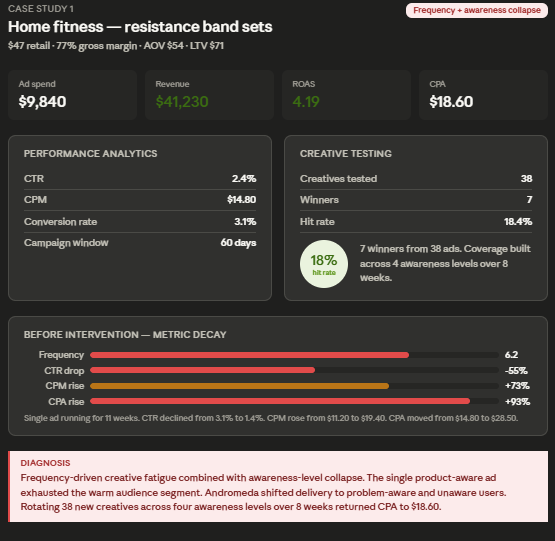
Diagnostic Insight This account arrived with a single ad that had been running for 11 weeks. Frequency had reached 6.2 on the primary audience segment. CTR had dropped from an initial 3.1% to 1.4%, and CPM had risen from $11.20 to $19.40 over the same period. The CPA had moved from $14.80 to $28.50. The operator assumed the offer had become uncompetitive.
The diagnosis was frequency-driven creative fatigue combined with awareness level collapse. The single ad was written for a product-aware audience. Andromeda had exhausted that segment and was delivering to problem-aware and unaware users who were not converting on product-comparison messaging. After rotating in 38 new creatives across four awareness levels over 8 weeks, CPA returned to $18.60 and held through budget increases.
Store 2: Skincare — Brightening Serum Subscription
Store Overview This store sold a brightening serum as a subscription product. First-order retail price was $39 (introductory). Recurring monthly price was $49. COGS per unit was $8.50. Gross margin on first order was 78%; subscription margin was 83%. AOV at checkout was $52 including a frequently purchased SPF add-on. 6-month LTV was $198 based on a 62% subscription retention rate.
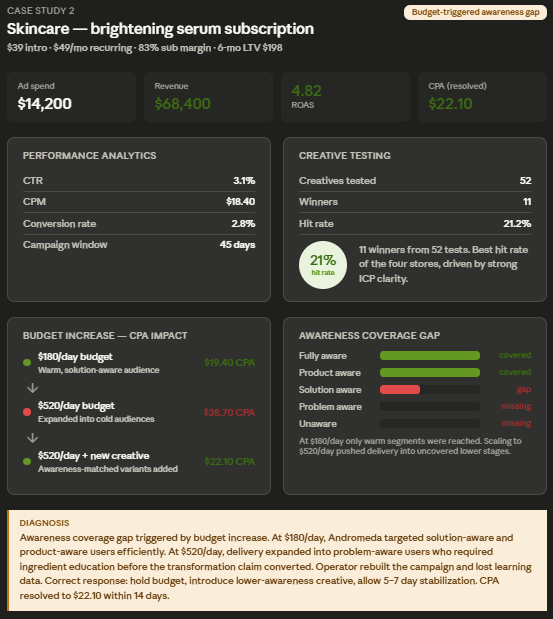
Diagnostic Insight This account had strong early numbers that degraded after a budget increase from $180 to $520 per day. CPA moved from $19.40 to $38.70 within 10 days of the increase. The operator pulled the campaign and rebuilt it, which wiped the learning data and required a full re-learning period.
The actual problem was an awareness coverage gap triggered by the budget increase. At $180 per day, Andromeda was efficiently reaching a warm, solution-aware audience that responded well to the transformation-focused creative. At $520, the audience expanded into problem-aware users who needed education on the ingredient mechanism before the transformation claim was credible. Introducing solution-aware and problem-aware creative variants, while holding the budget at $520 for a stabilization period, resolved the CPA deterioration within 14 days.
The Hit Rate Framework: Calculating Your Creative Production Requirements
Hit rate is the percentage of tested ads that meet a predefined performance benchmark. This single metric controls every variable in your creative system: production volume, budget allocation for testing, and how quickly you can respond to performance drops.
The calculation is direct:
Required Ads to Test = Desired Winning Ads ÷ Hit Rate
If you need 10 winning ads in active rotation and your hit rate is 20%, you must test 50 ads. If your hit rate is 10%, you must test 100. The math does not change based on platform conditions, seasonal periods, or how long you have been advertising.
Industry benchmarks cited in agency reporting frequently place hit rates at 2%. This reflects systems that lack structured testing methodology and clear creative frameworks. A 2% hit rate means producing 500 ad tests to generate 10 winners. At $100 per creative, that is $49,000 in non-performing creative spend to generate $1,000 in usable assets. This is not a workable operating model for a small business.
A structured system built around Ideal Customer Profile clarity and awareness-level targeting should consistently produce hit rates in the 15–25% range. The four store examples above reflect hit rates of 18.4%, 21.2%, 12.5%, and 18.2% respectively. The 12.5% result from Store 3 corresponds to a system that had allowed creative rotation to lapse, which eroded system performance over time and skewed the testing sample.
The frequency at which new creatives must enter rotation is proportional to daily spend. A ratio of one new creative per $5 of daily ad spend provides a practical production target. At $100 per day, 20 new creatives per month enter the system. At $500 per day, 100 creatives per month must enter the system to maintain frequency, awareness coverage, and algorithm signal quality.
Practical Implementation: How to Diagnose and Correct Frequency and Awareness Issues
Step 1: Pull the Diagnostic Metrics
Before adjusting any campaign, extract the following data at the ad level for a 14-day window:
Frequency
CTR (link click rate)
CPM
CPA
Conversion Rate
Compare current values to your 30-day trailing average. An increase in frequency above 3.5 on a primary audience, combined with a CTR decline of 20% or more, indicates frequency-driven fatigue. A stable CTR combined with a rising CPA indicates an awareness mismatch — traffic is arriving at the landing page but not converting, which points to a messaging gap between the ad and the purchase stage.
Step 2: Classify the Problem Type
Frequency problem: The same user is being served the same ad too many times. Solution is creative rotation — new variants must enter the account immediately.
Awareness mismatch: Delivery has shifted to colder audience segments, and the existing creative pool does not contain messaging appropriate for those segments. Solution is creative development at the relevant awareness stages, not campaign restructuring.
Budget-triggered expansion: A recent budget increase pushed delivery into broader audience segments faster than the creative system could adapt. Solution is to hold the budget at its current level, introduce lower-awareness creative, and allow Andromeda to re-optimize over a 5–7 day stabilization period before evaluating performance.
Step 3: Calculate Your Required Testing Volume
Define how many winning creatives you need in active rotation. Measure your current hit rate from your most recent testing batch. Apply the formula to determine weekly and monthly creative production requirements. This converts creative decisions from reactive guesswork to scheduled production.
Step 4: Build Awareness-Level Coverage
For each product, write creative variants addressing each relevant awareness stage:
Unaware: Addresses a latent problem or desire without mentioning the product. Introduces the problem frame.
Problem-aware: Acknowledges the problem explicitly and introduces the product category as a solution.
Solution-aware: Presents your specific product as the superior option within the category.
Product-aware: Provides proof, specifications, or social validation for users actively comparing options.
Fully aware: Presents the offer directly — pricing, urgency, and conversion incentives.
Most small accounts need three to four of these five stages covered to support scaling through audience expansion.
Step 5: Monitor and Iterate Weekly
Review frequency, CTR, CPM, and CPA at the ad level once per week. Flag any creative where frequency has exceeded 3.5 and CTR has declined more than 20% from its peak. Retire those creatives from primary rotation and replace them with new variants. Track hit rate across each testing batch. If hit rate falls below 10%, audit the messaging framework — a low hit rate is a signal about creative quality and ICP alignment, not platform conditions.
Common Structural Errors in Frequency and Awareness Management
Running a single creative indefinitely. A single ad produces creative fatigue, rising frequency, and declining CTR in a predictable sequence. There is no version of a single-ad approach that remains efficient beyond the initial warm audience segment.
Rebuilding campaigns after a budget-related CPA increase. When CPA rises after a budget increase, the correct diagnostic is audience expansion, not campaign failure. Rebuilding wipes learning data and restarts the algorithm's optimization process. The cost of that reset is measured in additional spend required to re-establish signal density.
Testing multiple variables within a single creative batch. If hooks, offers, and formats are all varied simultaneously, identifying why specific creatives succeed or fail becomes structurally impossible. Controlled testing — one variable changed at a time — produces signal clarity that compounds into hit rate improvement.
Equating CTR and conversion rate as the same metric. CTR measures whether the ad captured attention and produced a click. Conversion rate measures whether the landing page and offer closed the user. A high CTR with a low conversion rate is an awareness mismatch problem. A low CTR with a low conversion rate is a creative problem. These require different interventions.
Ignoring hit rate as a production planning metric. Most operators test ads without tracking hit rate formally. This produces creative programs that are reactive rather than scheduled. Without a defined hit rate, production volume requirements are unknown, and the creative system cannot support predictable scaling.
Treating CPM increases as external platform costs. CPM is partially determined by auction dynamics, but it is also influenced by engagement signals at the ad level. A CPM increase driven by low engagement is correctable through creative rotation. An operator who accepts CPM increases as external conditions will overpay indefinitely for declining delivery quality.
Conclusion
Diagnosing frequency and awareness on Meta ads requires a measurement-first approach. Performance drops that appear to be caused by platform instability, offer weakness, or budget misallocation are, in the majority of cases, caused by frequency accumulation or awareness-level mismatches between the active creative pool and the current audience composition being reached by Andromeda.
The corrective framework is not complex: measure frequency and CTR weekly, classify the problem type before intervening, calculate creative production requirements using hit rate, and build coverage across the awareness stages your audience actually occupies. Operators who apply this framework convert performance diagnosis from guesswork into structured execution.
The data from the four store examples above — hit rates between 12.5% and 21.2%, CPAs between $18.60 and $34.20, and ROAS figures between 3.25 and 4.82 — reflect systems built around these principles. No single campaign was optimized by instinct. Each was managed through defined diagnostic inputs and structured creative production schedules.
Meta's algorithm finds your best buyers first. The job of the operator is to ensure the system remains supplied with the creative inputs it needs as delivery expands beyond that initial pool.
Need More Hands-On Help?
If this article got you thinking, but you want done-for-you Facebook ad management on a performance basis, check out Affilicademy.com.
They only get paid when your ads perform, and yes — there's a free trial so you can see it in action before committing.
And yes, we're partnered with them, so reading this article helps us pay the bills and keep these guides free for you.
FAQ
What does it mean to diagnose frequency and awareness on Meta ads? Diagnosing frequency and awareness means identifying whether a performance decline is caused by overexposure of the same creative to the same audience, a shift in delivery toward lower-awareness audience segments, or a mismatch between current ad messaging and the decision stage of users being reached. Each condition requires a different corrective input.
How do I know if my Meta ads have a frequency problem? Pull frequency, CTR, and CPM data at the ad level for a 14-day window and compare to your 30-day average. A frequency figure above 3.5 on a primary audience combined with a CTR decline of 20% or more from peak indicates frequency-driven creative fatigue. The solution is creative rotation — new ad variants must enter the account to replace overexposed creatives.
Why does my CPA increase when I raise my Meta ads budget? When budget increases, Andromeda must fill a larger impression volume. It does this by expanding delivery into broader audience segments, which include users who are less purchase-ready than the initial warm audience. If your creative pool only contains messaging for product-aware or fully-aware users, it will underperform with colder segments. Introducing awareness-appropriate creative alongside the budget increase prevents the CPA deterioration.
What is a realistic hit rate for Meta ads creative testing? A well-structured system should produce a hit rate between 15% and 25%. Hit rates below 10% typically indicate issues with Ideal Customer Profile definition, awareness-level targeting, or creative messaging frameworks. Industry figures citing 2% hit rates reflect systems without structured testing methodology, not a universal platform standard.
How do awareness levels affect Meta ad delivery and performance? Meta's Andromeda algorithm reaches the highest-intent, most purchase-ready users in your audience first. As campaigns scale or run longer, delivery expands to users at lower stages of awareness — those who have not yet identified a need or who are unfamiliar with your product category. An ad written for a purchase-ready audience will not convert users at earlier awareness stages. Building creative for multiple awareness levels ensures performance holds as audience composition changes.
How often should I refresh my Meta ad creatives? A practical production ratio is one new creative per $5 of daily ad spend per month. At $100 per day, this means introducing approximately 20 new creatives per month. At $500 per day, the requirement is approximately 100 new creatives per month. This ratio maintains frequency within acceptable bounds and provides Andromeda with fresh signal data as audiences evolve.
What is the Andromeda algorithm on Meta? Andromeda is Meta's ad delivery system that predicts which users are most likely to complete a conversion event and prioritizes delivery to those users first. It builds probability maps from creative signals, landing page data, and historical account performance. Because it prioritizes high-intent users early, initial campaign performance is often stronger than performance after extended run time — a structural feature that operators should account for in their diagnostic frameworks.