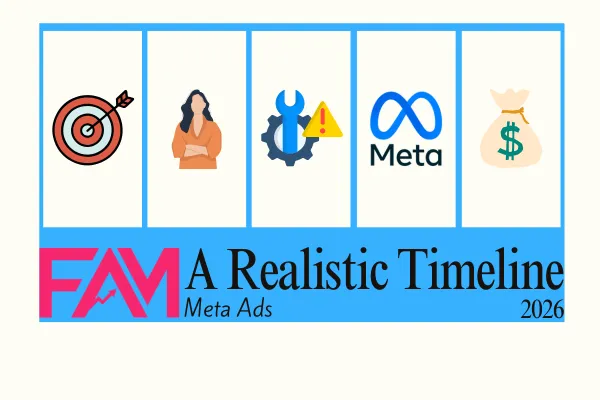
A Realistic Timeline for Businesses to Start Seeing Results from Social Media Campaigns
How Long Should It Take to See Results From Paid Social Campaigns?
Qualifying Section
If you are a small business owner running paid social ads and experiencing inconsistent performance, rising costs, or uncertainty about whether your campaigns are working, this guide is for you.
Many businesses launch Facebook or Instagram ads expecting immediate revenue results, only to encounter several weeks of unclear performance signals. Without a structured testing framework, it becomes difficult to determine whether campaigns are improving, stagnating, or failing.
FBAdsMaster.com exists to help small business owners run Facebook ads using disciplined acquisition systems, clear metrics, and structured testing processes.
For businesses that want hands-on execution instead of managing campaigns internally, we have partnered with Affilicademy for qualifying companies. A short explanation of that partnership appears at the end of this article.
Just the Most Important Bits
How long should it take to see results from paid social campaigns?
Most paid social campaigns begin generating meaningful performance signals within 7 to 14 days, but reliable profitability signals typically require 30 to 60 days of structured testing.
Why do Facebook ads take time to show results?
Paid social campaigns require sufficient data volume for the algorithm to optimize delivery. Early results often reflect learning-phase volatility rather than stable performance.
Can Facebook ads work immediately?
Some campaigns generate early conversions within the first few days, but isolated conversions do not indicate scalable performance. Consistent results require stable conversion rates and acceptable CPA across larger spend levels.
How long should creative testing run before making decisions?
Creative tests generally require enough impressions to evaluate CTR and conversion rate stability. Many advertisers evaluate results after 3,000–10,000 impressions per creative, depending on budget and traffic quality.
What metrics indicate that a campaign is starting to work?
Key indicators include stable CTR, acceptable CPM relative to the audience, improving conversion rate, and a CPA that trends toward the allowable acquisition cost.
When should a campaign be considered unsuccessful?
Campaigns should be reconsidered if CTR remains low, conversion rates remain unstable, or CPA remains above the allowable threshold after sufficient testing cycles.
Does increasing budget accelerate results?
Higher budgets increase data velocity but do not guarantee better outcomes. Without strong creative and landing page performance, increased spend simply produces more expensive data.
How many creatives should be tested before scaling?
Most successful advertisers test multiple creatives per week. Scaling typically occurs after several creatives consistently generate acceptable CPA and conversion stability.
Understanding the Timeline of Paid Social Campaign Results
Small business owners often approach paid social campaigns with an expectation that results should appear immediately after launch. This expectation conflicts with how modern advertising platforms optimize delivery.
Paid social campaigns operate on a data acquisition process. Platforms such as Facebook and Instagram analyze user behavior, engagement patterns, and conversion signals to determine which audiences respond to specific advertisements.
When a campaign launches, the platform begins collecting performance signals from impressions, clicks, and conversions. Early results represent preliminary learning rather than stable performance.
The timeline for campaign results therefore follows three general phases:
Initial Data Collection (Days 1–7)
Campaigns begin accumulating impressions, clicks, and early conversions. Performance metrics fluctuate significantly as the algorithm tests different segments of the target audience.
Performance Stabilization (Weeks 2–4)
Creative effectiveness, audience response, and conversion rates begin to stabilize. Early indicators of viable campaigns become clearer during this phase.
Optimization and Scaling (Months 1–3)
Winning creatives and campaigns are expanded through budget increases and additional creative variations. CPA and ROAS metrics stabilize sufficiently for scaling decisions.
Understanding these phases allows business owners to evaluate performance using realistic timelines instead of reacting prematurely to early fluctuations.
The Mechanism Behind Facebook Ad Performance Timelines
The reason paid social campaigns require time to generate results lies in the internal optimization systems used by advertising platforms.
Facebook’s delivery system evaluates advertisements across several variables:
Audience behavior signals
Creative engagement patterns
Click-through behavior
Conversion probability predictions
Budget allocation efficiency
Each ad impression provides additional behavioral data. Over time, the platform refines which users are most likely to convert based on these signals.
Three core metrics drive this process.
Click-Through Rate (CTR)
CTR measures how often users click on an advertisement after seeing it. High CTR indicates that creative messaging resonates with the target audience.
Conversion Rate
Conversion rate measures how many clicks convert into customers. This metric reflects landing page effectiveness, offer clarity, and audience alignment.
Cost Per Acquisition (CPA)
CPA represents the cost required to generate a customer. Businesses must maintain CPA below the allowable acquisition cost to maintain profitability.
During the early stages of a campaign, these metrics fluctuate because the algorithm has limited historical data for optimization. As impressions increase, statistical reliability improves, producing more stable performance indicators.
Campaign structure also influences the speed at which results appear. Advertisers running fragmented campaigns with limited budget per ad set typically experience slower optimization because data accumulates slowly.
Campaigns that concentrate budget into structured testing environments generate usable performance signals faster.
Practical Implementation: What Businesses Should Do During the First 60 Days
Small businesses benefit from following a structured process during the first several weeks of paid social advertising.
Week 1: Launch and Data Collection
The objective during the first week is data acquisition rather than profitability.
Businesses should launch campaigns with multiple creative variations that target a clearly defined customer profile. Early metrics such as CTR and CPM help identify whether the creative is capturing attention within the intended audience.
During this phase, major structural changes should be avoided unless performance indicators are extremely poor.
Weeks 2–3: Creative Evaluation
By the second and third week, enough impressions typically accumulate to evaluate creative performance.
Advertisements with strong CTR and acceptable CPM generally continue running, while low-performing creatives are paused or replaced. Additional creative variations should be introduced to maintain testing momentum.
Conversion rate trends also begin to emerge during this period.
Weeks 4–8: Optimization and Budget Allocation
After several testing cycles, the strongest creatives typically become clear.
At this stage, businesses can increase budget allocation toward the best-performing ads while continuing to introduce new creative variations. The objective is to maintain a consistent pipeline of creative tests while expanding campaigns that demonstrate stable CPA.
Businesses that scale too early often experience performance volatility because campaigns have not yet reached statistical stability.
A disciplined testing cycle improves the reliability of scaling decisions.
Common Structural Mistakes That Delay Results
Many paid social campaigns take longer to produce results because of structural execution errors rather than platform limitations.
One common issue is launching campaigns with only one or two creatives. With limited creative variation, the platform has fewer opportunities to identify audience resonance.
Another frequent mistake involves spreading budget across too many ad sets. When each ad set receives minimal daily spend, data accumulation slows significantly, delaying optimization.
Inconsistent creative testing also reduces performance clarity. Advertisers sometimes wait several weeks before introducing new creatives, which restricts the platform’s ability to identify higher-performing messaging.
Landing page alignment represents another major factor. Even high-performing ads cannot produce acceptable CPA if the landing page conversion rate remains low.
Businesses often misinterpret these issues as platform performance problems rather than structural campaign design flaws.
Financial Implications of Campaign Timelines
Understanding how long paid social campaigns take to produce results has direct financial implications.
Businesses must allocate sufficient testing budget to allow campaigns to reach statistical reliability.
Early campaigns frequently operate at higher CPA while creative testing identifies effective messaging. If advertisers terminate campaigns too quickly, they often abandon potential winners before optimization occurs.
Budget planning therefore requires separating testing spend from scaling spend.
Testing budgets are used to identify effective creatives and audiences. Scaling budgets expand campaigns that already demonstrate profitable performance.
This distinction protects businesses from prematurely judging campaigns that have not yet accumulated enough data.
Over time, companies that maintain consistent creative testing cycles develop stronger creative libraries, which reduces testing costs and accelerates future campaign performance.
Conclusion
Paid social advertising does not operate as an instant revenue channel. Campaign performance develops through a structured process of data collection, creative testing, and algorithmic optimization.
Most campaigns begin producing early signals within the first two weeks, but reliable profitability indicators generally require 30 to 60 days of disciplined testing.
Businesses that understand this timeline avoid premature campaign termination and instead focus on improving the underlying variables that drive results. These variables include creative quality, landing page performance, campaign structure, and budget allocation.
Advertisers who treat paid social as a systematic acquisition channel rather than a short-term experiment typically achieve more stable CPA and scalable performance.
Need more hands-on help?
If this article got you thinking, but you want done-for-you Facebook ad management on a performance basis, check out Affilicademy.com.
They only get paid when your ads perform, and yes — there’s a free trial so you can see it in action before committing.
And yes, we’re partnered with them, so reading this article helps us pay the bills and keep these guides free for you.
FAQ
How long should it take to see results from paid social campaigns?
Most paid social campaigns begin generating early performance signals within 7 to 14 days. However, reliable CPA and ROAS indicators typically require 30 to 60 days of structured creative testing and optimization.
Why are my Facebook ads not producing results immediately?
Facebook ads require sufficient impressions and conversions for the platform’s algorithm to optimize delivery. Early performance fluctuations are common because the system is still collecting behavioral data.
How much budget should be allocated before evaluating results?
Campaigns generally require enough spend to produce several thousand impressions and a meaningful number of clicks. Small budgets spread across multiple ad sets often delay performance evaluation because data accumulates slowly.
What metrics should be evaluated first in new campaigns?
Early campaign evaluation typically focuses on CTR, CPM, and initial conversion rates. These indicators reveal whether creative messaging and audience targeting align before CPA stabilizes.
Can Facebook ads become profitable quickly?
Some campaigns produce profitable conversions within the first few days, but consistent profitability typically requires multiple creative testing cycles and landing page optimization.