
How to Improve CTR (Andromeda Meta 2026)
How to Massively Improve your CTR on Meta ads by using Andromeda in 2026.
Just the Most Important Bits
1. How to Improve CTR in simple terms?
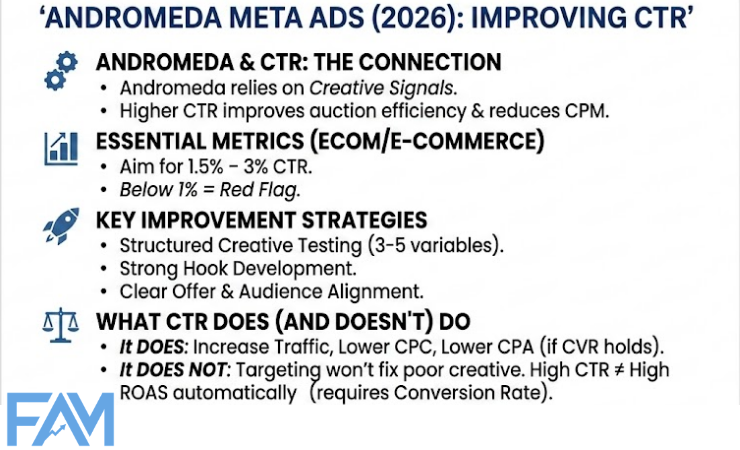
Improving CTR under Andromeda Meta requires structured Creative Testing, strong hook development, clear offer framing, and alignment between audience intent and messaging.
2. Why does CTR matter more after the Andromeda Meta update?
Andromeda relies heavily on creative performance signals. Higher CTR improves auction efficiency, reduces effective CPM pressure, and supports stable CPA.
3. What is a good CTR for Meta ads?
Benchmarks vary by industry, but sustained CTR below 1 percent often signals creative inefficiency. Competitive ecommerce accounts frequently target 1.5–3 percent depending on placement and audience temperature.
4. Can targeting fix low CTR?
Targeting refinements may help, but CTR is primarily driven by creative relevance and offer clarity rather than audience segmentation alone.
5. How many creatives should I test to improve CTR?
Each ad set should test 3–5 creatives at a time with controlled variable changes to isolate performance drivers.
6. Does higher CTR always mean better ROAS?
Higher CTR improves traffic volume and lowers cost per click, but Conversion Rate must remain stable to reduce CPA and improve ROAS.
7. How quickly should I replace low-CTR ads?
Ads should be evaluated after sufficient impressions. If CTR remains significantly below account average after meaningful delivery, replacement is justified.
8. Can improving CTR lower CPA?
Yes. Higher CTR improves auction efficiency, increases qualified traffic volume, and often reduces CPA when Conversion Rate is stable.
Introduction
“How to Improve CTR (Andromeda Meta)” has become a critical operational question for small business advertisers navigating Meta’s evolving delivery systems. Under Andromeda, creative performance carries increased weight in auction outcomes. Campaign Structure alone cannot compensate for weak messaging or poor visual execution.
CTR influences traffic volume, effective CPM, and downstream CPA. A decline in CTR reduces qualified click flow and forces advertisers to pay more per conversion. As Meta’s machine learning systems broaden targeting and optimize for predicted behavior, creative differentiation becomes the dominant lever.
This guide explains how CTR functions inside Meta ads, how Andromeda changes performance dynamics, and how structured Creative Testing can systematically increase CTR while protecting ROAS and scaling capacity.
Core Explanation: What CTR Actually Represents
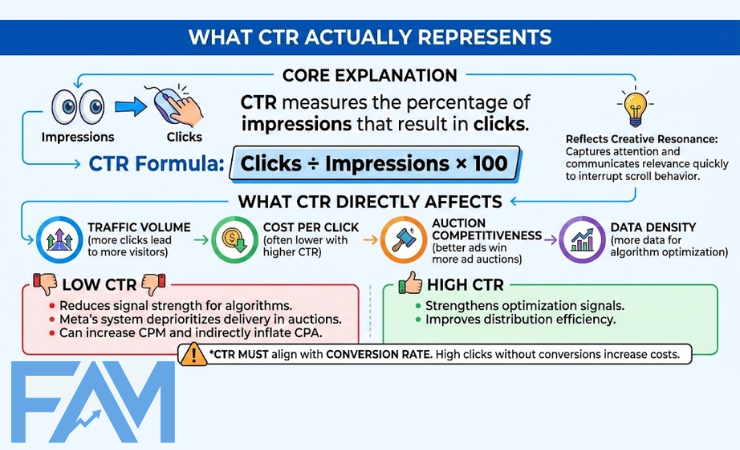
CTR, or Click-Through Rate, measures the percentage of impressions that result in clicks. It is calculated as:
Clicks ÷ Impressions × 100
CTR reflects creative resonance within a defined audience. It indicates whether the ad captures attention and communicates relevance quickly enough to interrupt scroll behavior.
CTR directly affects:
Traffic volume
Cost per click
Auction competitiveness
Data density for optimization
Low CTR reduces signal strength within the algorithm. When fewer users engage with an ad, Meta’s system deprioritizes delivery in competitive auctions. This can increase CPM and indirectly inflate CPA.
High CTR strengthens optimization signals and improves distribution efficiency. However, CTR must align with Conversion Rate. High click volume without conversion efficiency increases acquisition cost.
Under Andromeda Meta, CTR has become a primary early-stage performance indicator because broader targeting reduces reliance on manual audience segmentation and increases dependence on creative quality.
How Andromeda Meta Changes CTR Dynamics
Andromeda expands audience modeling and relies on predictive machine learning across broader segments. This shift changes how CTR influences performance.
Creative as the Primary Differentiator
As targeting becomes more expansive, creative must filter and qualify the audience. Strong hooks and precise messaging improve relevance within broader pools.
Faster Feedback Cycles
Andromeda processes engagement signals rapidly. Ads with weak CTR may lose delivery momentum quickly, making early performance indicators more significant.
Auction Efficiency and CTR
Higher CTR improves expected action rate. Ads predicted to generate engagement receive favorable auction placement relative to cost. This stabilizes CPM and supports lower CPA.
Reduced Impact of Micro-Targeting
Narrow interest stacking may restrict delivery and limit testing capacity. Broader structures amplify the importance of creative-driven CTR optimization.
Mechanism: How CTR Influences Facebook Ads Performance
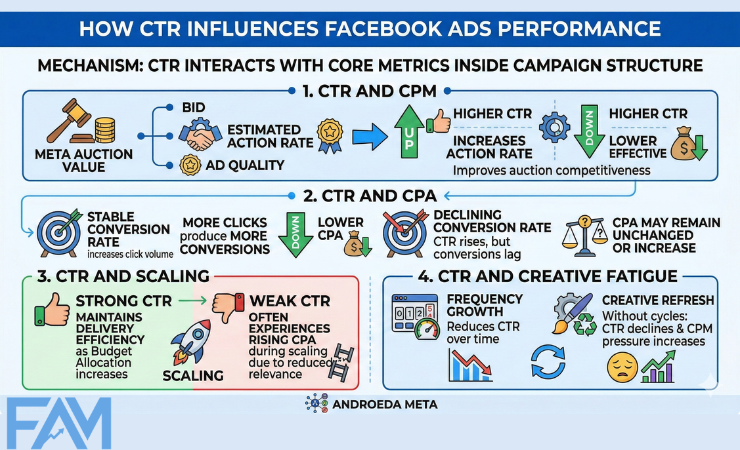
CTR interacts with several core metrics inside Campaign Structure.
1. CTR and CPM
Meta calculates auction value based on bid, estimated action rate, and ad quality. Higher CTR increases estimated action rate. This can improve auction competitiveness and reduce effective CPM.
2. CTR and CPA
Higher CTR increases click volume for a given impression base. If Conversion Rate remains stable, more clicks produce more conversions, lowering CPA.
If Conversion Rate declines while CTR rises, CPA may remain unchanged or increase.
3. CTR and Scaling
Campaigns with strong CTR maintain delivery efficiency as Budget Allocation increases. Weak CTR campaigns often experience rising CPA during Scaling due to reduced relevance.
4. CTR and Creative Fatigue
Frequency growth reduces CTR over time. Without creative refresh cycles, CTR declines and CPM pressure increases.
Practical Application: Step-by-Step CTR Improvement Framework
Step 1: Establish Baseline Metrics
Document current CTR across campaigns, ad sets, and creatives. Identify account averages and outliers.
Separate cold and warm traffic benchmarks.
Step 2: Isolate Creative Variables
Test one primary variable at a time, such as:
Hook variation
Offer framing
Headline emphasis
Visual style
Social proof integration
Avoid simultaneous multi-variable changes that obscure diagnostic clarity.
Step 3: Strengthen the First Three Seconds
Scroll-stopping creative requires immediate clarity. Visual hierarchy must highlight the core benefit or pain point instantly.
Text overlays should reinforce the primary message without clutter.
Step 4: Align Message With Intent Level
Cold audiences require problem identification and value clarity.
Warm audiences respond to urgency, proof, and direct offers.
Misaligned messaging reduces CTR even if targeting is correct.
Step 5: Increase Creative Volume Systematically
Launch 3–5 new creatives per ad set per testing cycle.
Maintain structured iteration cadence to prevent fatigue-driven CTR decline.
Step 6: Monitor Early Indicators Carefully
Evaluate CTR after meaningful impression volume. Premature pausing prevents valid conclusions.
Pause creatives performing significantly below account benchmark after adequate data accumulation.
Step 7: Protect Conversion Rate
Ensure landing page message continuity matches ad promise. Improved CTR without Conversion Rate stability increases CPA.
Advanced CTR Optimization Techniques
Hook Differentiation
Different psychological entry points produce varying CTR results:
Problem agitation
Direct benefit statement
Quantified result
Demonstration visual
Testimonial framing
Each should be tested independently.
Placement-Specific Adaptation
CTR varies by placement. Vertical video may outperform static in Reels or Stories. Desktop feed may favor clear headline emphasis.
Creative formatting must align with placement behavior.
Creative Fatigue Monitoring
Track frequency alongside CTR. A sustained decline in CTR combined with rising frequency indicates the need for refresh.
Offer Clarity
Ambiguous offers reduce CTR. Explicit benefit communication improves engagement probability.
Common Structural Mistakes
Over-Segmentation
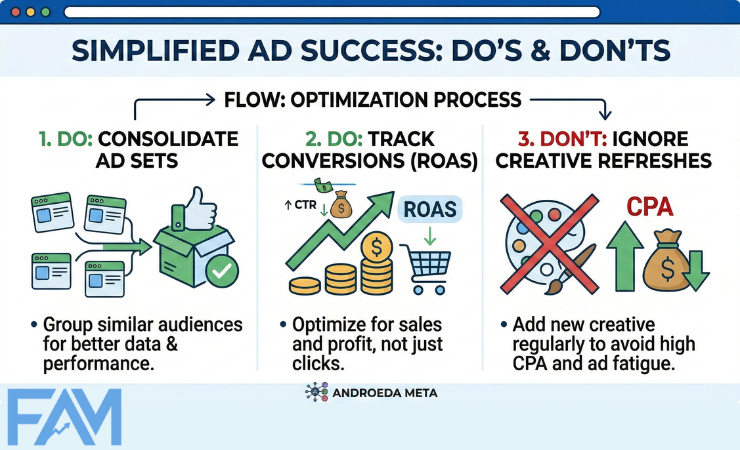
Fragmented ad sets dilute impression volume, delaying reliable CTR data collection.
Chasing CTR Alone
Improving CTR without monitoring CPA and ROAS can misallocate budget toward unprofitable traffic.
Rapid Budget Scaling
Sudden Budget Allocation increases can distort CTR temporarily as delivery expands into lower-intent segments.
Ignoring Creative Rotation
Failure to introduce new creatives leads to declining CTR and rising CPA over time.
Testing Too Many Variations Simultaneously
Excessive Creative Testing reduces interpretability and delays actionable insights.
Financial and Performance Implications
Improving CTR influences core business outcomes.
Lower Effective Cost Per Click
Higher CTR increases clicks per impression, reducing cost per visit when CPM remains stable.
Reduced CPA
If Conversion Rate remains constant, improved CTR lowers CPA due to higher conversion volume.
Improved ROAS Stability
Higher CTR supports consistent traffic flow, improving revenue predictability and scaling reliability.
Increased Scaling Capacity
Campaigns with stable CTR and Conversion Rate can tolerate higher Budget Allocation without disproportionate CPA inflation.
CTR improvement must integrate with overall acquisition math. Metrics must remain aligned with break-even thresholds and LTV projections.
Conclusion
“How to Improve CTR (Andromeda Meta)” is fundamentally a question of creative precision and structural discipline.
Under Andromeda, broader targeting elevates creative performance as the dominant variable. CTR influences auction efficiency, CPA stability, and Scaling capacity.
Improvement requires systematic Creative Testing, controlled Campaign Structure, and consistent measurement against defined financial guardrails.
CTR is not an isolated vanity metric. It is an operational lever that affects profitability across the entire acquisition system.
Need more hands-on help?
If this article got you thinking, but you want done-for-you Facebook ad management on a performance basis, check out Affilicademy.com.
They only get paid when your ads perform, and yes — there’s a free trial so you can see it in action before committing.
And yes, we’re partnered with them, so reading this article helps us pay the bills and keep these guides free for you.
FAQ
What is a good CTR for Meta ads after Andromeda?
A good CTR varies by industry, but sustained CTR above 1.5 percent for cold traffic often indicates healthy creative relevance.
Why did my CTR drop suddenly?
CTR declines commonly result from creative fatigue, increased frequency, broader audience expansion during Scaling, or competitive CPM pressure.
Does improving CTR guarantee better ROAS?
Improving CTR improves traffic efficiency, but Conversion Rate must remain stable to produce lower CPA and stronger ROAS.
Should I duplicate winning ads to increase CTR?
Duplicating creatives rarely improves CTR. Developing new angles through structured Creative Testing produces more reliable improvements.
How often should I refresh creatives?
Refresh cadence depends on frequency growth and CTR decline trends. Many active accounts introduce new creatives every one to two weeks to maintain stability.