It's Never Been Easier to Lower Your CPA on Meta - Andromeda 2026
How to Lower CPA with Andromeda Meta Ads Using Real Data
Just the Most Important Bits
1. What does “How to lower CPA with Andromeda Meta ads Using Real Data” actually mean?
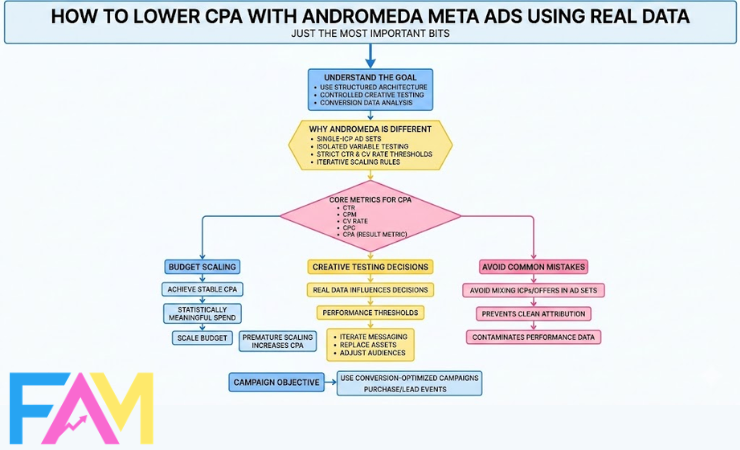
It means using structured campaign architecture, controlled creative testing, and conversion data analysis to systematically reduce Cost Per Acquisition inside Meta Ads Manager rather than relying on subjective creative opinions.
2. How does Andromeda lower CPA differently from traditional Meta ad setups?
Andromeda focuses on single-ICP ad sets, isolated variable testing, strict CTR and conversion rate thresholds, and iterative scaling rules that protect budget allocation efficiency.
3. Which metrics matter most when lowering CPA?
CTR, CPM, Conversion Rate, Cost Per Click, CPA, and downstream metrics such as ROAS and LTV. CPA is a result metric; it improves when upstream variables improve.
4. Should I scale budget while trying to lower CPA?
Budget should only scale after a stable CPA is achieved across statistically meaningful spend levels. Scaling prematurely increases volatility and raises blended CPA.
5. How does real data influence creative testing decisions?
Real data determines whether to iterate messaging, replace creative assets, or adjust audience segmentation. Decisions are based on performance thresholds, not impressions or engagement volume.
6. What is the most common structural mistake increasing CPA?
Mixing multiple ICPs, creatives, and offers in the same ad set, which prevents clean attribution and contaminates performance data.
7. Does campaign objective selection affect CPA?
Yes. Conversion-optimized campaigns using purchase or lead events typically produce lower CPA than traffic campaigns when pixel data is sufficient.
Introduction
Small business owners often struggle with rising acquisition costs inside Meta advertising. Lowering CPA requires more than increasing budget or refreshing creative. It requires structured systems, disciplined testing, and strict adherence to performance data.
This guide explains how to lower CPA with Andromeda Meta ads Using Real Data. It outlines the operational logic behind CPA reduction, how campaign structure influences performance, and how real acquisition metrics should govern decision-making. The focus is practical implementation using measurable thresholds rather than subjective interpretation.
Core Explanation: What It Means to Lower CPA with Andromeda Meta Ads Using Real Data
Lowering CPA is not a single tactic. It is the outcome of optimizing three performance drivers:
Cost to reach the right audience (CPM)
Likelihood of generating engagement (CTR)
Likelihood of converting traffic (Conversion Rate)
CPA is mathematically derived:
CPA=CPMCTR×ConversionRateCPA = \frac{CPM}{CTR \times Conversion\ Rate}CPA=CTR×ConversionRateCPM
Any sustainable CPA reduction must address one or more of these variables.
The Andromeda framework applies disciplined structure to isolate and improve these variables:
One ICP per ad set
One primary message angle per test
Controlled creative variation
Clear performance thresholds
Iterative scaling rules
Real data governs optimization decisions. Emotional interpretation, subjective aesthetic preference, and anecdotal feedback are excluded from decision criteria.
Mechanism: How Andromeda Lowers CPA Inside Meta Ads
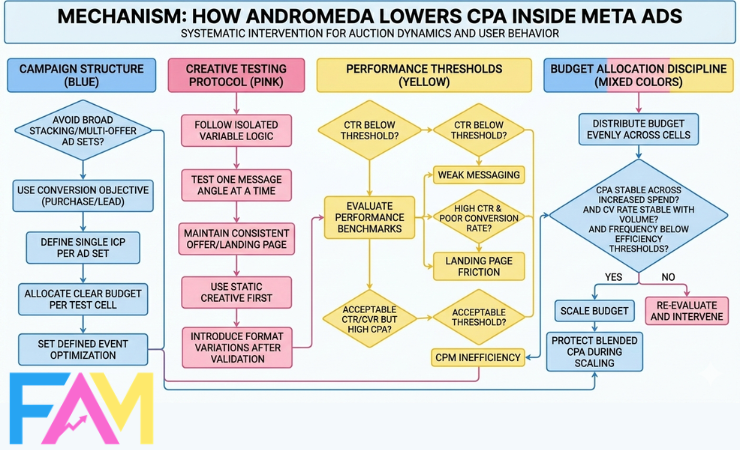
Inside Meta Ads Manager, CPA is influenced by auction dynamics and user behavior. The Andromeda system intervenes at structural and operational levels.
1. Campaign Structure
Each campaign is built around:
Conversion objective (Purchase or Lead)
Single ICP per ad set
Clear budget allocation per test cell
Defined event optimization
Broad audience stacking and multi-offer ad sets are avoided because they obscure attribution clarity.
2. Creative Testing Protocol
Creative testing follows isolated variable logic:
Test one message angle at a time
Maintain consistent offer and landing page
Use static creative first to measure pure message performance
Introduce format variations after message validation
This prevents multiple variable contamination that inflates CPA through misattribution.
3. Performance Thresholds
Decisions are based on numeric benchmarks:
CTR below acceptable threshold indicates weak messaging
High CTR but poor Conversion Rate indicates landing page friction
Acceptable CTR and Conversion Rate but high CPA indicates CPM inefficiency
Each metric directs a different intervention.
4. Budget Allocation Discipline
Budget is distributed evenly across test cells. Scaling occurs only when:
CPA remains stable across increasing spend
Conversion Rate does not decline with volume
Frequency does not exceed efficiency thresholds
This protects blended CPA during scaling.
Practical Application: Step-by-Step CPA Reduction System
Step 1: Define Your ICP Precisely
Identify one specific audience:
Demographics
Pain points
Purchase triggers
Value sensitivity
Each ICP must receive its own ad set. Mixed targeting increases volatility and CPA.
Step 2: Launch Controlled Creative Tests
Deploy 3–5 creatives within one message category. Maintain consistent:
Headline structure
Offer
Landing page
Optimization event
Allow sufficient spend per creative to reach statistically meaningful data.
Step 3: Evaluate Upstream Metrics First
Do not analyze CPA immediately.
First review:
CPM
CTR
CPC
If CTR is low, replace the message. If CPM is abnormally high, refine targeting. If CTR is strong but CPA remains high, analyze Conversion Rate.
Step 4: Diagnose Conversion Rate
If Conversion Rate is low:
Audit landing page clarity
Improve page load speed
Remove friction fields
Align ad promise with page headline
Lower CPA often results from landing page improvements rather than ad adjustments.
Step 5: Remove Underperforming Variants Quickly
Any creative significantly below performance thresholds should be paused. Retaining weak creatives increases blended CPA.
Step 6: Scale Incrementally
Increase budget gradually once CPA stabilizes. Monitor:
Frequency
Conversion Rate drift
Cost Per Click changes
Scale horizontally across new ICPs before aggressively increasing vertical spend.
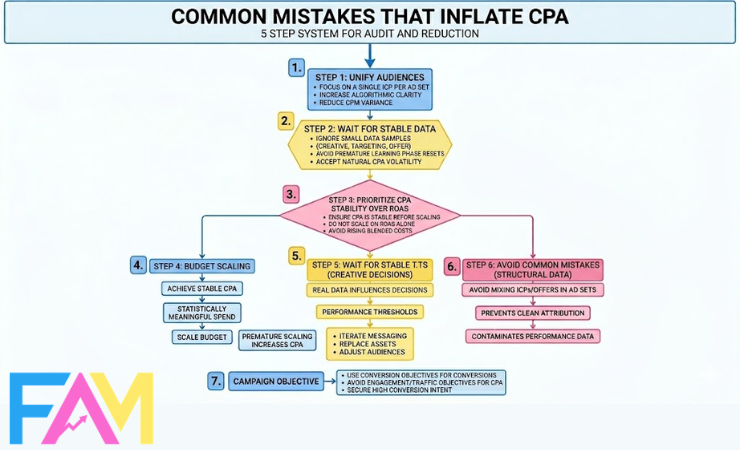
Common Mistakes That Inflate CPA
1. Multiple ICPs in One Ad Set
This reduces algorithmic clarity and increases CPM variance.
2. Changing Multiple Variables Simultaneously
If creative, targeting, and offer change at once, performance causality becomes untraceable.
3. Overreacting to Small Data Samples
CPA volatility is common in low-spend environments. Premature changes reset learning phases and increase acquisition cost.
4. Scaling Based on ROAS Without CPA Stability
High short-term ROAS can mask unstable CPA. Scaling on unstable metrics increases blended cost.
5. Using Engagement Objectives to Drive Conversions
Traffic and engagement campaigns often produce cheaper clicks but higher CPA due to lower conversion intent.
Financial and Performance Implications
Lower CPA directly impacts:
ROAS
Profit margin
LTV scaling potential
Budget allocation efficiency
If CPA decreases by 20 percent while Conversion Rate and AOV remain stable, ROAS improves proportionally.
Lower CPA also expands scaling thresholds. When LTV exceeds CPA by a wider margin, budget expansion becomes mathematically justified.
Sustainable scaling requires:
LTV>CPA×TargetProfitMarginLTV > CPA \times Target\ Profit\ MarginLTV>CPA×TargetProfitMargin
Without disciplined CPA control, scaling increases loss velocity.
Andromeda’s real-data testing prevents budget expansion until acquisition economics justify it.
Conclusion
Lowering CPA with Andromeda Meta ads Using Real Data requires structural discipline, metric literacy, and strict operational execution. CPA reduction is a mathematical outcome of improving CPM efficiency, increasing CTR, and optimizing Conversion Rate.
The Andromeda framework enforces single-ICP clarity, isolated creative testing, numeric performance thresholds, and responsible scaling logic. When decisions are based on real acquisition data rather than subjective interpretation, CPA becomes controllable and scalable.
Disciplined systems outperform reactive optimization.
Need More Hands-On Help?
Need more hands-on help?
If this article got you thinking, but you want done-for-you Facebook ad management on a performance basis, check out Affilicademy.com.
They only get paid when your ads perform, and yes, there’s a free trial so you can see it in action before committing.
And yes, we’re partnered with them, so reading this article helps us pay the bills and keep these guides free for you.
FAQ
How long does it take to lower CPA using Andromeda Meta ads?
It depends on traffic volume and budget, but meaningful optimization patterns typically emerge after statistically significant spend per test cell.
Does broad targeting lower CPA on Meta?
Broad targeting can reduce CPM in some cases, but only when the message is highly aligned. Without ICP clarity, CPA volatility increases.
What is a good CTR for lowering CPA?
Acceptable CTR varies by industry, but consistent CTR improvement generally reduces CPC and supports lower CPA when Conversion Rate is stable.
Should I duplicate winning ad sets to scale?
Duplication can fragment data. Budget increases within stable ad sets are often more efficient when CPA is controlled.
Can creative alone fix high CPA?
Creative influences CTR and CPM, but landing page Conversion Rate and offer structure also determine final CPA.