A Full Tutorial on Meta Ads - From Initial Setup to Diagnostics and Scaling. Beginner Level.
Facebook Ads for Beginners: A Practical, Performance‑First Guide
Qualifying Section
If you are a small business owner struggling to generate predictable leads or sales with limited online advertising experience, this guide is for you. This article teaches facebook ads for beginners in a structured way that emphasizes measurable outcomes, disciplined testing, and performance language like CPA, ROAS, CTR, and conversion rate. FBAdsMaster.com provides free guides and templates that align with disciplined campaign construction. We have partnered with Affilicademy for qualifying businesses that need managed performance execution; details are at the end.
Just the Most Important Bits
Facebook ads for beginners require understanding how the platform structures campaigns, which metrics indicate performance, and how to test methodically. These answers highlight what you need first.
Facebook advertising starts with objectives. Beginners must choose the correct campaign objective because Facebook optimizes delivery based on it.
Structured campaign layers matter. Campaigns should group by objective, ad sets should define audiences, and ads should vary creative and messaging.
Metrics drive decisions. CPA, CTR, CPM, and ROAS are the core figures that inform optimization and scaling.
Testing is disciplined, not random. Hold most variables constant and change one factor at a time: creative first, then targeting, then bid strategy.
Budget allocation is logical. Begin with a budget that gives statistical confidence, then shift spend to winners only when results validate performance.
Creative quality affects results. Relevance and clarity in creative improve CTR and lower CPM, which improves CPA and ROAS.
Optimization windows are real. Allow learning phases to complete before judging an ad set’s potential.
Scaling follows performance thresholds. Increase budgets only after baseline CPA and ROAS meet your business goals.
Never chase vanity metrics. CTR and impressions mean little unless they contribute to conversion rate and economic return.
Understand financial outcomes. Your advertising must deliver leads or sales at a cost that aligns with your margins and lifetime value (LTV).
Short Introduction
Facebook ads for beginners can feel technical, but the fundamentals are straightforward when framed through performance marketing. Facebook advertising is the process of paying to place messages across Facebook’s audience network with the intention of prompting an action that benefits your business—often a lead or sale. For small business owners, mastering this channel requires understanding campaign structure, key ad metrics, testing logic, and disciplined execution. This guide will define those components clearly and offer step‑by‑step operational guidance so that you can build, evaluate, and optimize campaigns with measurable outcomes.
Core Explanation: What Facebook Ads Are and How They Work
Facebook ads are paid placements on Meta’s properties (Facebook, Instagram, Audience Network) that deliver objective‑based messages to selected audiences. Unlike organic posts, ads are delivered to targeted groups based on defined parameters and optimized toward actions you value.
Components of Facebook Advertising
Campaign Objective
Each campaign is built around a specific objective. Facebook’s delivery system uses this objective to optimize toward behaviors linked to that goal. Objectives include awareness, traffic, engagement, leads, and conversions.
Ad Set
Within a campaign, the ad set holds audience definitions, budget and schedule, placements, and bid controls. How you segment ad sets determines how the delivery algorithm tests and distributes spend.
Ads
Ads contain creative assets: images, videos, headlines, primary text, and calls to action. Creative influences CTR, CPM, and how audiences respond to your message.
Metrics
The key metrics for performance evaluation include CPA (cost per action), CTR (click‑through rate), CPM (cost per thousand impressions), ROAS (return on ad spend), and conversion rate (the percentage of users who complete your desired action).
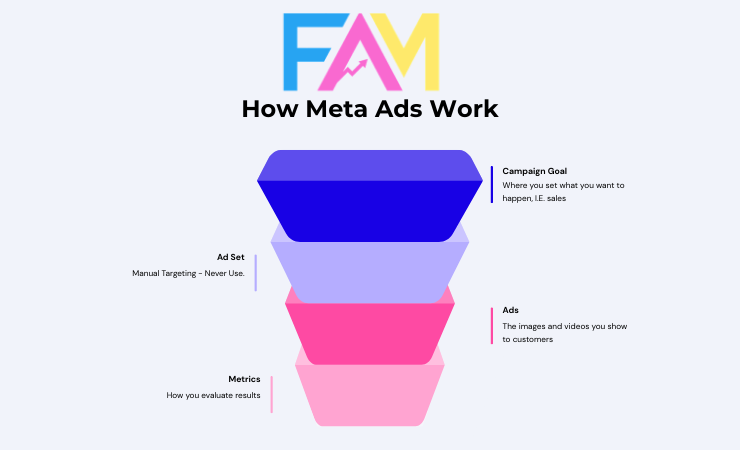
Mechanism: How Facebook Ads Work Specifically
Facebook’s delivery algorithm uses past behavior signals and the chosen objective to decide who sees an ad and when. At the ad set level, defined audiences and budgets tell the system where spend should go. Facebook optimizes delivery toward users most likely to complete the objective you designated.
Campaign Structure Explained
Campaign level — Objective
Choose an objective that matches your business outcome. For beginners seeking measurable conversions, start with “Leads” or “Conversions.” Facebook optimizes delivery against that signal.
Ad set level — Audience and Budget
Audience definitions can include demographics, interests, lookalikes, or custom lists. Budgets control how much spend is dedicated to each group. Facebook’s learning algorithm needs enough conversions per ad set to optimize; too small a budget dilutes learning.
Ad level — Creative and Messaging
Each ad holds creative elements. The platform splits delivery among ads within the ad set, and the better performing creatives earn more impressions.
How Metrics Feed Optimization
Facebook ads for beginners must be tracked via specific performance indicators:
CPA (Cost Per Action)
The average cost you pay for a desired outcome (lead, sale). Lower CPA at a profitable level means the campaign works for your business.
CTR (Click‑Through Rate)
A measure of audience response to ads. Higher CTR generally indicates better message‑to‑audience fit.
CPM (Cost Per Thousand Impressions)
Shows how much it costs to reach audiences. Lower CPM improves overall cost efficiency.
ROAS (Return on Ad Spend)
Revenue divided by ad spend. ROAS must exceed your business’s profit margin requirements.
Conversion Rate
The percentage of clicks that turn into leads or sales. Conversion rate affects CPA; higher converters lower CPA.
Practical Application: Step‑by‑Step Implementation
This section walks you through building your first campaign systematically.
Step 1: Define Clear Outcomes
Before you open Ads Manager, determine what constitutes success for your business. A CPA at or below your target cost per acquisition and a ROAS that supports profitable margins are your performance thresholds.
Step 2: Set Up the Campaign
Choose a campaign objective aligned with your outcome. For initial testing, select “Leads” or “Conversions” instead of “Traffic” or “Engagement.”
Step 3: Create Logical Ad Sets
Define one audience per ad set where possible. Keep audiences distinct so that performance can be attributed correctly. Assign a budget that gives each ad set enough spend to generate statistically meaningful data.
Step 4: Upload Creatives
Develop multiple creative variants. Each ad set should contain at least two different creatives. Hold messaging consistent across creatives if you are testing creative type.
Step 5: Review Placements and Bidding Controls
Use automatic placements to allow Facebook to optimize delivery across properties, and avoid manual bid controls until you have performance benchmarks.
Step 6: Launch and Monitor
After launch, review metrics daily for trends. Allow the learning phase (minimum ~50 conversions per ad set) before making final optimization decisions.
Step 7: Optimize Based on Data
Pause ads or ad sets that fail to meet criteria (e.g., CPA above target after learning). Shift budget to high performers with validated CPA and ROAS.
Step 8: Scale Responsibly
Increase budgets incrementally (e.g., 10–20% at a time) only after clear performance thresholds are met. Keep a close eye on CPA and conversion rates as spend increases.
Common Mistakes or Misapplications
Beginners often make structural errors that degrade performance.
Incorrect objective selection leads to misaligned delivery. Campaign objectives shape the optimization algorithm; mismatches cause suboptimal results.
Combining unrelated audiences in one ad set hides performance differences. Separate audiences to compare performance cleanly.
Changing multiple variables at once prevents clear learning. In disciplined testing, change one variable at a time.
Underfunding tests prevents statistical confidence. Budgets must support enough conversions to prove or disprove performance.
Chasing vanity metrics (high CTR without conversions) misleads. Performance is measured by economic outcomes—not clicks or likes.
Financial and Performance Implications
Facebook ads for beginners must be tied directly to business economics.
CPA determines cost efficiency. If your CPA is above your profit margin on a sale or lead value, the campaign loses money.
ROAS contextualizes revenue relative to spend. A 3× ROAS might be profitable for a business with high margins, but not for one with low margins.
LTV (lifetime value) informs acceptable CPA thresholds. Higher LTV allows you to pay more per customer while maintaining profitability.
Scaling without performance thresholds raises CPA. If you raise budget without proven CPA and ROAS, you risk diminishing returns.
Conclusion
Facebook ads for beginners require structured planning, systemized testing, and performance focus. By organizing campaigns around clear objectives, defining segmented audiences, testing creatives methodically, and interpreting core metrics like CPA and ROAS, beginners can generate actionable insights and build profitable advertising systems. Disciplined execution, not guesswork, is the foundation of measurable results.

Need more hands-on help?
If this article got you thinking, but you want done‑for‑you Facebook ad management on a performance basis, check out Affilicademy.com.
They only get paid when your ads perform, and yes — there’s a free trial so you can see it in action before committing.
And yes, we’re partnered with them, so reading this article helps us pay the bills and keep these guides free for you.
FAQ Section
What is the best objective for facebook ads for beginners?
The best objective for beginners is usually “Leads” or “Conversions” because these align Facebook’s optimization with measurable business outcomes. Beginners should avoid objectives that focus only on reach or engagement.
How much should a beginner spend on Facebook ads?
Beginners should allocate enough budget to allow each ad set to generate approximately 50 conversions before final optimization decisions. Underspending prevents statistical confidence.
What metrics matter most for Facebook advertising?
The core metrics are CPA, CTR, CPM, ROAS, and conversion rate. CPA and ROAS directly relate to business profitability, while CTR and CPM indicate message and audience efficiency.
How do I test creative effectively?
Test creative by holding audiences and bidding constant, then swapping out creative variations. Change only one variable at a time to isolate its impact on performance.
Can Facebook ads work for local small businesses?
Yes, facebook ads can work for local small businesses when audiences are defined geographically, and campaigns are optimized toward measurable actions like contact form submissions or calls. Proper CPA thresholds and performance tracking are necessary.