
A Beginners Guide to Understanding What CPM is, and Why it Matters.
A Beginners Guide to Understanding What CPM is, and Why it Matters.
Just the Most Important Bits
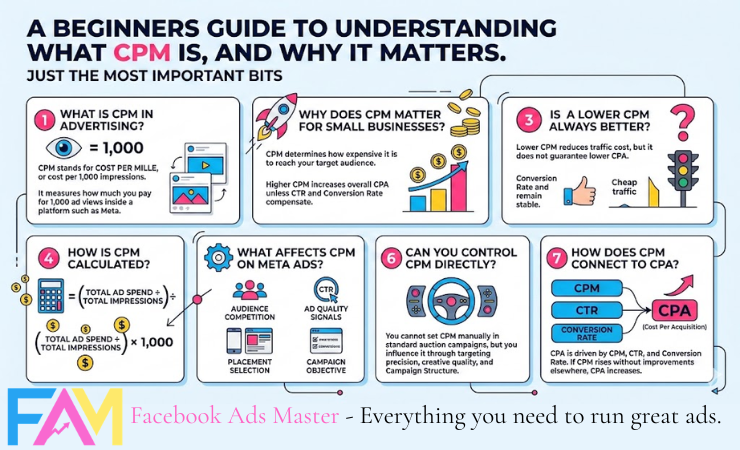
1. What is CPM in advertising?
CPM stands for Cost Per Mille, or cost per 1,000 impressions. It measures how much you pay for 1,000 ad views inside a platform such as Meta.
2. Why does CPM matter for small businesses?
CPM determines how expensive it is to reach your target audience. Higher CPM increases overall CPA unless CTR and Conversion Rate compensate.
3. Is a lower CPM always better?
Lower CPM reduces traffic cost, but it does not guarantee lower CPA. Conversion Rate and audience quality must remain stable.
4. How is CPM calculated?
CPM = (Total Ad Spend ÷ Total Impressions) × 1,000.
5. What affects CPM on Meta ads?
Audience competition, ad quality signals, CTR, placement selection, and campaign objective all influence CPM.
6. Can you control CPM directly?
You cannot set CPM manually in standard auction campaigns, but you influence it through targeting precision, creative quality, and Campaign Structure.
7. How does CPM connect to CPA?
CPA is driven by CPM, CTR, and Conversion Rate. If CPM rises without improvements elsewhere, CPA increases.
Introduction
Understanding CPM is foundational for anyone running paid acquisition campaigns. Many small business owners focus only on CPA or ROAS, but CPM directly influences both metrics. Without clarity on CPM, diagnosing performance inefficiencies becomes difficult.
This article provides A Beginners Guide to Understanding What CPM is, and Why it Matters. The goal is to explain CPM using acquisition math and real campaign logic, specifically within Meta advertising. By the end, you will understand how CPM interacts with CTR, Conversion Rate, and CPA, and how disciplined testing can reduce overall acquisition costs.
Core Explanation: What CPM Is in Performance Marketing
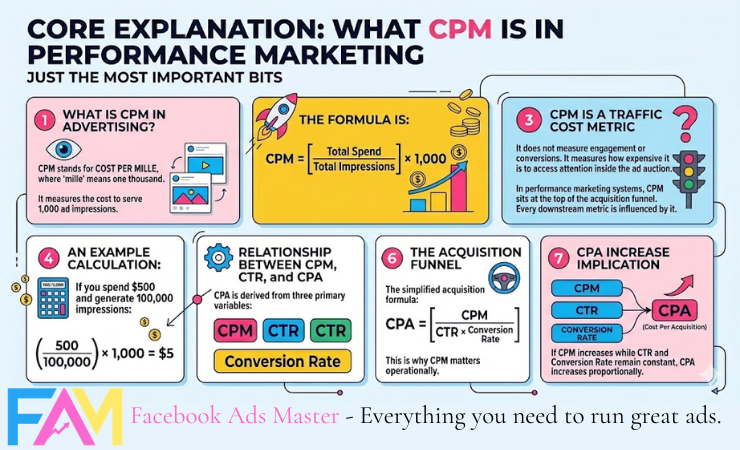
CPM stands for Cost Per Mille, with “mille” meaning one thousand. It measures the cost to serve 1,000 ad impressions and is calculated using the formula: CPM = (Total Spend ÷ Total Impressions) × 1,000.
For example, if you spend $500 and generate 100,000 impressions, your CPM is $5. CPM is strictly a traffic cost metric.
It does not measure engagement, clicks, or conversions. It measures how expensive it is to access attention inside the Meta ad auction.
In performance marketing systems, CPM sits at the top of the acquisition funnel, and every downstream metric is influenced by it.
CPA is derived from three primary variables: CPM, CTR, and Conversion Rate. The simplified acquisition formula is CPA = CPM ÷ (CTR × Conversion Rate). (See photo for details)
If CPM increases while CTR and Conversion Rate remain constant, CPA increases proportionally. This direct mathematical relationship is why CPM matters operationally within any structured acquisition system.
How CPM Works Inside Meta Ads
Meta operates on an auction-based advertising system. Advertisers compete for impressions within specific audience segments.
CPM is influenced by:
Audience competition
Ad relevance signals
Predicted engagement
Historical account performance
Campaign objective
Campaign Structure Influence
In structured Campaign Structure, each ad set targets one ICP. This reduces audience overlap and improves auction clarity.
Broad stacking of multiple audiences into one ad set can increase CPM due to internal competition and inefficient delivery.
Creative Testing Influence
Creative Testing impacts CPM through engagement signals.
If an ad generates strong CTR, Meta interprets it as relevant. Higher engagement often improves auction efficiency, which can stabilize or reduce CPM over time.
Weak creatives reduce engagement signals, which can lead to higher effective CPM.
Objective Selection
Conversion-optimized campaigns generally produce higher CPM than traffic campaigns because Meta prioritizes users more likely to convert.
However, higher CPM with better Conversion Rate often results in lower CPA.
Practical Application: How to Manage CPM Strategically
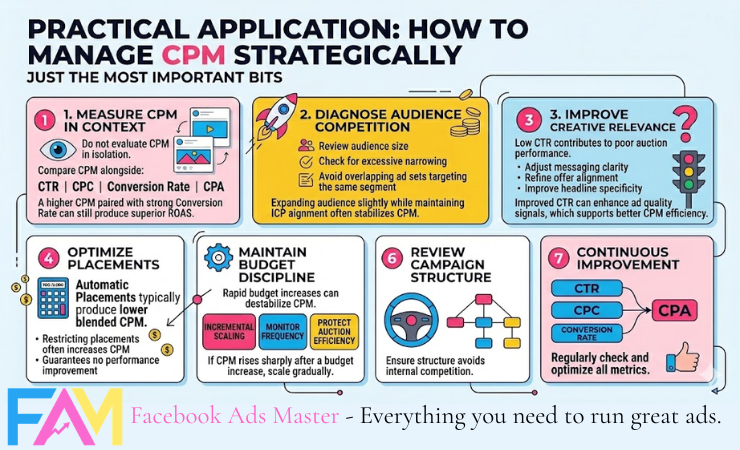
Step 1: Measure CPM in Context
Do not evaluate CPM in isolation.
Compare CPM alongside:
CTR
CPC
Conversion Rate
CPA
A higher CPM paired with strong Conversion Rate can still produce superior ROAS.
Step 2: Diagnose Audience Competition
If CPM is unusually high:
Review audience size
Check for excessive narrowing
Avoid overlapping ad sets targeting the same segment
Expanding audience slightly while maintaining ICP alignment often stabilizes CPM.
Step 3: Improve Creative Relevance
Low CTR contributes to poor auction performance.
If CTR is below acceptable benchmarks:
Adjust messaging clarity
Refine offer alignment
Improve headline specificity
Improved CTR can enhance ad quality signals, which supports better CPM efficiency.
Step 4: Optimize Placements
Automatic placements typically produce lower blended CPM compared to manual restriction.
Restricting placements to premium inventory often increases CPM without guaranteed performance improvement.
Step 5: Maintain Budget Discipline
Rapid budget increases can destabilize CPM.
Incremental Scaling protects auction efficiency. If CPM rises sharply after a budget increase, scale gradually and monitor frequency.
Common Mistakes That Misinterpret CPM
1. Obsessing Over Low CPM
Low CPM with poor Conversion Rate results in high CPA. Traffic quality matters.
2. Comparing CPM Across Industries
CPM varies significantly between industries, seasons, and audience categories. Benchmarks are contextual.
3. Ignoring Seasonal Competition
During high-demand periods, CPM rises due to auction pressure. Performance planning must account for this.
4. Using Engagement Objectives to Artificially Lower CPM
Engagement campaigns often show low CPM but produce weaker purchase intent. This increases CPA downstream.
5. Over-Segmentation
Excessive audience layering restricts delivery and increases CPM volatility.
Financial and Performance Implications
CPM directly impacts:
CPA
ROAS
Profit margin
LTV scaling thresholds
If CPM increases by 20 percent without improvement in CTR or Conversion Rate, CPA increases proportionally.
Lower CPM expands acquisition efficiency, allowing more aggressive Scaling while preserving margins.
Consider the simplified relationship:
If:
CPM = $10
CTR = 2%
Conversion Rate = 5%
Then:
CPA = \frac{10}{0.02 \times 0.05} = $10
If CPM increases to $12 with no other changes:
CPA = \frac{12}{0.02 \times 0.05} = $12
This directly reduces ROAS unless Average Order Value increases.
Understanding CPM is essential for margin control. Businesses with narrow contribution margins must monitor CPM closely to maintain profitability.
Conclusion
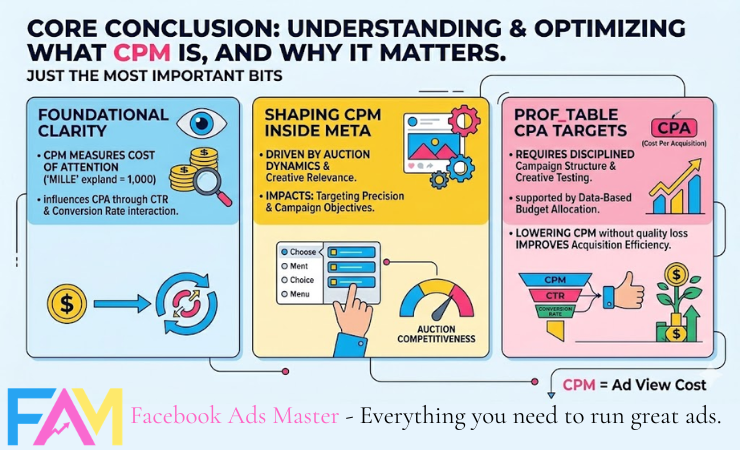
A Beginners Guide to Understanding What CPM is, and Why it Matters provides foundational clarity for performance-driven advertisers. CPM measures the cost of attention. It influences CPA through its interaction with CTR and Conversion Rate.
Inside Meta advertising, CPM is shaped by auction dynamics, creative relevance, targeting precision, and campaign objective selection. Lowering CPM without compromising traffic quality improves acquisition efficiency and supports scalable growth.
Disciplined Campaign Structure, controlled Creative Testing, and data-based budget allocation ensure CPM remains aligned with profitable CPA targets.
Need More Hands-On Help?
Need more hands-on help?
If this article got you thinking, but you want done-for-you Facebook ad management on a performance basis, check out Affilicademy.com.
They only get paid when your ads perform, and yes — there’s a free trial so you can see it in action before committing.
And yes, we’re partnered with them, so reading this article helps us pay the bills and keep these guides free for you.

FAQ
What is a good CPM for Facebook ads?
A good CPM depends on industry and competition. Evaluate CPM relative to CTR, Conversion Rate, and CPA rather than using universal benchmarks.
Why is my CPM so high on Meta ads?
High CPM can result from narrow targeting, strong competition, weak engagement signals, or restrictive placements.
Does higher CPM mean better traffic?
Higher CPM can indicate more competitive audience segments with stronger purchase intent, but it does not guarantee improved Conversion Rate.
How can I lower CPM on Facebook ads?
Improve creative relevance, expand audience size strategically, enable automatic placements, and avoid internal audience overlap.
Is CPM more important than CPA?
CPA determines profitability, but CPM influences CPA. Both must be monitored within a structured acquisition framework.