How Much Should You Be Investing Into Meta (Facebook and Instagram) Ads in 2026, as a Small Business Owner?
When You Should Invest More Into Meta Ads
If you are a small business owner running Meta Ads and experiencing inconsistent CPA, unpredictable ROAS, or uncertainty about when to increase your budget, this article is for you.
FBAdsMaster exists to provide structured, system-driven education for business owners who want to understand acquisition math, Campaign Structure, and disciplined scaling. All resources are built to help operators make capital allocation decisions based on data rather than emotion.
For qualifying businesses that prefer execution over internal management, we have partnered with Affilicademy to help you use their performance based marketing. Details are provided at the end of this article.
Just the Most Important Bits
1. When you should invest more into Meta Ads?
You should invest more into Meta Ads only when CPA is stable, ROAS meets margin requirements, and LTV materially exceeds acquisition cost.
2. What is the primary scaling signal?
Consistent CPA across increasing spend levels without Conversion Rate deterioration.
3. Should you scale if performance is strong for three days?
No. Scaling decisions require statistically meaningful data across multiple budget cycles.
4. Does higher budget automatically improve results?
No. Budget expansion exposes your ads to broader auction conditions, which can increase CPM and lower Conversion Rate.
5. What is the safest scaling method?
Incremental vertical budget increases combined with horizontal expansion into additional ICPs and creative variations.
6. How does LTV determine scaling capacity?
If LTV comfortably exceeds CPA while preserving contribution margin, additional investment is justified.
7. What is the most common scaling failure?
Increasing spend before validating Campaign Structure and Creative Testing depth.
Introduction
Budget expansion inside Meta advertising is a capital allocation decision. It determines whether your ad account becomes a scalable growth asset or a margin drain. Many business owners increase spend when results “look good” without confirming whether performance is structurally stable.
This article explains when you should invest more into Meta Ads using acquisition math, performance thresholds, and disciplined testing logic. The objective is to define clear criteria for scaling based on CPA, ROAS, LTV, Conversion Rate, and Campaign Structure integrity. Scaling is justified only when economics are proven under controlled conditions.
Core Explanation: What It Means to Invest More Into Meta Ads
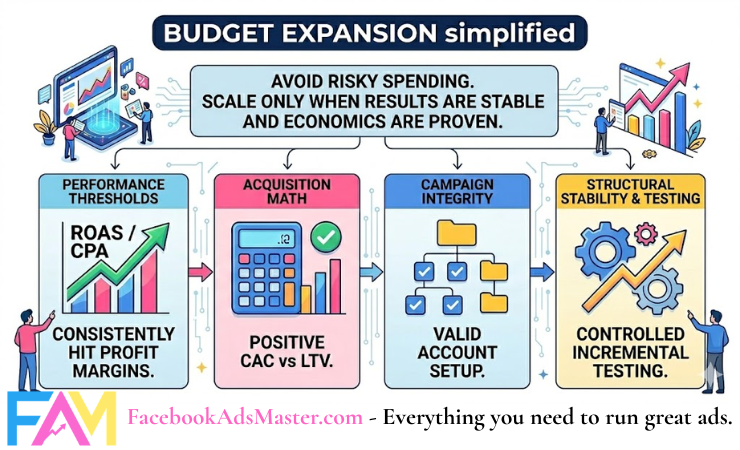
Investing more into Meta Ads means increasing Budget Allocation into a validated acquisition system that produces predictable CPA and sustainable ROAS.
Scaling is not defined by higher daily spend. It is defined by capital expansion into a system that preserves margin while increasing volume.
Three economic conditions must exist:
CPA is consistently below maximum allowable threshold.
ROAS aligns with margin requirements.
LTV-to-CPA ratio supports long-term profitability.
Maximum allowable CPA can be calculated as:
Maximum CPA = LTV × Target Acquisition Percentage
If LTV is $400 and your business allocates 25 percent to customer acquisition, maximum CPA equals $100. If current CPA is $70 with stability, there is scaling capacity. If CPA is $95 and volatile, scaling risk is high.
Stability Over Performance Spikes
Short-term performance spikes do not justify budget expansion. Scaling decisions require:
Minimum 50 conversions per ad set at current budget levels.
CPA consistency across 7-day and 14-day windows.
Conversion Rate stability across multiple spend cycles.
No significant CTR decline as spend increases.
Without these criteria, increased investment amplifies volatility.
Mechanism: How Scaling Changes Performance Inside Meta
Meta’s delivery system operates on auction dynamics. When budget increases, your ads enter broader auction pools within your targeting constraints.
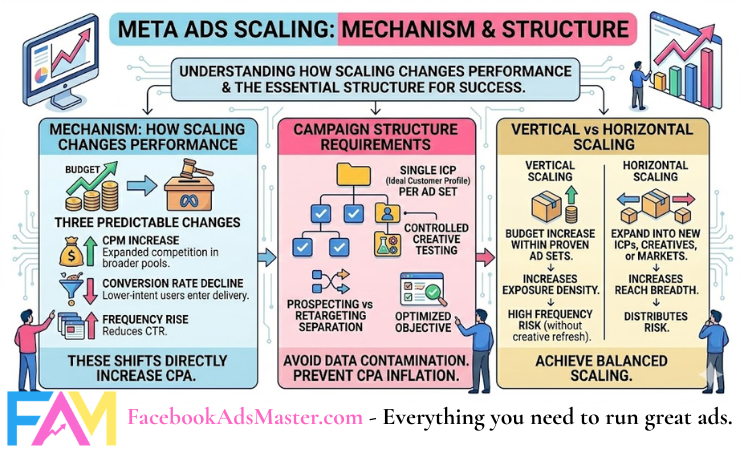
This produces three predictable changes:
CPM may increase due to expanded competition.
Conversion Rate may decline as lower-intent users enter delivery.
Frequency may rise, reducing CTR.
These shifts directly affect CPA.
Campaign Structure Requirements Before Scaling
A scalable Campaign Structure must include:
Single ICP per ad set.
Controlled Creative Testing within each ICP.
Clear separation between prospecting and retargeting.
Defined conversion objective optimized for Purchase or Lead.
If multiple ICPs exist within the same ad set, scaling introduces data contamination and inflates CPA.
Vertical vs Horizontal Scaling
Vertical Scaling: Increase budget within proven ad sets.
Horizontal Scaling: Expand into new ICPs, new creatives, or new markets.
Vertical scaling increases exposure density. Horizontal scaling increases reach breadth.
Over-reliance on vertical scaling increases frequency quickly. Frequency expansion without creative refresh reduces CTR and increases CPM, raising CPA.
Balanced scaling distributes risk.
Practical Application: A Structured Scaling Framework
Step 1: Confirm Economic Viability
Calculate:
Current CPA
Average Order Value
LTV
Contribution Margin
If CPA allows acceptable margin buffer, proceed to stability analysis.
Step 2: Confirm Data Volume
Each scaling candidate ad set should have:
Minimum 50 conversions.
Stable CPA over two consecutive 7-day windows.
Conversion Rate variance within acceptable tolerance.
Without sufficient data density, performance is not validated.
Step 3: Increase Budget in Controlled Increments
Increase daily budget by 10 to 20 percent every three to five days.
After each increase, monitor:
CPA change
CTR movement
CPM shift
Frequency progression
If CPA increases beyond tolerance, halt scaling.
Step 4: Maintain Creative Testing Pipeline
Creative decay is predictable. Without ongoing Creative Testing, frequency increases will reduce CTR and raise CPA.
Maintain active testing of:
New angles
New hooks
New formats
Scaling without creative expansion is structurally unstable.
Step 5: Expand Horizontally After Vertical Stability
Once a core ICP proves scalable:
Launch adjacent ICPs in separate ad sets.
Test new audience segments.
Expand geographic targeting where relevant.
Horizontal expansion reduces saturation risk.
Common Scaling Errors
Increasing Budget During Volatility
Scaling during unstable learning periods amplifies inconsistency.
Ignoring CPA Drift
If CPA rises gradually across increases, margin erosion may go unnoticed until ROAS collapses.
Scaling Based Solely on ROAS
ROAS can be inflated by retargeting concentration. Prospecting CPA must remain within target to justify expansion.
Underestimating Frequency Impact
Frequency increases reduce engagement quality. If CTR declines and CPM rises simultaneously, CPA escalates rapidly.
Expanding Too Broadly
Expanding targeting beyond ICP clarity reduces Conversion Rate and increases acquisition cost.
Financial and Performance Implications
Scaling increases revenue only if unit economics remain intact.
Consider:
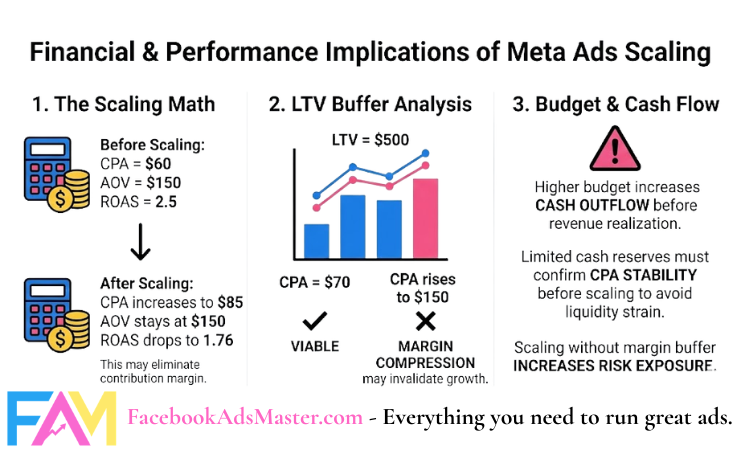
CPA = $60
AOV = $150
ROAS = 2.5
If scaling increases CPA to $85 while AOV remains constant:
ROAS drops to 1.76
This may eliminate contribution margin entirely.
LTV Buffer Analysis
If LTV equals $500 and CPA equals $70, scaling remains viable. If CPA rises to $150, margin compression may invalidate growth.
Budget Allocation and Cash Flow
Higher budget increases cash outflow before revenue realization. Businesses with limited cash reserves must confirm CPA stability before scaling to avoid liquidity strain.
Scaling without margin buffer increases risk exposure.
Advanced Considerations
Scaling Retargeting vs Prospecting
Retargeting often produces higher ROAS but limited scale. Prospecting drives volume.
Investing more into Meta Ads requires prioritizing scalable prospecting systems.
Auction Pressure and Seasonality
High competition periods increase CPM. During these periods, CPA tolerance must be tighter.
Scaling during inflated CPM environments requires superior CTR and Conversion Rate performance.
Account-Level Blended Performance
Evaluate account-level CPA and ROAS after scaling. Individual ad sets may perform well while blended performance deteriorates.
Blended economics determine profitability.
Decision Checklist: When You Should Invest More Into Meta Ads
You should increase investment only when:
CPA is below maximum allowable threshold with margin buffer.
Conversion Rate remains stable across increased spend.
CTR does not decline materially with frequency increases.
CPM increases remain proportional.
LTV supports acquisition expansion.
Creative Testing pipeline is active.
Prospecting performance is validated, not solely retargeting-driven.
If these conditions are not met, capital expansion introduces structural risk.
Conclusion
Determining when you should invest more into Meta Ads requires strict evaluation of acquisition math and performance stability. Budget expansion is justified only when CPA, ROAS, and LTV align under real delivery conditions.
Scaling without validated Campaign Structure and disciplined Creative Testing results in higher CPM, lower Conversion Rate, and margin compression. Scaling with structure preserves capital efficiency and enables predictable growth.
Meta Ads can scale profitably when investment decisions are governed by data, not optimism.
Need More Hands-On Help (as Mentioned at the Beginning)?
Need more hands-on help?
If this article got you thinking, but you want done-for-you Facebook ad management on a performance basis, check out Affilicademy.com.
They only get paid when your ads perform, and yes — there’s a free trial so you can see it in action before committing.
And yes, we’re partnered with them, so reading this article helps us pay the bills and keep these guides free for you.
FAQ
How much should I increase my Meta Ads budget at once?
Increase budget in controlled increments of 10 to 20 percent while monitoring CPA, CTR, CPM, and Conversion Rate stability.
How do I know if my Meta Ads are scalable?
Your ads are scalable when CPA remains stable across increasing spend and LTV provides margin protection.
Should I scale prospecting or retargeting first?
Prospecting drives scalable growth. Retargeting supports efficiency but has volume limits.
What happens if I scale too quickly?
Rapid scaling increases CPM, reduces Conversion Rate, and inflates CPA due to broader auction exposure.
Can higher budget lower CPA?
Higher budget can reduce volatility through data density, but only if Campaign Structure and Creative Testing are sound.